



 Chat with AI
Exam 8: Monopoly, Oligopoly, and Monopolistic Competition

Exam 1: Thinking Like an Economist142 Questions
Exam 2: Comparative Advantage163 Questions
Exam 3: Supply and Demand181 Questions
Exam 4: Elasticity154 Questions
Exam 5: Demand144 Questions
Exam 6: Perfectly Competitive Supply159 Questions
Exam 7: Efficiency, Exchange, and the Invisible Hand in Action159 Questions
Exam 8: Monopoly, Oligopoly, and Monopolistic Competition147 Questions
Exam 9: Games and Strategic Behavior150 Questions
Exam 10: An Introduction to Behavioral Economics111 Questions
Exam 11: Externalities, Property Rights, and the Environment184 Questions
Exam 12: The Economics of Information127 Questions
Exam 13: Labor Markets, Poverty, and Income Distribution138 Questions
Exam 14: Public Goods and Tax Policy142 Questions
Exam 15: International Trade and Trade Policy164 Questions
Exam 16: Macroeconomics: The Birds Eye View of the Economy154 Questions
Exam 17: Measuring Economic Activity: GDP and Unemployment210 Questions
Exam 18: Measuring the Price Level and Inflation160 Questions
Exam 19: Economic Growth, Productivity, and Living Standards158 Questions
Exam 20: The Labor Market: Workers, Wages, and Unemployment121 Questions
Exam 21: Saving and Capital Formation144 Questions
Exam 22: Money Prices and the Federal Reserve107 Questions
Exam 23: Financial Markets and International Capital Flows104 Questions
Exam 24: Short-Term Economic Fluctuations: An Introduction124 Questions
Exam 25: Spending and Output in the Short Run146 Questions
Exam 26: Stabilizing the Economy: The Role of the Fed162 Questions
Exam 27: Aggregate Demand, Aggregate Supply, and Inflation159 Questions
Exam 28: Exchange Rates and the Open Economy157 Questions
Select questions type


Suppose Island Bikes, a profit-maximizing firm, is the only bike rental company in a small resort town. The marginal cost to Island Bikes of renting out a bike is $3, and Island Bikes has no fixed costs. Each day Island Bikes has six potential customers, whose reservations prices are listed in the table.
Custamer Reservetion Price (\ /Rental) 22 16 12 6 4 Suppose Island Bikes knows that customers whose reservation prices are at least $10 always rent bikes before noon, while those whose reservation prices are below $10 never do so. If Island bikes can charge a different price in the morning and in the afternoon, then in the afternoon, it will rent out ________ bike(s)and charge ________ per bike.
(Multiple Choice)
4.8/5  (75)
(75) Suppose the accompanying table describes the relationship between price and quantity demanded for a monopolist.
Quntity Price 1 \ 10 2 \ 9 3 \ 8 4 \ 7 5 \ 6 6 \ 5 7 \ 4 8 \ 3 The marginal revenue of the fifth unit of output is:
(Multiple Choice)
4.8/5 (72)
(72) Suppose Campus Books, a profit-maximizing firm, is the only supplier of the textbook for a given class. The marginal cost of supplying each book is constant and equal to $10, and Campus Books has no fixed costs. The table shows the reservation prices of the eight students enrolled in the class.
Custamer Reservutian Price (S/Bank) 60 54 48 42 36 30 24 18 If Campus Books is permitted to charge 2 prices, and the bookstore knows customers with a reservation price above $30 never bother with coupons, whereas those with a reservation price of $30 or less always use them, then what will be the bookstore's total economic profit?
(Multiple Choice)
4.9/5 (72)
(72) In exchange for a share of the revenues earned on campus, State U has granted CheapFizz the exclusive right to sell soft drinks in the student union and in vending machines on campus. Prior to the deal, three soft drink companies sold beverages on campus; now no other soft drink company is allowed to sell its products on campus. CheapFizz now has market power due to:
(Multiple Choice)
5.0/5 (61)
(61) Suppose the accompanying table describes the demand for a good produced by monopolist.
Price Quantity \ 10 1 \ 9 2 \ 8 3 \ 7 4 \ 6 5 \ 5 6 \ 4 7 The monopolist's total revenue from selling 3 units is ________, and the monopolist's marginal revenue from selling the 3ʳᵈ unit is ________.
(Multiple Choice)
4.7/5 (89)
(89) Imagine that you are an entrepreneur, making designer t-shirts in your garage. Your total cost (in dollars)is given by the equation TC = 300 + 10Q, where Q represents the number of t-shirts you make. If you make 1,000 t-shirts, your average total cost is ________.
(Multiple Choice)
4.9/5 (97)
(97) A consumer goes to purchase a TV advertised for $300. As he is checking out, the clerk informs him of a $20 rebate offer for the TV, which he fills out and receives in 3 months. What can one can infer about the consumer's reservation price?
(Multiple Choice)
4.8/5 (70)
(70) Suppose Campus Books, a profit-maximizing firm, is the only supplier of the textbook for a given class. The marginal cost of supplying each book is constant and equal to $10, and Campus Books has no fixed costs. The table shows the reservation prices of the eight students enrolled in the class.
Custamer Reservutian Price (S/Bank) 60 54 48 42 36 30 24 18 How many books will Campus Books sell if it must charge a single price to all of its customers?
(Multiple Choice)
4.9/5 (83)
(83) If the demand curve facing the monopolist is P = 70 − 14Q, then the slope of its marginal revenue curve is:
(Multiple Choice)
4.7/5 (80)
(80) Suppose the accompanying table describes the demand for a good produced by monopolist.
Price Quantity \ 10 1 \ 9 2 \ 8 3 \ 7 4 \ 6 5 \ 5 6 \ 4 7
The total revenue from selling 6 units is ________, and the marginal revenue of selling the 6?? unit is ________.
(Multiple Choice)
4.8/5 (77)
(77) To sell an extra unit of output, a perfectly competitive firm ________, and an imperfectly competitive firm ________.
(Multiple Choice)
4.9/5 (83)
(83) The accompanying figure shows the demand curve, marginal revenue curve, marginal cost curve and average total cost curve for a monopolist. 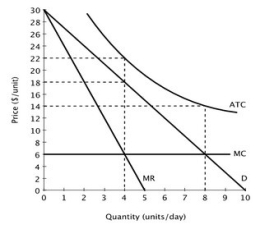 This monopolist maximizes its profit by producing ________ units per day and charging a price of ________ per unit.
 (Multiple Choice)
4.8/5 (69)
(69) In exchange for a share of the revenues earned on campus, State U has granted CheapFizz the exclusive right to sell soft drinks in the student union and in vending machines on campus. Prior to the deal, three soft drink companies sold beverages on campus; now no other soft drink company is allowed to sell its products on campus. The beneficiaries of this deal is/are ________.
(Multiple Choice)
4.9/5 (78)
(78) When a perfectly competitive firm sells additional units of output, ________, and when a monopolist sells additional units of output, ________.
(Multiple Choice)
4.8/5 (80)
(80) According to the textbook, the most important and enduring source of market power is:
(Multiple Choice)
4.7/5 (83)
(83) Under cost-plus regulation, a regulated firm is permitted to charge prices that cover the explicit cost of production plus a markup to cover the:
(Multiple Choice)
4.8/5 (88)
(88) Which of the following is NOT an example of a good with network economies?
(Multiple Choice)
4.9/5 (77)
(77) 
Filters
- Essay(0)
- Multiple Choice(0)
- Short Answer(0)
- True False(0)
- Matching(0)