



 Chat with AI
Exam 8: Monopoly, Oligopoly, and Monopolistic Competition

Exam 1: Thinking Like an Economist142 Questions
Exam 2: Comparative Advantage163 Questions
Exam 3: Supply and Demand181 Questions
Exam 4: Elasticity154 Questions
Exam 5: Demand144 Questions
Exam 6: Perfectly Competitive Supply159 Questions
Exam 7: Efficiency, Exchange, and the Invisible Hand in Action159 Questions
Exam 8: Monopoly, Oligopoly, and Monopolistic Competition147 Questions
Exam 9: Games and Strategic Behavior150 Questions
Exam 10: An Introduction to Behavioral Economics111 Questions
Exam 11: Externalities, Property Rights, and the Environment184 Questions
Exam 12: The Economics of Information127 Questions
Exam 13: Labor Markets, Poverty, and Income Distribution138 Questions
Exam 14: Public Goods and Tax Policy142 Questions
Exam 15: International Trade and Trade Policy164 Questions
Exam 16: Macroeconomics: The Birds Eye View of the Economy154 Questions
Exam 17: Measuring Economic Activity: GDP and Unemployment210 Questions
Exam 18: Measuring the Price Level and Inflation160 Questions
Exam 19: Economic Growth, Productivity, and Living Standards158 Questions
Exam 20: The Labor Market: Workers, Wages, and Unemployment121 Questions
Exam 21: Saving and Capital Formation144 Questions
Exam 22: Money Prices and the Federal Reserve107 Questions
Exam 23: Financial Markets and International Capital Flows104 Questions
Exam 24: Short-Term Economic Fluctuations: An Introduction124 Questions
Exam 25: Spending and Output in the Short Run146 Questions
Exam 26: Stabilizing the Economy: The Role of the Fed162 Questions
Exam 27: Aggregate Demand, Aggregate Supply, and Inflation159 Questions
Exam 28: Exchange Rates and the Open Economy157 Questions
Select questions type


Because monopolists charge a price in excess of marginal cost, it must be the case that monopolists:
(Multiple Choice)
4.8/5  (69)
(69) If a firm is experiencing economies of scale, then as the firm's output rises, its average total cost ________.
(Multiple Choice)
4.8/5 (80)
(80) The essential feature that differentiates imperfectly competitive firms from perfectly competitive firms is that an imperfectly competitive firm:
(Multiple Choice)
4.9/5 (77)
(77) Imagine that you are an entrepreneur, making designer t-shirts in your garage. Your total cost (in dollars)is given by the equation TC = 300 + 10Q, where Q represents the number of t-shirts you make. Your fixed cost is $________, and your marginal cost is $________.
(Multiple Choice)
4.7/5 (76)
(76) A perfectly price discriminating monopolist's profit is ________ the profit of a monopolist who charges the same price to all of its customers.
(Multiple Choice)
4.9/5 (93)
(93) If a monopolist's marginal revenue is $25 and its marginal cost is $19, then the monopolist should:
(Multiple Choice)
4.8/5 (78)
(78) Suppose Island Bikes, a profit-maximizing firm, is the only bike rental company in a small resort town. The marginal cost to Island Bikes of renting out a bike is $3, and Island Bikes has no fixed costs. Each day Island Bikes has six potential customers, whose reservation prices are listed in the table.
Custamer Reservetion Price (\ /Rental) 22 16 12 6 4 What is the socially optimal number of bikes for Island Bikes to rent out each day?
(Multiple Choice)
4.7/5 (83)
(83) Suppose the accompanying figure shows the demand curve, marginal revenue curve and marginal cost curve for a monopolist. 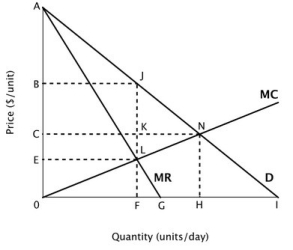 At the monopolist's profit-maximizing level of output, deadweight loss equals the area:
 (Multiple Choice)
4.8/5 (76)
(76) For all firms, the additional revenue collected from the sale of one additional unit of output is termed:
(Multiple Choice)
4.9/5 (79)
(79) Suppose a monopolist faces the demand curve shown.  If the monopolist's marginal cost is constant and equal to $30, its profit-maximizing level of output is:
 (Multiple Choice)
4.8/5 (82)
(82) If a firm collects $90 in revenue when it sells 4 units, $100 in revenue when it sells 5 units, and $105 in revenue when it sells 6 units, then one can infer the firm is a:
(Multiple Choice)
4.8/5 (77)
(77) The demand curve for a perfectly competitive firm is ________, while the demand curve for a monopolist is ________.
(Multiple Choice)
4.9/5 (82)
(82) A firm whose production process exhibits constant returns to scale would find that if it doubled all of its inputs, its output would ________.
(Multiple Choice)
4.8/5 (87)
(87) A monopoly that results from economies of scale is called a(n):
(Multiple Choice)
4.9/5 (81)
(81) Consider an industry with two firms producing similar products. Each firm's total cost (in dollars)is given below. Acme Manufacturing: TC = 100 + 3Q
Generic Industries: TC = 500 + 3Q
When each firm is producing the same quantity, Acme's average total cost is:
(Multiple Choice)
4.7/5 (80)
(80) Suppose the accompanying figure shows the demand curve, marginal revenue curve and marginal cost curve for a monopolist. 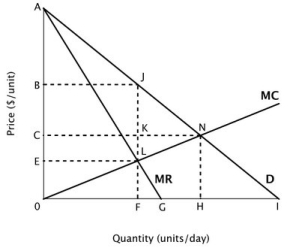 When this monopolist maximizes its profit, consumer surplus equals the area:
 (Multiple Choice)
4.9/5 (68)
(68) 
Filters
- Essay(0)
- Multiple Choice(0)
- Short Answer(0)
- True False(0)
- Matching(0)