



 Chat with AI
Exam 3: Supply and Demand

Exam 1: Thinking Like an Economist142 Questions
Exam 2: Comparative Advantage163 Questions
Exam 3: Supply and Demand181 Questions
Exam 4: Elasticity154 Questions
Exam 5: Demand144 Questions
Exam 6: Perfectly Competitive Supply159 Questions
Exam 7: Efficiency, Exchange, and the Invisible Hand in Action159 Questions
Exam 8: Monopoly, Oligopoly, and Monopolistic Competition147 Questions
Exam 9: Games and Strategic Behavior150 Questions
Exam 10: An Introduction to Behavioral Economics111 Questions
Exam 11: Externalities, Property Rights, and the Environment184 Questions
Exam 12: The Economics of Information127 Questions
Exam 13: Labor Markets, Poverty, and Income Distribution138 Questions
Exam 14: Public Goods and Tax Policy142 Questions
Exam 15: International Trade and Trade Policy164 Questions
Exam 16: Macroeconomics: The Birds Eye View of the Economy154 Questions
Exam 17: Measuring Economic Activity: GDP and Unemployment210 Questions
Exam 18: Measuring the Price Level and Inflation160 Questions
Exam 19: Economic Growth, Productivity, and Living Standards158 Questions
Exam 20: The Labor Market: Workers, Wages, and Unemployment121 Questions
Exam 21: Saving and Capital Formation144 Questions
Exam 22: Money Prices and the Federal Reserve107 Questions
Exam 23: Financial Markets and International Capital Flows104 Questions
Exam 24: Short-Term Economic Fluctuations: An Introduction124 Questions
Exam 25: Spending and Output in the Short Run146 Questions
Exam 26: Stabilizing the Economy: The Role of the Fed162 Questions
Exam 27: Aggregate Demand, Aggregate Supply, and Inflation159 Questions
Exam 28: Exchange Rates and the Open Economy157 Questions
Select questions type


Refer to the accompanying figure. Suppose the solid line shows the current demand for coffee. In response to news that next year's coffee harvest will be extremely good due to favorable weather conditions, you should expect: 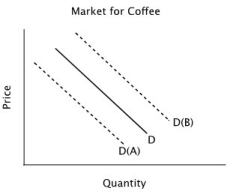
(Multiple Choice)
4.8/5  (86)
(86) In a free market, if the price of a good is above the equilibrium price, then;
(Multiple Choice)
4.9/5 (77)
(77) Which of the following is NOT a characteristic of a market in equilibrium?
(Multiple Choice)
4.7/5 (64)
(64) Refer to the given table. Relative to column C, column D represents: Price Per Unit Columu A Units Per Year Colum B Units Per Year \ 20 50 40 \ 30 60 50 \ 40 70 60 \ 50 80 70 \ 60 90 80
(Multiple Choice)
4.8/5 (91)
(91) You can spend $10 for lunch and you would like to purchase two cheeseburgers. When you get to the restaurant, you find out the price for cheeseburger has increased from $5 to $6, so you decide to purchase just one cheeseburger. This is best described as:
(Multiple Choice)
4.7/5 (84)
(84) Suppose that when the price of broccoli is $4 per pound, buyers wish to buy 500 pounds per day and sellers wish to sell 800 pounds per day. In this case:
(Multiple Choice)
4.9/5 (85)
(85) If price is above the equilibrium price, then there will be:
(Multiple Choice)
4.9/5 (71)
(71) Assume the demand for coffee increases and the supply of coffee decreases. Which of the following outcomes is certain to occur?
(Multiple Choice)
4.8/5 (79)
(79) If the local slaughterhouse gives off an unpleasant stench, then the equilibrium quantity of meat will be ________ the quantity that maximizes total economic surplus.
(Multiple Choice)
4.8/5 (97)
(97) Shelly purchases a leather purse for $400. One can infer that:
(Multiple Choice)
4.7/5 (79)
(79) You have noticed that there is a persistent shortage of teachers in an inner-city school district in your state. Based on this observation, you suspect that:
(Multiple Choice)
4.9/5 (85)
(85) Refer to the accompanying figure. Suppose the solid line shows the current demand curve for coffee. In response to an announcement that much of next year's coffee crop has been destroyed by a storm in Brazil, you should expect: 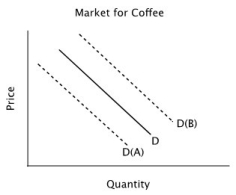
(Multiple Choice)
4.8/5 (87)
(87) Suppose that when the price of oranges is $3 per pound, the quantity demanded is 4.7 tons per day and the quantity supplied is 3.9 tons. In this case:
(Multiple Choice)
4.8/5 (68)
(68) As coffee becomes more expensive, Joe starts drinking tea instead of coffee. This is called:
(Multiple Choice)
4.8/5 (76)
(76) When the supply curve shifts to the left and there is no change in demand:
(Multiple Choice)
4.7/5 (82)
(82) Suppose a new study highlights the health benefits of eating bacon. At the same time, suppose the cost of producing bacon falls. Given these changes, you should expect to see:
(Multiple Choice)
4.9/5 (89)
(89) All else equal, a decrease in the demand for oranges will lead to a(n)________ in equilibrium price and a(n)________ in equilibrium quantity.
(Multiple Choice)
4.9/5 (85)
(85) When the demand curve shifts to the right and supply doesn't change:
(Multiple Choice)
4.8/5 (82)
(82) 
Filters
- Essay(0)
- Multiple Choice(0)
- Short Answer(0)
- True False(0)
- Matching(0)