



 Chat with AI
Exam 22: Money Prices and the Federal Reserve

Exam 1: Thinking Like an Economist142 Questions
Exam 2: Comparative Advantage163 Questions
Exam 3: Supply and Demand181 Questions
Exam 4: Elasticity154 Questions
Exam 5: Demand144 Questions
Exam 6: Perfectly Competitive Supply159 Questions
Exam 7: Efficiency, Exchange, and the Invisible Hand in Action159 Questions
Exam 8: Monopoly, Oligopoly, and Monopolistic Competition147 Questions
Exam 9: Games and Strategic Behavior150 Questions
Exam 10: An Introduction to Behavioral Economics111 Questions
Exam 11: Externalities, Property Rights, and the Environment184 Questions
Exam 12: The Economics of Information127 Questions
Exam 13: Labor Markets, Poverty, and Income Distribution138 Questions
Exam 14: Public Goods and Tax Policy142 Questions
Exam 15: International Trade and Trade Policy164 Questions
Exam 16: Macroeconomics: The Birds Eye View of the Economy154 Questions
Exam 17: Measuring Economic Activity: GDP and Unemployment210 Questions
Exam 18: Measuring the Price Level and Inflation160 Questions
Exam 19: Economic Growth, Productivity, and Living Standards158 Questions
Exam 20: The Labor Market: Workers, Wages, and Unemployment121 Questions
Exam 21: Saving and Capital Formation144 Questions
Exam 22: Money Prices and the Federal Reserve107 Questions
Exam 23: Financial Markets and International Capital Flows104 Questions
Exam 24: Short-Term Economic Fluctuations: An Introduction124 Questions
Exam 25: Spending and Output in the Short Run146 Questions
Exam 26: Stabilizing the Economy: The Role of the Fed162 Questions
Exam 27: Aggregate Demand, Aggregate Supply, and Inflation159 Questions
Exam 28: Exchange Rates and the Open Economy157 Questions
Select questions type


If real GDP equals 1,500, nominal GDP equals 3,750, and the price level equals 2.75, then what is velocity if the money stock equals 1,875?
(Multiple Choice)
5.0/5  (84)
(84) The two main responsibilities of the Federal Reserve System are to ________ and to ________.
(Multiple Choice)
4.9/5 (79)
(79) The seven leaders of the Federal Reserve System headquartered in Washington, D.C. constitute the:
(Multiple Choice)
4.8/5 (76)
(76) In the past, some governments' budget deficits became so large that they could not raise sufficient taxes to finance the spending, so they ________, which led to ________.
(Multiple Choice)
4.9/5 (74)
(74) Based on the information in the table, what quantity of reserves would the Federal Reserve have had to inject into the economy in 1932 to prevent the money supply from falling, given that the public increased the amount of currency it held and that banks increased the reserve-deposit ratio? 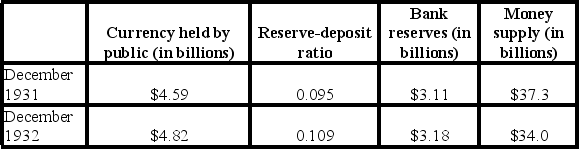
(Multiple Choice)
4.9/5 (76)
(76) Extremely rapid rates of money growth are usually the result of:
(Multiple Choice)
4.7/5 (72)
(72) If the Central Bank of Macroland puts an additional 1,000 dollars of currency into the economy, the public deposits all currency into the banking system, and banks have a desired reserve/deposit ratio of 0.10, then the banks will eventually make new loans totaling ________ and the money supply will increase by ________.
(Multiple Choice)
4.8/5 (79)
(79) When your grandfather keeps a bundle of $100 dollar bills behind a brick in the basement, this is an example of dollars serving as:
(Multiple Choice)
4.9/5 (74)
(74) Two examples of governments that printed large quantities of paper currency to finance massive budget deficits, causing hyperinflation, are ________ and ________.
(Multiple Choice)
4.9/5 (89)
(89) Historically, the most important tool of monetary policy is:
(Multiple Choice)
4.9/5 (78)
(78) In an open-market sale the Federal Reserve ________ government bonds and the supply of bank reserves ________.
(Multiple Choice)
4.7/5 (89)
(89) When the central bank sells $1,000,000 worth of government bonds to the public, the money supply:
(Multiple Choice)
4.8/5 (78)
(78) 
Filters
- Essay(0)
- Multiple Choice(0)
- Short Answer(0)
- True False(0)
- Matching(0)