



 Chat with AI
Exam 8: What Genes Are

Exam 1: The Nature of Science66 Questions
Exam 2: Chemistry of Life78 Questions
Exam 3: Life Is Cellular72 Questions
Exam 4: How Cells Work64 Questions
Exam 5: Cell Division62 Questions
Exam 6: Patterns of Inheritance67 Questions
Exam 7: Chromosomes and Human Genetics68 Questions
Exam 8: What Genes Are64 Questions
Exam 9: How Genes Work64 Questions
Exam 10: Evidence for Evolution64 Questions
Exam 11: Mechanisms of Evolution64 Questions
Exam 12: Adaptation and Species64 Questions
Exam 13: The History of Life71 Questions
Exam 14: Human Evolution66 Questions
Exam 15: General Principles of Ecology64 Questions
Exam 16: Growth of Populations65 Questions
Exam 17: Communities of Organisms64 Questions
Exam 18: Ecosystems66 Questions
Exam 19: Homeostasis, Reproduction, and Development67 Questions
Exam 20: Digestive, Muscular, and Skeletal Systems66 Questions
Exam 21: Circulatory, Respiratory, Urinary, and Nervous Systems72 Questions
Exam 22: Endocrine and Immune Systems66 Questions
Exam 23: Plant Physiology64 Questions
Exam 24: Applying the Science67 Questions
Select questions type


In the first step of the polymerase chain reaction (PCR), the two strands of the DNA being amplified must be separated by exposing the DNA to high ________.
(Short Answer)
4.7/5  (88)
(88) Once replication in a DNA molecule is complete, each new DNA molecule contains
(Multiple Choice)
4.9/5 (83)
(83) People with xeroderma pigmentosum frequently exhibit skin cancer. The disease is a result of a mutation in a gene that produces a ________ protein. Without this protein, cells cannot fix changes in their DNA sequence caused by exposure to ultraviolet (UV) light.
(Short Answer)
4.8/5 (96)
(96) Which of the following must occur for a mismatch error to be repaired?
(Multiple Choice)
4.8/5 (85)
(85) When examining the two complementary strands of nucleotides in one DNA molecule, you would expect to find that
(Multiple Choice)
4.8/5 (79)
(79) A scientist uses polymerase chain reaction (PCR) to compare the sequence of a disease and a healthy gene. The scientist finds that these two genes are identical except for one G in place of a T at position 256 in the gene. This type of mutation is a(n)
(Multiple Choice)
4.7/5 (71)
(71) How many phosphate groups are present in a single strand of DNA?
(Multiple Choice)
4.8/5 (91)
(91) When studying genomes of organisms, scientists often will only list the sequence of a single strand. Explain why the sequence of the second strand would be unnecessary information.
(Essay)
4.9/5 (94)
(94) The adenine bases in a DNA molecule are radioactively labeled. The DNA is then placed in a solution containing unlabeled nucleotides and the enzymes needed for DNA replication. The DNA molecule is allowed to replicate twice, forming four new DNA molecules. You would find the radioactively labeled adenine in
(Multiple Choice)
4.9/5 (65)
(65) A segment of DNA in a test tube replicates and produces many copies of itself. What was probably in the test tube that enhanced this process?
(Multiple Choice)
4.9/5 (77)
(77) If one strand of DNA has the sequence CGATT, the sequence of the other strand of the same molecule will be
(Multiple Choice)
4.8/5 (91)
(91) The following figure illustrates DNA undergoing replication. The region indicated by the arrow in this image represents a 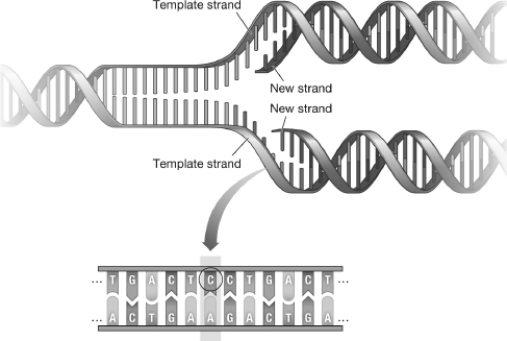
(Multiple Choice)
4.8/5 (80)
(80) Is a species that lacks DNA repair mechanisms likely to have more or fewer variations between individuals than a species that possesses repair mechanisms?
(Multiple Choice)
4.7/5 (79)
(79) A strand of DNA has the sequence GCAATTCG. The sequence of the complementary strand is ________.
(Short Answer)
4.9/5 (76)
(76) 
Filters
- Essay(0)
- Multiple Choice(0)
- Short Answer(0)
- True False(0)
- Matching(0)