



 Chat with AI
Exam 4: Supply and Demand: an Initial Look

Exam 1: What Is Economics232 Questions
Exam 2: The Economy: Myth and Reality155 Questions
Exam 3: The Fundamental Economic Problem: Scarcity and Choice255 Questions
Exam 4: Supply and Demand: an Initial Look313 Questions
Exam 5: Consumer Choice: Individual and Market Demand206 Questions
Exam 6: Demand and Elasticity214 Questions
Exam 7: Production, Inputs, and Cost: Building Blocks for Supply Analysis221 Questions
Exam 8: Output, Price, and Profit: the Importance of Marginal Analysis194 Questions
Exam 9: Securities: Business Finance and the Economy: the Tail That Wags the Dog203 Questions
Exam 10: The Firm and the Industry Under Perfect Competition212 Questions
Exam 11: Monopoly208 Questions
Exam 12: Between Competition and Monopoly230 Questions
Exam 13: Limiting Market Power: Regulation and Antitrust155 Questions
Exam 14: The Case for Free Markets: the Price System225 Questions
Exam 15: The Shortcomings of Free Markets219 Questions
Exam 16: Externalities, the Environment, and Natural Resources222 Questions
Exam 17: Taxation and Resource Allocation221 Questions
Exam 18: Pricing the Factors of Production233 Questions
Exam 19: Labor and Entrepreneurship: the Human Inputs271 Questions
Exam 20: Poverty, Inequality, and Discrimination172 Questions
Exam 21: Is Useconomic Leadership Threatened75 Questions
Exam 22: An Introduction to Macroeconomics216 Questions
Exam 23: The Goals of Macroeconomic Policy212 Questions
Exam 24: Economic Growth: Theory and Policy228 Questions
Exam 25: Aggregate Demand and the Powerful Consumer219 Questions
Exam 26: Demand-Side Equilibrium: Unemployment or Inflation216 Questions
Exam 27: Bringing in the Supply Side: Unemployment and Inflation228 Questions
Exam 28: Managing Aggregate Demand: Fiscal Policy210 Questions
Exam 29: Money and the Banking System224 Questions
Exam 30: Monetary Policy: Conventional and Unconventional210 Questions
Exam 31: He Financial Crisis and the Great Recession66 Questions
Exam 32: The Debate Over Monetary and Fiscal Policy219 Questions
Exam 33: Budget Deficits in the Short and Long Run215 Questions
Exam 34: The Trade-Off Between Inflation and Unemployment219 Questions
Exam 35: International Trade and Comparative Advantage223 Questions
Exam 36: The International Monetary System: Order or Disorder218 Questions
Exam 37: Exchange Rates and the Macroeconomy219 Questions
Select questions type


In early 1996, Congress proposed an agriculture bill that would gradually reduce price supports for many agricultural products.If the bill were to be approved, what would most likely happen to the number of families employed in agriculture?
(Multiple Choice)
4.8/5  (68)
(68) Figure 4-22
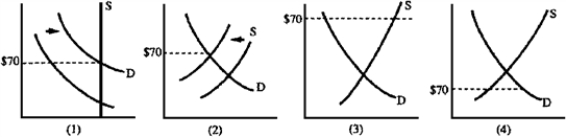 -Because of falling oil prices in the past, Libya could afford fewer imported goods.Government controls were established to limit imports of cigarettes.In 1985, the market price of Marlboros rose to $70 a carton.Which graph in Figure 4-22 best depicts this situation?
 (Multiple Choice)
4.9/5 (73)
(73) An increase in consumer income will shift both the supply and demand curves.
(True/False)
4.8/5 (81)
(81) If the demand for steak shifts to the right, the most likely explanation is that
(Multiple Choice)
4.9/5 (68)
(68) Figure 4-4
 -Assume that Figure 4-4 shows demand for steak.An increase in income of buyers will change demand from
 (Multiple Choice)
4.8/5 (79)
(79) If the government puts price controls on medical care, this will increase the supply of affordable care in the United States.
(True/False)
4.9/5 (80)
(80) Rent controls are designed to protect consumers from high rents.
(True/False)
4.9/5 (91)
(91) A demand schedule relates prices of a particular good to quantities demanded.
(True/False)
4.8/5 (84)
(84) Show graphically the effect of technological advance on the price of music downloads.In a separate graph show what happens to the price of CDs as a secondary effect of the new download technology.
(Essay)
4.9/5 (83)
(83) 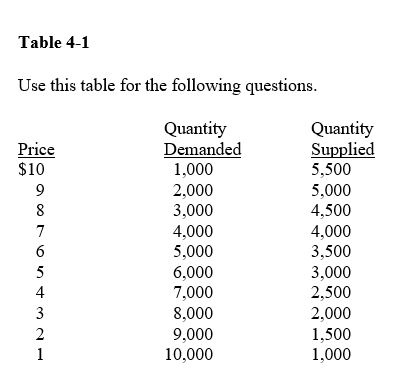 -Refer to Table 4-1.What is the equilibrium price in the example above?
 (Multiple Choice)
4.9/5 (68)
(68) "The market has failed to provide enough rental housing in New York City.This demonstrates another failure of free markets-they may lead to shortages of necessities." Explain why you agree or disagree.
(Essay)
4.7/5 (71)
(71) Why do airlines tend to lower ticket prices in the winter?
(Multiple Choice)
4.7/5 (84)
(84) Figure 4-2
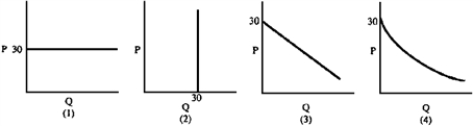 -If the government has stated that it will buy any amount of good X offered at $30, which demand curve in Figure 4-2 is appropriate?
 (Multiple Choice)
4.9/5 (75)
(75) 
Filters
- Essay(0)
- Multiple Choice(0)
- Short Answer(0)
- True False(0)
- Matching(0)