



 Chat with AI
Exam 4: Supply and Demand: an Initial Look

Exam 1: What Is Economics232 Questions
Exam 2: The Economy: Myth and Reality155 Questions
Exam 3: The Fundamental Economic Problem: Scarcity and Choice255 Questions
Exam 4: Supply and Demand: an Initial Look313 Questions
Exam 5: Consumer Choice: Individual and Market Demand206 Questions
Exam 6: Demand and Elasticity214 Questions
Exam 7: Production, Inputs, and Cost: Building Blocks for Supply Analysis221 Questions
Exam 8: Output, Price, and Profit: the Importance of Marginal Analysis194 Questions
Exam 9: Securities: Business Finance and the Economy: the Tail That Wags the Dog203 Questions
Exam 10: The Firm and the Industry Under Perfect Competition212 Questions
Exam 11: Monopoly208 Questions
Exam 12: Between Competition and Monopoly230 Questions
Exam 13: Limiting Market Power: Regulation and Antitrust155 Questions
Exam 14: The Case for Free Markets: the Price System225 Questions
Exam 15: The Shortcomings of Free Markets219 Questions
Exam 16: Externalities, the Environment, and Natural Resources222 Questions
Exam 17: Taxation and Resource Allocation221 Questions
Exam 18: Pricing the Factors of Production233 Questions
Exam 19: Labor and Entrepreneurship: the Human Inputs271 Questions
Exam 20: Poverty, Inequality, and Discrimination172 Questions
Exam 21: Is Useconomic Leadership Threatened75 Questions
Exam 22: An Introduction to Macroeconomics216 Questions
Exam 23: The Goals of Macroeconomic Policy212 Questions
Exam 24: Economic Growth: Theory and Policy228 Questions
Exam 25: Aggregate Demand and the Powerful Consumer219 Questions
Exam 26: Demand-Side Equilibrium: Unemployment or Inflation216 Questions
Exam 27: Bringing in the Supply Side: Unemployment and Inflation228 Questions
Exam 28: Managing Aggregate Demand: Fiscal Policy210 Questions
Exam 29: Money and the Banking System224 Questions
Exam 30: Monetary Policy: Conventional and Unconventional210 Questions
Exam 31: He Financial Crisis and the Great Recession66 Questions
Exam 32: The Debate Over Monetary and Fiscal Policy219 Questions
Exam 33: Budget Deficits in the Short and Long Run215 Questions
Exam 34: The Trade-Off Between Inflation and Unemployment219 Questions
Exam 35: International Trade and Comparative Advantage223 Questions
Exam 36: The International Monetary System: Order or Disorder218 Questions
Exam 37: Exchange Rates and the Macroeconomy219 Questions
Select questions type


The law of increasing relative costs, depicted by the concavity of the production opportunities frontier, is most closely related to the
(Multiple Choice)
4.9/5  (89)
(89) A shift of the demand curve for a good occurs whenever new technologies make inputs used in producing that good available at lower prices.
(True/False)
4.7/5 (88)
(88) Professional baseball teams in the United States use only wooden bats.If aluminum bats were permitted, the likely result would be a
(Multiple Choice)
4.9/5 (92)
(92) Cost-reducing technological advancements allow suppliers to earn more profits but have no noticeable effect on the supply curve.
(True/False)
4.7/5 (83)
(83) Figure 4-21
 -A shortage will tend to occur at which price in Figure 4-21?
 (Multiple Choice)
4.8/5 (81)
(81) Figure 4-16
 -Assume that Figure 4-16 shows the supply of new houses.An improvement in the technology for building houses will shift supply from
 (Multiple Choice)
4.7/5 (66)
(66) How much the quantity of a good traded changes after a shift of the supply curve depends on
(Multiple Choice)
4.8/5 (76)
(76) Figure 4-15
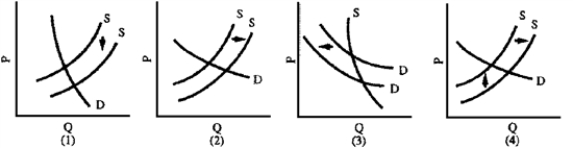 -Recycling of newspapers has been undermined by its success.The supply of old papers, gathered diligently by those concerned with the environment, has increased dramatically, as has the number of firms that convert the material into recycled newsprint.The quantity demanded has remained relatively stable despite falling prices because newspapers consider recycled newsprint an inferior substitute for regular newsprint.Consequently, the price of recycled newsprint has fallen below the cost of production; recycling firms are going out of business; mountains of old newspapers are left behind.Which graph in Figure 4-15 best illustrates this situation?
 (Multiple Choice)
4.8/5 (70)
(70) The price for labor is the wage rate.What happens to the supply of labor if wages increase?
(Multiple Choice)
4.9/5 (78)
(78) George Washington's troops at Valley Forge were almost destroyed by price controls.
(True/False)
4.8/5 (69)
(69) "Demand" is a series of quantities demanded, one for each person in the market.
(True/False)
4.9/5 (82)
(82) Figure 4-6
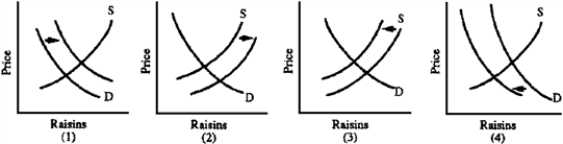 -Grapes can be used for wine or for raisins.Which graph in Figure 4-6 best depicts the effects on the U.S.raisin market of a decrease in purchases of domestic wines?
 (Multiple Choice)
4.9/5 (68)
(68) Figure 4-16
-Assume that Figure 4-16 shows the supply of steak.An increase in the price of pork will change the supply from
-Assume that Figure 4-16 shows the supply of steak.An increase in the price of pork will change the supply from (Multiple Choice)
4.8/5 (77)
(77) Two studies published in the New England Journal of Medicine link the risk of breast cancer to alcohol consumption.Young women who have nine drinks per week were reportedly 150 percent more likely to develop breast cancer.Considering the market for alcohol, an economist would predict a movement
(Multiple Choice)
4.9/5 (76)
(76) Since rent controls have been in effect in New York City, apartments have been more plentiful.
(True/False)
4.9/5 (85)
(85) In an attempt to forecast enrollment, a major university hired an economist to give a "head count." One variable which she would probably emphasize more than any other in trying to forecast this is
(Multiple Choice)
4.8/5 (69)
(69) 
Filters
- Essay(0)
- Multiple Choice(0)
- Short Answer(0)
- True False(0)
- Matching(0)