



 Chat with AI
Exam 35: International Trade and Comparative Advantage

Exam 1: What Is Economics232 Questions
Exam 2: The Economy: Myth and Reality155 Questions
Exam 3: The Fundamental Economic Problem: Scarcity and Choice255 Questions
Exam 4: Supply and Demand: an Initial Look313 Questions
Exam 5: Consumer Choice: Individual and Market Demand206 Questions
Exam 6: Demand and Elasticity214 Questions
Exam 7: Production, Inputs, and Cost: Building Blocks for Supply Analysis221 Questions
Exam 8: Output, Price, and Profit: the Importance of Marginal Analysis194 Questions
Exam 9: Securities: Business Finance and the Economy: the Tail That Wags the Dog203 Questions
Exam 10: The Firm and the Industry Under Perfect Competition212 Questions
Exam 11: Monopoly208 Questions
Exam 12: Between Competition and Monopoly230 Questions
Exam 13: Limiting Market Power: Regulation and Antitrust155 Questions
Exam 14: The Case for Free Markets: the Price System225 Questions
Exam 15: The Shortcomings of Free Markets219 Questions
Exam 16: Externalities, the Environment, and Natural Resources222 Questions
Exam 17: Taxation and Resource Allocation221 Questions
Exam 18: Pricing the Factors of Production233 Questions
Exam 19: Labor and Entrepreneurship: the Human Inputs271 Questions
Exam 20: Poverty, Inequality, and Discrimination172 Questions
Exam 21: Is Useconomic Leadership Threatened75 Questions
Exam 22: An Introduction to Macroeconomics216 Questions
Exam 23: The Goals of Macroeconomic Policy212 Questions
Exam 24: Economic Growth: Theory and Policy228 Questions
Exam 25: Aggregate Demand and the Powerful Consumer219 Questions
Exam 26: Demand-Side Equilibrium: Unemployment or Inflation216 Questions
Exam 27: Bringing in the Supply Side: Unemployment and Inflation228 Questions
Exam 28: Managing Aggregate Demand: Fiscal Policy210 Questions
Exam 29: Money and the Banking System224 Questions
Exam 30: Monetary Policy: Conventional and Unconventional210 Questions
Exam 31: He Financial Crisis and the Great Recession66 Questions
Exam 32: The Debate Over Monetary and Fiscal Policy219 Questions
Exam 33: Budget Deficits in the Short and Long Run215 Questions
Exam 34: The Trade-Off Between Inflation and Unemployment219 Questions
Exam 35: International Trade and Comparative Advantage223 Questions
Exam 36: The International Monetary System: Order or Disorder218 Questions
Exam 37: Exchange Rates and the Macroeconomy219 Questions
Select questions type


The United States is known worldwide as being a low tariff nation.

Free
(True/False)
4.9/5  (82)
(82) Correct Answer: Verified
True
Which of the following might lead a nation to engage in international trade?
Free
(Multiple Choice)
4.9/5 (89)
(89) Correct Answer:Verified
VerifiedD
Absolute advantage states that a country has an advantage over another if it can produce a good with fewer resources.
Free
(True/False)
4.9/5 (83)
(83) Correct Answer:Verified
VerifiedTrue
Specialization is the concept of devoting resources to the production of only a small number of goods and services.
(True/False)
5.0/5 (64)
(64)
 -Table 22-4 presents the demand and supply schedules for television sets in Japan and the United States.If there is no trade between these countries, what are the equilibrium price and quantity in the United States?
 (Multiple Choice)
4.8/5 (81)
(81) In discussing trade, it is ____ that matters rather than ____.
(Multiple Choice)
4.9/5 (79)
(79) Strategic trade policy relies on threats of protectionism to protect free trade.
(True/False)
4.9/5 (74)
(74) An import quota will ordinarily raise the price of the good in the importing country.
(True/False)
4.7/5 (72)
(72) Opening trade between a nation that has "cheap labor" and one that has "expensive labor" will
(Multiple Choice)
5.0/5 (81)
(81) American producers often complain about dumping.What is dumping, and should it be prohibited?
(Essay)
4.8/5 (72)
(72) How can tariffs lead to a situation in which all parties to a trade lose?
(Essay)
4.7/5 (72)
(72) Table 22-1 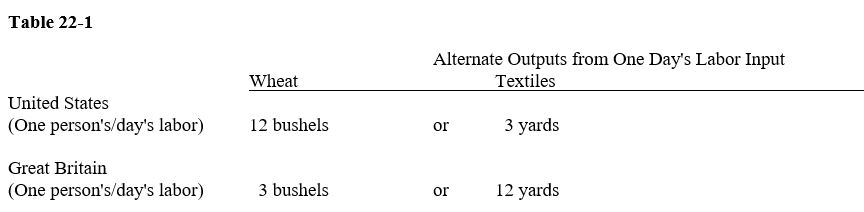 -From Table 22-1, the opportunity cost of one bushel of wheat in Great Britain is
 (Multiple Choice)
4.8/5 (96)
(96) If the production possibilities curves of two countries have the same slope,
(Multiple Choice)
4.9/5 (94)
(94) An upward spiral of protectionism is a possible outcome of strategic trade policy.
(True/False)
4.7/5 (74)
(74) "I oppose a free trade agreement with Mexico because American workers will lose jobs to low-paid Mexican workers." Explain whether you agree or disagree with this statement.
(Essay)
4.8/5 (63)
(63) 
Filters
- Essay(0)
- Multiple Choice(0)
- Short Answer(0)
- True False(0)
- Matching(0)