



 Chat with AI
Exam 11: Monopoly

Exam 1: What Is Economics232 Questions
Exam 2: The Economy: Myth and Reality155 Questions
Exam 3: The Fundamental Economic Problem: Scarcity and Choice255 Questions
Exam 4: Supply and Demand: an Initial Look313 Questions
Exam 5: Consumer Choice: Individual and Market Demand206 Questions
Exam 6: Demand and Elasticity214 Questions
Exam 7: Production, Inputs, and Cost: Building Blocks for Supply Analysis221 Questions
Exam 8: Output, Price, and Profit: the Importance of Marginal Analysis194 Questions
Exam 9: Securities: Business Finance and the Economy: the Tail That Wags the Dog203 Questions
Exam 10: The Firm and the Industry Under Perfect Competition212 Questions
Exam 11: Monopoly208 Questions
Exam 12: Between Competition and Monopoly230 Questions
Exam 13: Limiting Market Power: Regulation and Antitrust155 Questions
Exam 14: The Case for Free Markets: the Price System225 Questions
Exam 15: The Shortcomings of Free Markets219 Questions
Exam 16: Externalities, the Environment, and Natural Resources222 Questions
Exam 17: Taxation and Resource Allocation221 Questions
Exam 18: Pricing the Factors of Production233 Questions
Exam 19: Labor and Entrepreneurship: the Human Inputs271 Questions
Exam 20: Poverty, Inequality, and Discrimination172 Questions
Exam 21: Is Useconomic Leadership Threatened75 Questions
Exam 22: An Introduction to Macroeconomics216 Questions
Exam 23: The Goals of Macroeconomic Policy212 Questions
Exam 24: Economic Growth: Theory and Policy228 Questions
Exam 25: Aggregate Demand and the Powerful Consumer219 Questions
Exam 26: Demand-Side Equilibrium: Unemployment or Inflation216 Questions
Exam 27: Bringing in the Supply Side: Unemployment and Inflation228 Questions
Exam 28: Managing Aggregate Demand: Fiscal Policy210 Questions
Exam 29: Money and the Banking System224 Questions
Exam 30: Monetary Policy: Conventional and Unconventional210 Questions
Exam 31: He Financial Crisis and the Great Recession66 Questions
Exam 32: The Debate Over Monetary and Fiscal Policy219 Questions
Exam 33: Budget Deficits in the Short and Long Run215 Questions
Exam 34: The Trade-Off Between Inflation and Unemployment219 Questions
Exam 35: International Trade and Comparative Advantage223 Questions
Exam 36: The International Monetary System: Order or Disorder218 Questions
Exam 37: Exchange Rates and the Macroeconomy219 Questions
Select questions type


Explain the source of monopoly power for DeBeers' Diamond Mine in South Africa, Microsoft (owned by Bill Gates), the American Medical Association (which licenses doctors), Polaroid's Instant Picture Cameras, USAir (which owns virtually all the gates at the airport in Charlotte, North Carolina), and electric utilities.

Free
(Essay)
4.8/5  (78)
(78) Correct Answer: Verified
DeBeers' controls the scarce resource by controlling the distribution of the vast majority of the world's diamonds.Microsoft has marketing superiority and perhaps a unique resource in Bill Gates, now a multibillionaire.The AMA restricts the supply of doctors through licensing (a legal restriction).Polaroid had an (expired) patent that allowed it to monopolize instant pictures.It successfully challenged Kodak's attempt to enter the instant photography market.USAir is using a deliberately erected entry barrier; planes cannot fly into or out of an airport without a gate.Electric companies have economies of scale (as well as large sunk costs).
Which of the following will occur if a natural monopoly is broken into two smaller firms?
Free
(Multiple Choice)
4.7/5 (77)
(77) Correct Answer:Verified
VerifiedC
A natural monopoly occurs when a single firm can produce the entire output of the market at a lower average cost than could many firms.
Free
(True/False)
4.9/5 (79)
(79) Correct Answer:Verified
VerifiedTrue
A monopoly may breed inefficiency by reducing competition and restricting production.
(True/False)
4.9/5 (82)
(82) Why is the demand curve for a monopolist downward sloping?ow does this affect the monopolist's behavior?
(Essay)
4.8/5 (85)
(85) Figure 11-9
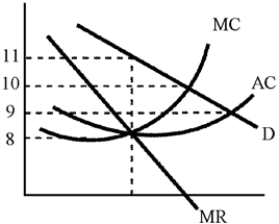 -In Figure 11-9, how much more than the long-run competitive price will the profit-maximizing monopolist charge?
 (Multiple Choice)
4.9/5 (80)
(80) The South African diamond production monopoly is an example of monopoly through
(Multiple Choice)
4.8/5 (76)
(76) A major difference between a monopoly and perfect competition is that monopolies can earn an economic profit in the long run and a perfectly competitive firm cannot.
(True/False)
4.9/5 (82)
(82) In assessing the difference between monopoly performance and that of perfect competition, the best approach is to
(Multiple Choice)
5.0/5 (84)
(84) Figure 11-9
-In Figure 11-9, which of the following is true?
-In Figure 11-9, which of the following is true? (Multiple Choice)
4.8/5 (86)
(86) Figure 11-3
 -In Figure 11-3, which of the following is true, whether or not the monopolist is maximizing profits?
 (Multiple Choice)
4.9/5 (74)
(74) Figure 11-6
 -At its optimal output level, the profit-maximizing monopolist in Figure 11-6 will earn a profit equal to
 (Multiple Choice)
4.9/5 (94)
(94) The marketing division of a firm has measured demand for its product and reports that it is 2Q = 24 − P, where Q is units and P is price per unit in dollars.The cost is given in the table below.Complete the table and determine the profit-maximizing level of output for this firm.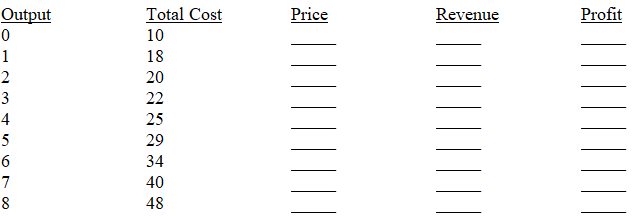
(Essay)
5.0/5 (80)
(80) Table 11-1  -Table 11-1 shows demand and total cost schedules for Monopoliteria.At its profit-maximizing level of output, Monopoliteria's profit is
 (Multiple Choice)
4.8/5 (76)
(76) Give a complete and concise definition of each of the following terms.
a.deliberately erected entry barriers
b.inefficiency of monopoly
c.price discrimination
d.profit-maximizing equilibrium for a monopolist
(Essay)
4.7/5 (82)
(82) 
Filters
- Essay(0)
- Multiple Choice(0)
- Short Answer(0)
- True False(0)
- Matching(0)