



 Chat with AI
Exam 11: Monopoly

Exam 1: What Is Economics232 Questions
Exam 2: The Economy: Myth and Reality155 Questions
Exam 3: The Fundamental Economic Problem: Scarcity and Choice255 Questions
Exam 4: Supply and Demand: an Initial Look313 Questions
Exam 5: Consumer Choice: Individual and Market Demand206 Questions
Exam 6: Demand and Elasticity214 Questions
Exam 7: Production, Inputs, and Cost: Building Blocks for Supply Analysis221 Questions
Exam 8: Output, Price, and Profit: the Importance of Marginal Analysis194 Questions
Exam 9: Securities: Business Finance and the Economy: the Tail That Wags the Dog203 Questions
Exam 10: The Firm and the Industry Under Perfect Competition212 Questions
Exam 11: Monopoly208 Questions
Exam 12: Between Competition and Monopoly230 Questions
Exam 13: Limiting Market Power: Regulation and Antitrust155 Questions
Exam 14: The Case for Free Markets: the Price System225 Questions
Exam 15: The Shortcomings of Free Markets219 Questions
Exam 16: Externalities, the Environment, and Natural Resources222 Questions
Exam 17: Taxation and Resource Allocation221 Questions
Exam 18: Pricing the Factors of Production233 Questions
Exam 19: Labor and Entrepreneurship: the Human Inputs271 Questions
Exam 20: Poverty, Inequality, and Discrimination172 Questions
Exam 21: Is Useconomic Leadership Threatened75 Questions
Exam 22: An Introduction to Macroeconomics216 Questions
Exam 23: The Goals of Macroeconomic Policy212 Questions
Exam 24: Economic Growth: Theory and Policy228 Questions
Exam 25: Aggregate Demand and the Powerful Consumer219 Questions
Exam 26: Demand-Side Equilibrium: Unemployment or Inflation216 Questions
Exam 27: Bringing in the Supply Side: Unemployment and Inflation228 Questions
Exam 28: Managing Aggregate Demand: Fiscal Policy210 Questions
Exam 29: Money and the Banking System224 Questions
Exam 30: Monetary Policy: Conventional and Unconventional210 Questions
Exam 31: He Financial Crisis and the Great Recession66 Questions
Exam 32: The Debate Over Monetary and Fiscal Policy219 Questions
Exam 33: Budget Deficits in the Short and Long Run215 Questions
Exam 34: The Trade-Off Between Inflation and Unemployment219 Questions
Exam 35: International Trade and Comparative Advantage223 Questions
Exam 36: The International Monetary System: Order or Disorder218 Questions
Exam 37: Exchange Rates and the Macroeconomy219 Questions
Select questions type


The software industry has traits in common with monopoly markets.
(True/False)
5.0/5  (82)
(82) Figure 11-8
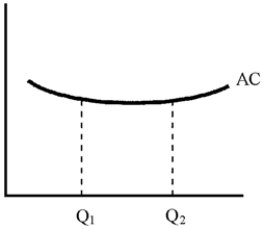 -Given the average cost curve shown in Figure 11-8 for dry cleaning, where Q₁ is the quantity demanded in a small town, and Q₂ for a larger town, you would expect dry cleaning to be a monopoly
 (Multiple Choice)
4.8/5 (84)
(84) Draw the demand, marginal revenue and marginal cost curve for a monopolist.Show the equilibrium price and quantity supplied and total profit.Show the equilibrium price and quantity supplied and total profit.
(Short Answer)
4.9/5 (77)
(77)
 -In Table 11-2, average cost at the profit-maximizing output is how much?
 (Multiple Choice)
4.9/5 (77)
(77) A monopolist can sell 10 wangdoodles if he charges $10 per wangdoodle and 11 wangdoodles if he charges $9.The MR from selling the 11th wangdoodle is
(Multiple Choice)
4.9/5 (84)
(84) A monopolist in the radio industry has two radio-making plants.The marginal cost of radio production by Plant A is $4Q (where Q is the number of radios produced) and the marginal cost of radio production by Plant B is always $16.If the demand curve for radios is downward sloping, the monopolist will
(Multiple Choice)
4.8/5 (91)
(91) Pure monopoly is able to exist because the firm's product is better than the substitutes that are available in the market.
(True/False)
4.8/5 (71)
(71) Many public utilities are permitted to operate as monopolies because they enjoy economies of large-scale production.
(True/False)
4.8/5 (73)
(73) Figure 11-6
 -The profit-maximizing monopolist in Figure 11-6 will produce ____ units of output.
 (Multiple Choice)
4.8/5 (83)
(83) Is the monopolist supply decision more complicated than that of competitive supply?
(Multiple Choice)
4.8/5 (78)
(78) What is the equilibrium condition for price discriminating monopoly firm?
Give some examples for price discrimination.
(Essay)
4.8/5 (74)
(74) What is true for monopoly that is not true for perfect competition?
(Multiple Choice)
5.0/5 (67)
(67) Figure 11-1
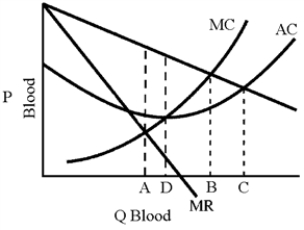 -The Red Cross is virtually the only operator of blood banks in the United States.In Figure 11-1 are the demand and supply curves facing the Red Cross blood bank.If it were to operate like a profit-maximizing business, how many units of blood would it sell?
 (Multiple Choice)
4.9/5 (78)
(78) An increase in fixed cost will, in the short run, alter the industry's output of
(Multiple Choice)
4.8/5 (74)
(74) Because a monopolist must cut its price to increase its sales by one unit,
(Multiple Choice)
5.0/5 (85)
(85) A monopolist's profit per unit is shown by the difference between price and average cost per unit.
(True/False)
4.9/5 (70)
(70) 
Filters
- Essay(0)
- Multiple Choice(0)
- Short Answer(0)
- True False(0)
- Matching(0)