



 Chat with AI
Exam 18: Pricing the Factors of Production

Exam 1: What Is Economics232 Questions
Exam 2: The Economy: Myth and Reality155 Questions
Exam 3: The Fundamental Economic Problem: Scarcity and Choice255 Questions
Exam 4: Supply and Demand: an Initial Look313 Questions
Exam 5: Consumer Choice: Individual and Market Demand206 Questions
Exam 6: Demand and Elasticity214 Questions
Exam 7: Production, Inputs, and Cost: Building Blocks for Supply Analysis221 Questions
Exam 8: Output, Price, and Profit: the Importance of Marginal Analysis194 Questions
Exam 9: Securities: Business Finance and the Economy: the Tail That Wags the Dog203 Questions
Exam 10: The Firm and the Industry Under Perfect Competition212 Questions
Exam 11: Monopoly208 Questions
Exam 12: Between Competition and Monopoly230 Questions
Exam 13: Limiting Market Power: Regulation and Antitrust155 Questions
Exam 14: The Case for Free Markets: the Price System225 Questions
Exam 15: The Shortcomings of Free Markets219 Questions
Exam 16: Externalities, the Environment, and Natural Resources222 Questions
Exam 17: Taxation and Resource Allocation221 Questions
Exam 18: Pricing the Factors of Production233 Questions
Exam 19: Labor and Entrepreneurship: the Human Inputs271 Questions
Exam 20: Poverty, Inequality, and Discrimination172 Questions
Exam 21: Is Useconomic Leadership Threatened75 Questions
Exam 22: An Introduction to Macroeconomics216 Questions
Exam 23: The Goals of Macroeconomic Policy212 Questions
Exam 24: Economic Growth: Theory and Policy228 Questions
Exam 25: Aggregate Demand and the Powerful Consumer219 Questions
Exam 26: Demand-Side Equilibrium: Unemployment or Inflation216 Questions
Exam 27: Bringing in the Supply Side: Unemployment and Inflation228 Questions
Exam 28: Managing Aggregate Demand: Fiscal Policy210 Questions
Exam 29: Money and the Banking System224 Questions
Exam 30: Monetary Policy: Conventional and Unconventional210 Questions
Exam 31: He Financial Crisis and the Great Recession66 Questions
Exam 32: The Debate Over Monetary and Fiscal Policy219 Questions
Exam 33: Budget Deficits in the Short and Long Run215 Questions
Exam 34: The Trade-Off Between Inflation and Unemployment219 Questions
Exam 35: International Trade and Comparative Advantage223 Questions
Exam 36: The International Monetary System: Order or Disorder218 Questions
Exam 37: Exchange Rates and the Macroeconomy219 Questions
Select questions type


Profit is the return to entrepreneurship.

Free
(True/False)
4.7/5  (78)
(78) Correct Answer: Verified
True
The theory of land rent holds that
Free
(Multiple Choice)
4.8/5 (85)
(85) Correct Answer:Verified
VerifiedD
The process of building up capital includes
Free
(Multiple Choice)
4.7/5 (89)
(89) Correct Answer:Verified
VerifiedD
Economic rent is the payment made to a factor of production above the amount necessary to induce any of that factor to be supplied at its present employment.
(True/False)
4.9/5 (70)
(70) In 2013, corporate profits were about ____ percent of national income.
(Multiple Choice)
4.8/5 (93)
(93) If the interest rate is r (expressed as a decimal number), the present value today of $1 to be received n years from today equals ____.
(Multiple Choice)
4.8/5 (85)
(85) An inward shift of the demand curve for a product causes outward shifts in the demand curves for all the factors used to produce the product.
(True/False)
5.0/5 (81)
(81) At higher interest rates, fewer people or firms will want to borrow.At lower interest rates, fewer people or firms will want to save.
(True/False)
4.8/5 (85)
(85) Figure 19-4
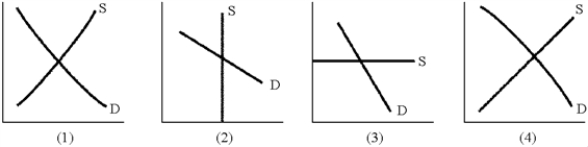 -The panels in Figure 19-4 represent the supply and demand conditions for a factor of production.In which case is the factor not earning any rent?
 (Multiple Choice)
4.9/5 (79)
(79) The only circumstance under which a factor will earn no rent is when the factor's supply curve is
(Multiple Choice)
4.9/5 (78)
(78) If the equilibrium rate of interest would be 10 percent, but the usury law sets 8 percent,
(Multiple Choice)
4.8/5 (74)
(74) In 2013, corporate profits in the U.S.economy were about 14 percent of national income.
(True/False)
4.8/5 (87)
(87) The cost of production on the "bottom forty" is $100,000 for a given size crop.On the "north forty," due to erosion of the soil, the cost is $150,000.If both are being farmed by tenants, we would expect the rent on the "bottom forty" to be
(Multiple Choice)
4.9/5 (84)
(84) 
Filters
- Essay(0)
- Multiple Choice(0)
- Short Answer(0)
- True False(0)
- Matching(0)