



 Chat with AI
Exam 27: Bringing in the Supply Side: Unemployment and Inflation

Exam 1: What Is Economics232 Questions
Exam 2: The Economy: Myth and Reality155 Questions
Exam 3: The Fundamental Economic Problem: Scarcity and Choice255 Questions
Exam 4: Supply and Demand: an Initial Look313 Questions
Exam 5: Consumer Choice: Individual and Market Demand206 Questions
Exam 6: Demand and Elasticity214 Questions
Exam 7: Production, Inputs, and Cost: Building Blocks for Supply Analysis221 Questions
Exam 8: Output, Price, and Profit: the Importance of Marginal Analysis194 Questions
Exam 9: Securities: Business Finance and the Economy: the Tail That Wags the Dog203 Questions
Exam 10: The Firm and the Industry Under Perfect Competition212 Questions
Exam 11: Monopoly208 Questions
Exam 12: Between Competition and Monopoly230 Questions
Exam 13: Limiting Market Power: Regulation and Antitrust155 Questions
Exam 14: The Case for Free Markets: the Price System225 Questions
Exam 15: The Shortcomings of Free Markets219 Questions
Exam 16: Externalities, the Environment, and Natural Resources222 Questions
Exam 17: Taxation and Resource Allocation221 Questions
Exam 18: Pricing the Factors of Production233 Questions
Exam 19: Labor and Entrepreneurship: the Human Inputs271 Questions
Exam 20: Poverty, Inequality, and Discrimination172 Questions
Exam 21: Is Useconomic Leadership Threatened75 Questions
Exam 22: An Introduction to Macroeconomics216 Questions
Exam 23: The Goals of Macroeconomic Policy212 Questions
Exam 24: Economic Growth: Theory and Policy228 Questions
Exam 25: Aggregate Demand and the Powerful Consumer219 Questions
Exam 26: Demand-Side Equilibrium: Unemployment or Inflation216 Questions
Exam 27: Bringing in the Supply Side: Unemployment and Inflation228 Questions
Exam 28: Managing Aggregate Demand: Fiscal Policy210 Questions
Exam 29: Money and the Banking System224 Questions
Exam 30: Monetary Policy: Conventional and Unconventional210 Questions
Exam 31: He Financial Crisis and the Great Recession66 Questions
Exam 32: The Debate Over Monetary and Fiscal Policy219 Questions
Exam 33: Budget Deficits in the Short and Long Run215 Questions
Exam 34: The Trade-Off Between Inflation and Unemployment219 Questions
Exam 35: International Trade and Comparative Advantage223 Questions
Exam 36: The International Monetary System: Order or Disorder218 Questions
Exam 37: Exchange Rates and the Macroeconomy219 Questions
Select questions type


During 2008-2010, the U.S.economy showed signs of a(n)

Free
(Multiple Choice)
4.8/5  (67)
(67) Correct Answer: Verified
B
In 1973, the U.S.experienced a decline in output and high inflation.
Free
(True/False)
4.7/5 (82)
(82) Correct Answer:Verified
VerifiedTrue
When inflation occurs, consumers
Free
(Multiple Choice)
4.8/5 (77)
(77) Correct Answer:Verified
VerifiedD
The reason why inflation reduces the value of the multiplier is that part of the change in demand is
(Multiple Choice)
4.8/5 (75)
(75) If profit per unit equals (price - cost per unit) and costs are temporarily fixed, then the aggregate supply curve will have
(Multiple Choice)
4.8/5 (70)
(70) If aggregate quantity supplied exceeds aggregate quantity demanded, we can expect an unplanned
(Multiple Choice)
5.0/5 (86)
(86) Recessionary gaps are associated with output below potential and high unemployment rates.
(True/False)
4.9/5 (80)
(80) Economists do not agree on why wages are more rigid now than they were before World War II.
(True/False)
4.7/5 (66)
(66) A decrease in the price of resources will cause the aggregate supply curve to
(Multiple Choice)
5.0/5 (76)
(76) If the economy experiences inflation and economic growth, this means that aggregate demand grows by more than aggregate supply.
(True/False)
4.8/5 (80)
(80) As a result of the war in Afghanistan, the population of Afghanistan as well as their capital stock was reduced.This can be illustrated by aggregate supply curve
(Multiple Choice)
4.7/5 (65)
(65) Inflation reduces the multiplier effect by reducing consumers' wealth and purchasing power.
(True/False)
4.9/5 (84)
(84) If wages or prices of other inputs change, the aggregate supply curve will shift to another position.
(True/False)
4.9/5 (83)
(83) The reason that stagflation tends to follow an inflationary gap is that
(Multiple Choice)
4.8/5 (70)
(70) From the mid-1980s until late 2007, the less world's less volatile economies were probably due, at least in part, to good luck.
(True/False)
4.9/5 (79)
(79) When the expenditure schedule is too low, the result is a(n)
(Multiple Choice)
4.8/5 (75)
(75) Distinguish between a movement along the aggregate supply curve and a shift of the entire aggregate supply curve.What factors cause each to occur?
(Essay)
4.8/5 (87)
(87) Figure 10-2
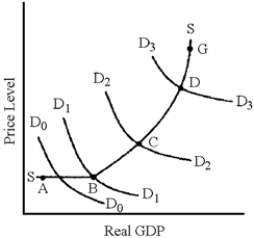 -In Figure 10-2, which segment of the aggregate supply curve has the smallest multiplier effect?
 (Multiple Choice)
4.9/5 (82)
(82) 
Filters
- Essay(0)
- Multiple Choice(0)
- Short Answer(0)
- True False(0)
- Matching(0)