



 Chat with AI
Exam 27: Bringing in the Supply Side: Unemployment and Inflation

Exam 1: What Is Economics232 Questions
Exam 2: The Economy: Myth and Reality155 Questions
Exam 3: The Fundamental Economic Problem: Scarcity and Choice255 Questions
Exam 4: Supply and Demand: an Initial Look313 Questions
Exam 5: Consumer Choice: Individual and Market Demand206 Questions
Exam 6: Demand and Elasticity214 Questions
Exam 7: Production, Inputs, and Cost: Building Blocks for Supply Analysis221 Questions
Exam 8: Output, Price, and Profit: the Importance of Marginal Analysis194 Questions
Exam 9: Securities: Business Finance and the Economy: the Tail That Wags the Dog203 Questions
Exam 10: The Firm and the Industry Under Perfect Competition212 Questions
Exam 11: Monopoly208 Questions
Exam 12: Between Competition and Monopoly230 Questions
Exam 13: Limiting Market Power: Regulation and Antitrust155 Questions
Exam 14: The Case for Free Markets: the Price System225 Questions
Exam 15: The Shortcomings of Free Markets219 Questions
Exam 16: Externalities, the Environment, and Natural Resources222 Questions
Exam 17: Taxation and Resource Allocation221 Questions
Exam 18: Pricing the Factors of Production233 Questions
Exam 19: Labor and Entrepreneurship: the Human Inputs271 Questions
Exam 20: Poverty, Inequality, and Discrimination172 Questions
Exam 21: Is Useconomic Leadership Threatened75 Questions
Exam 22: An Introduction to Macroeconomics216 Questions
Exam 23: The Goals of Macroeconomic Policy212 Questions
Exam 24: Economic Growth: Theory and Policy228 Questions
Exam 25: Aggregate Demand and the Powerful Consumer219 Questions
Exam 26: Demand-Side Equilibrium: Unemployment or Inflation216 Questions
Exam 27: Bringing in the Supply Side: Unemployment and Inflation228 Questions
Exam 28: Managing Aggregate Demand: Fiscal Policy210 Questions
Exam 29: Money and the Banking System224 Questions
Exam 30: Monetary Policy: Conventional and Unconventional210 Questions
Exam 31: He Financial Crisis and the Great Recession66 Questions
Exam 32: The Debate Over Monetary and Fiscal Policy219 Questions
Exam 33: Budget Deficits in the Short and Long Run215 Questions
Exam 34: The Trade-Off Between Inflation and Unemployment219 Questions
Exam 35: International Trade and Comparative Advantage223 Questions
Exam 36: The International Monetary System: Order or Disorder218 Questions
Exam 37: Exchange Rates and the Macroeconomy219 Questions
Select questions type


A consequence of an inflationary gap is ____ as output begins to decrease and prices continue to increase.
(Multiple Choice)
4.9/5  (80)
(80)
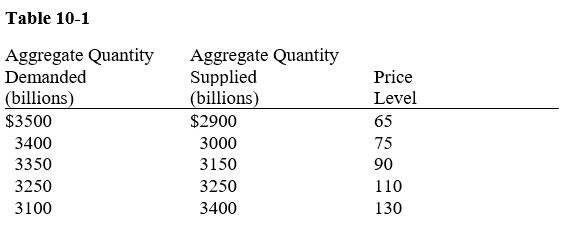 -In Table 10-1, if full employment occurs at $3,400 billion, then
 (Multiple Choice)
4.8/5 (82)
(82) An increase in wages will cause the aggregate supply curve to
(Multiple Choice)
4.9/5 (82)
(82) What is the usual response of firm to an increase in the price of what they sell?
(Multiple Choice)
4.8/5 (75)
(75) A price level lower than equilibrium will cause quantity supplied to exceed quantity demanded.
(True/False)
4.9/5 (80)
(80) The slope of the aggregate supply curve decreases as total output increases.
(True/False)
4.8/5 (93)
(93) From the mid-1980s until late 2007, many world economies became less volatile because of:
(Multiple Choice)
4.8/5 (89)
(89) A period of stagflation can be considered as part of the normal aftermath of a
(Multiple Choice)
4.7/5 (68)
(68) The diminished employment prospects for the graduates of 2002 is most likely due to the existence of a(n)
(Multiple Choice)
4.8/5 (75)
(75) In spite of the fact that unemployment rates were at a 30-year low in 1996-2000, the United States economy also experienced
(Multiple Choice)
4.7/5 (83)
(83) Over time, aggregate demand and aggregate supply grow by the same amount.
(True/False)
5.0/5 (83)
(83) Economists believed that the U.S.economy had a (n) ____ in 2006 and 2007.
(Multiple Choice)
4.9/5 (73)
(73) A statement issued by the president's economic advisors stating that growth can continue without price increases indicates that they believe the relevant aggregate supply curve is
(Multiple Choice)
4.8/5 (94)
(94) Part of the normal aftermath of a period of excessive aggregate demand is
(Multiple Choice)
4.9/5 (68)
(68) The OPEC production cuts of 1999-2000 increased energy prices and caused the aggregate supply curve to
(Multiple Choice)
4.8/5 (82)
(82) One complication that tends to prolong recessionary gaps is that wages
(Multiple Choice)
4.9/5 (85)
(85) What would be the likely result of a recessionary gap?
If this leads to a fall in the nominal wage what impact it would have on the aggregate supply curve and on recessionary gap?
(Essay)
4.9/5 (96)
(96) What is meant by an economy's self correcting mechanism?
Explain the process through which self correcting mechanism reduces inflationary gap.
(Essay)
5.0/5 (89)
(89) A severe hurricane hits Florida, destroying large amounts of the citrus crop.What is the most likely effect of this on aggregate supply?
(Multiple Choice)
4.8/5 (65)
(65) 
Filters
- Essay(0)
- Multiple Choice(0)
- Short Answer(0)
- True False(0)
- Matching(0)