



 Chat with AI
Exam 33: Budget Deficits in the Short and Long Run

Exam 1: What Is Economics232 Questions
Exam 2: The Economy: Myth and Reality155 Questions
Exam 3: The Fundamental Economic Problem: Scarcity and Choice255 Questions
Exam 4: Supply and Demand: an Initial Look313 Questions
Exam 5: Consumer Choice: Individual and Market Demand206 Questions
Exam 6: Demand and Elasticity214 Questions
Exam 7: Production, Inputs, and Cost: Building Blocks for Supply Analysis221 Questions
Exam 8: Output, Price, and Profit: the Importance of Marginal Analysis194 Questions
Exam 9: Securities: Business Finance and the Economy: the Tail That Wags the Dog203 Questions
Exam 10: The Firm and the Industry Under Perfect Competition212 Questions
Exam 11: Monopoly208 Questions
Exam 12: Between Competition and Monopoly230 Questions
Exam 13: Limiting Market Power: Regulation and Antitrust155 Questions
Exam 14: The Case for Free Markets: the Price System225 Questions
Exam 15: The Shortcomings of Free Markets219 Questions
Exam 16: Externalities, the Environment, and Natural Resources222 Questions
Exam 17: Taxation and Resource Allocation221 Questions
Exam 18: Pricing the Factors of Production233 Questions
Exam 19: Labor and Entrepreneurship: the Human Inputs271 Questions
Exam 20: Poverty, Inequality, and Discrimination172 Questions
Exam 21: Is Useconomic Leadership Threatened75 Questions
Exam 22: An Introduction to Macroeconomics216 Questions
Exam 23: The Goals of Macroeconomic Policy212 Questions
Exam 24: Economic Growth: Theory and Policy228 Questions
Exam 25: Aggregate Demand and the Powerful Consumer219 Questions
Exam 26: Demand-Side Equilibrium: Unemployment or Inflation216 Questions
Exam 27: Bringing in the Supply Side: Unemployment and Inflation228 Questions
Exam 28: Managing Aggregate Demand: Fiscal Policy210 Questions
Exam 29: Money and the Banking System224 Questions
Exam 30: Monetary Policy: Conventional and Unconventional210 Questions
Exam 31: He Financial Crisis and the Great Recession66 Questions
Exam 32: The Debate Over Monetary and Fiscal Policy219 Questions
Exam 33: Budget Deficits in the Short and Long Run215 Questions
Exam 34: The Trade-Off Between Inflation and Unemployment219 Questions
Exam 35: International Trade and Comparative Advantage223 Questions
Exam 36: The International Monetary System: Order or Disorder218 Questions
Exam 37: Exchange Rates and the Macroeconomy219 Questions
Select questions type


The statement that "repaying our enormous national debt will ruin the nation" is

Free
(Multiple Choice)
4.9/5  (83)
(83) Correct Answer: Verified
D
Monetization of the deficit (or debt) means that
Free
(Multiple Choice)
4.8/5 (63)
(63) Correct Answer:Verified
VerifiedC
What is the difference between the deficit and the debt?
Free
(Essay)
5.0/5 (62)
(62) Correct Answer:Verified
VerifiedThe budget deficit is the difference over some time period, usually a year, between government receipts and outlays (expenditures plus transfers).When outlays exceed receipts, the budget is in deficit.The national debt is the accumulation of past deficits.The budget deficits in the 1980s and the early 1990s were often over $150 billion a year or more.The national debt at the end of 1998 was about $3.3 billion on a net basis.
The structural deficit is determined by established expenditure-transfer policies and tax rates and is independent of the current level of GDP.
(True/False)
4.9/5 (68)
(68) The blame for failing to address the budget deficits of the 1980s and early 1990s
(Multiple Choice)
4.8/5 (78)
(78) Differentiate between "off-budget" deficit and the "on-budget" deficit.
(Essay)
4.9/5 (66)
(66) The fallacy in the strict crowding-out argument comes from supposing that
(Multiple Choice)
5.0/5 (68)
(68) Figure 16-3
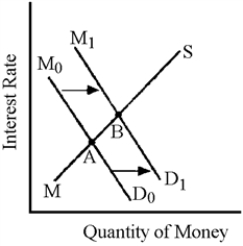 -Figure 16-3 shows the impact of deficit spending and the corresponding economic expansion on the demand curve for money.If the Federal Reserve does not want interest rates to rise, it will
 (Multiple Choice)
4.8/5 (81)
(81) If the Federal Reserve takes no countervailing actions, an expansionary fiscal policy will increase the deficit, increase GDP, increase prices, and drive up interest rates.
(True/False)
4.9/5 (72)
(72) The policy mix that the Clinton administration sought in early 1993 was a
(Multiple Choice)
5.0/5 (77)
(77) The structural deficit is extremely sensitive to the performance of the economy.
(True/False)
4.9/5 (68)
(68) Deficit spending will not cause much inflation if the economy is operating near full employment.
(True/False)
4.8/5 (75)
(75) Why do economists view structural budget deficit as a good measure of the direction of the fiscal policy?
(Essay)
4.8/5 (72)
(72) One measure of "ability to pay," the national debt is the debt to
(Multiple Choice)
4.9/5 (84)
(84) 
Filters
- Essay(0)
- Multiple Choice(0)
- Short Answer(0)
- True False(0)
- Matching(0)