



 Chat with AI
Exam 33: Budget Deficits in the Short and Long Run

Exam 1: What Is Economics232 Questions
Exam 2: The Economy: Myth and Reality155 Questions
Exam 3: The Fundamental Economic Problem: Scarcity and Choice255 Questions
Exam 4: Supply and Demand: an Initial Look313 Questions
Exam 5: Consumer Choice: Individual and Market Demand206 Questions
Exam 6: Demand and Elasticity214 Questions
Exam 7: Production, Inputs, and Cost: Building Blocks for Supply Analysis221 Questions
Exam 8: Output, Price, and Profit: the Importance of Marginal Analysis194 Questions
Exam 9: Securities: Business Finance and the Economy: the Tail That Wags the Dog203 Questions
Exam 10: The Firm and the Industry Under Perfect Competition212 Questions
Exam 11: Monopoly208 Questions
Exam 12: Between Competition and Monopoly230 Questions
Exam 13: Limiting Market Power: Regulation and Antitrust155 Questions
Exam 14: The Case for Free Markets: the Price System225 Questions
Exam 15: The Shortcomings of Free Markets219 Questions
Exam 16: Externalities, the Environment, and Natural Resources222 Questions
Exam 17: Taxation and Resource Allocation221 Questions
Exam 18: Pricing the Factors of Production233 Questions
Exam 19: Labor and Entrepreneurship: the Human Inputs271 Questions
Exam 20: Poverty, Inequality, and Discrimination172 Questions
Exam 21: Is Useconomic Leadership Threatened75 Questions
Exam 22: An Introduction to Macroeconomics216 Questions
Exam 23: The Goals of Macroeconomic Policy212 Questions
Exam 24: Economic Growth: Theory and Policy228 Questions
Exam 25: Aggregate Demand and the Powerful Consumer219 Questions
Exam 26: Demand-Side Equilibrium: Unemployment or Inflation216 Questions
Exam 27: Bringing in the Supply Side: Unemployment and Inflation228 Questions
Exam 28: Managing Aggregate Demand: Fiscal Policy210 Questions
Exam 29: Money and the Banking System224 Questions
Exam 30: Monetary Policy: Conventional and Unconventional210 Questions
Exam 31: He Financial Crisis and the Great Recession66 Questions
Exam 32: The Debate Over Monetary and Fiscal Policy219 Questions
Exam 33: Budget Deficits in the Short and Long Run215 Questions
Exam 34: The Trade-Off Between Inflation and Unemployment219 Questions
Exam 35: International Trade and Comparative Advantage223 Questions
Exam 36: The International Monetary System: Order or Disorder218 Questions
Exam 37: Exchange Rates and the Macroeconomy219 Questions
Select questions type


The main reason that the deficit grows in a recession is that
(Multiple Choice)
4.7/5  (73)
(73) If the U.S.government decides to eliminate a budget surplus by reducing taxes, the most likely effect would be
(Multiple Choice)
4.9/5 (84)
(84) Like the debt of many families, the national debt in 2014 was many times larger than the national income.
(True/False)
4.9/5 (75)
(75) The share of the net national debt owned by foreign individuals, businesses, and governments has steadily risen to 80%.
(True/False)
4.8/5 (84)
(84) Figure 16-3
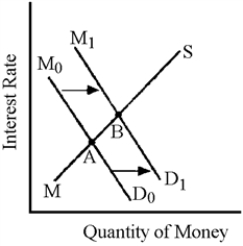 -If budget deficits shift the money demand curve as is illustrated in Figure 16-3, which component of total expenditures will be affected the most?
 (Multiple Choice)
4.9/5 (76)
(76) Because of the American national debt, future Americans will be burdened by heavy interest payments which will necessitate higher taxes.
(True/False)
4.7/5 (70)
(70) What happens typically to a budget deficit during a recession?
(Multiple Choice)
4.7/5 (77)
(77) Figure 16-1
 -In Figure 16-1, there are four levels of income.G is government expenditures and TT is taxes less transfers.At which level of income is the actual deficit the greatest?
 (Multiple Choice)
5.0/5 (68)
(68) Which of the following is true regarding the effect of deficits from 1980-2005 in the U.S.?
(Multiple Choice)
4.7/5 (88)
(88) If a budget deficit increases interest rates, it is possible that investment will
(Multiple Choice)
4.9/5 (74)
(74) Suppose that the economy is currently at full employment.All other things being equal, if central bank implements contractionary policy, then the appropriate fiscal policy is to
(Multiple Choice)
4.9/5 (74)
(74) At levels of GDP above full employment, the federal budget would usually be in a deficit position.
(True/False)
4.7/5 (80)
(80) At the end of 2014, the net national debt per person in the United States was approximately
(Multiple Choice)
4.9/5 (90)
(90) A serious burden of a budget deficit and an increase in the national debt comes on the supply side because large budget deficits
(Multiple Choice)
4.8/5 (68)
(68) If the government ran a major deficit, and there was no noticeable effect on the level of GDP, this could be taken as evidence of
(Multiple Choice)
4.9/5 (75)
(75) 
Filters
- Essay(0)
- Multiple Choice(0)
- Short Answer(0)
- True False(0)
- Matching(0)