



 Chat with AI
Exam 33: Budget Deficits in the Short and Long Run

Exam 1: What Is Economics232 Questions
Exam 2: The Economy: Myth and Reality155 Questions
Exam 3: The Fundamental Economic Problem: Scarcity and Choice255 Questions
Exam 4: Supply and Demand: an Initial Look313 Questions
Exam 5: Consumer Choice: Individual and Market Demand206 Questions
Exam 6: Demand and Elasticity214 Questions
Exam 7: Production, Inputs, and Cost: Building Blocks for Supply Analysis221 Questions
Exam 8: Output, Price, and Profit: the Importance of Marginal Analysis194 Questions
Exam 9: Securities: Business Finance and the Economy: the Tail That Wags the Dog203 Questions
Exam 10: The Firm and the Industry Under Perfect Competition212 Questions
Exam 11: Monopoly208 Questions
Exam 12: Between Competition and Monopoly230 Questions
Exam 13: Limiting Market Power: Regulation and Antitrust155 Questions
Exam 14: The Case for Free Markets: the Price System225 Questions
Exam 15: The Shortcomings of Free Markets219 Questions
Exam 16: Externalities, the Environment, and Natural Resources222 Questions
Exam 17: Taxation and Resource Allocation221 Questions
Exam 18: Pricing the Factors of Production233 Questions
Exam 19: Labor and Entrepreneurship: the Human Inputs271 Questions
Exam 20: Poverty, Inequality, and Discrimination172 Questions
Exam 21: Is Useconomic Leadership Threatened75 Questions
Exam 22: An Introduction to Macroeconomics216 Questions
Exam 23: The Goals of Macroeconomic Policy212 Questions
Exam 24: Economic Growth: Theory and Policy228 Questions
Exam 25: Aggregate Demand and the Powerful Consumer219 Questions
Exam 26: Demand-Side Equilibrium: Unemployment or Inflation216 Questions
Exam 27: Bringing in the Supply Side: Unemployment and Inflation228 Questions
Exam 28: Managing Aggregate Demand: Fiscal Policy210 Questions
Exam 29: Money and the Banking System224 Questions
Exam 30: Monetary Policy: Conventional and Unconventional210 Questions
Exam 31: He Financial Crisis and the Great Recession66 Questions
Exam 32: The Debate Over Monetary and Fiscal Policy219 Questions
Exam 33: Budget Deficits in the Short and Long Run215 Questions
Exam 34: The Trade-Off Between Inflation and Unemployment219 Questions
Exam 35: International Trade and Comparative Advantage223 Questions
Exam 36: The International Monetary System: Order or Disorder218 Questions
Exam 37: Exchange Rates and the Macroeconomy219 Questions
Select questions type


In the long run, aggregate demand controls, no matter what happens to aggregate supply.
(True/False)
4.8/5  (82)
(82) If the economy is in an inflationary gap, and the government attempts to balance the budget, the effect will be to
(Multiple Choice)
4.9/5 (85)
(85) The crowding-out effect is more likely to dominate the crowding-in effect when investment is relatively
(Multiple Choice)
4.8/5 (76)
(76) The short-run effects of government's financial rescue program and fiscal stimulus package helped the economy increase aggregate demand curing the Great Recession.
(True/False)
4.9/5 (79)
(79) What is "crowding-in" effect?
Explain the factors which determine the strength of the crowding in effect.
(Essay)
4.8/5 (81)
(81) Future generations will be hurt by a high national debt if incurring the debt
(Multiple Choice)
4.9/5 (77)
(77) Figure 16-2
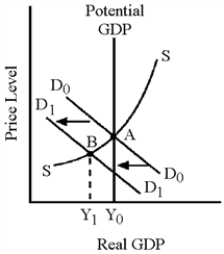 -Suppose that Figure 16-2 shows the effects of reducing the budget deficit by raising taxes.If authorities do not want real GDP to fall, monetary policy must
 (Multiple Choice)
4.7/5 (100)
(100) "Budget deficits are inflationary." The truth of this statement depends on
(Multiple Choice)
4.8/5 (83)
(83) During the period from 1945 to 1975, the debt to GDP ratio
(Multiple Choice)
4.8/5 (73)
(73) In 2010, which of the following was true regarding the extremely large deficits that the U.S.recently encountered?
(Multiple Choice)
4.8/5 (72)
(72) If the level of government spending increases at the same time the Fed is pursuing contractionary monetary policy, we know that
(Multiple Choice)
4.9/5 (86)
(86) In the early 1990s, economists became alarmed over the national debt because it
(Multiple Choice)
4.9/5 (80)
(80) Higher interest rates and, therefore, a decrease in investment spending is most likely to be caused by which policy mix?
(Multiple Choice)
4.8/5 (87)
(87) Economists who argue in favor of rapid deficit reduction claim that deficit reduction will
(Multiple Choice)
4.9/5 (77)
(77) 
Filters
- Essay(0)
- Multiple Choice(0)
- Short Answer(0)
- True False(0)
- Matching(0)