



 Chat with AI
Exam 11: Monopoly

Exam 1: What Is Economics232 Questions
Exam 2: The Economy: Myth and Reality155 Questions
Exam 3: The Fundamental Economic Problem: Scarcity and Choice255 Questions
Exam 4: Supply and Demand: an Initial Look313 Questions
Exam 5: Consumer Choice: Individual and Market Demand206 Questions
Exam 6: Demand and Elasticity214 Questions
Exam 7: Production, Inputs, and Cost: Building Blocks for Supply Analysis221 Questions
Exam 8: Output, Price, and Profit: the Importance of Marginal Analysis194 Questions
Exam 9: Securities: Business Finance and the Economy: the Tail That Wags the Dog203 Questions
Exam 10: The Firm and the Industry Under Perfect Competition212 Questions
Exam 11: Monopoly208 Questions
Exam 12: Between Competition and Monopoly230 Questions
Exam 13: Limiting Market Power: Regulation and Antitrust155 Questions
Exam 14: The Case for Free Markets: the Price System225 Questions
Exam 15: The Shortcomings of Free Markets219 Questions
Exam 16: Externalities, the Environment, and Natural Resources222 Questions
Exam 17: Taxation and Resource Allocation221 Questions
Exam 18: Pricing the Factors of Production233 Questions
Exam 19: Labor and Entrepreneurship: the Human Inputs271 Questions
Exam 20: Poverty, Inequality, and Discrimination172 Questions
Exam 21: Is Useconomic Leadership Threatened75 Questions
Exam 22: An Introduction to Macroeconomics216 Questions
Exam 23: The Goals of Macroeconomic Policy212 Questions
Exam 24: Economic Growth: Theory and Policy228 Questions
Exam 25: Aggregate Demand and the Powerful Consumer219 Questions
Exam 26: Demand-Side Equilibrium: Unemployment or Inflation216 Questions
Exam 27: Bringing in the Supply Side: Unemployment and Inflation228 Questions
Exam 28: Managing Aggregate Demand: Fiscal Policy210 Questions
Exam 29: Money and the Banking System224 Questions
Exam 30: Monetary Policy: Conventional and Unconventional210 Questions
Exam 31: He Financial Crisis and the Great Recession66 Questions
Exam 32: The Debate Over Monetary and Fiscal Policy219 Questions
Exam 33: Budget Deficits in the Short and Long Run215 Questions
Exam 34: The Trade-Off Between Inflation and Unemployment219 Questions
Exam 35: International Trade and Comparative Advantage223 Questions
Exam 36: The International Monetary System: Order or Disorder218 Questions
Exam 37: Exchange Rates and the Macroeconomy219 Questions
Select questions type


Since a monopolist has a unique product, it makes no sense for the firm to advertise.
(True/False)
5.0/5  (74)
(74) Wendy retails motor homes, which she buys for a sum that does not vary with the number she purchases from the manufacturer.She can sell eleven per week at $40,000.If she limits sales to ten, she can charge $41,000 each.She will sell eleven per week if the cost of each vehicle is no more than
(Multiple Choice)
5.0/5 (59)
(59) The U.S.Postal Service enjoys a monopoly position because of patent rights.
(True/False)
4.9/5 (87)
(87) Figure 11-4
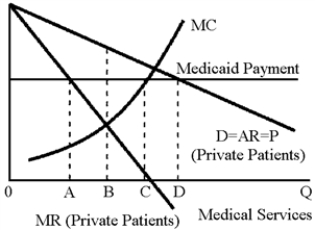 -Physicians have two types of patients: private patients who pay directly or with insurance, and Medicaid patients whose care is paid for by the state.Physicians must lower prices to attract more private patients, but they can add unlimited Medicaid patients at a constant price.The situation facing Dr.Casey is depicted in Figure 11-4.Units of medical service (say, number of patients × number of visits) are measured on the horizontal axis.How many units of medical service will Dr.Casey deliver?
 (Multiple Choice)
4.8/5 (67)
(67) A monopolist's profit per unit is shown by the difference between price and marginal cost per unit.
(True/False)
4.9/5 (69)
(69) A monopoly restricts output and charges a higher price than other types of firms.
(True/False)
4.7/5 (76)
(76) Which of the following observations concerning price discrimination is true?
(Multiple Choice)
4.9/5 (78)
(78) Inefficient resource allocation is a major problem with monopolies.
(True/False)
4.8/5 (79)
(79) Table 11-1  -Table 11-1 shows demand and total cost schedules for the monopolist Monopoliteria.Monopoliteria's profit-maximizing price per unit in dollars is
 (Multiple Choice)
4.9/5 (81)
(81) Figure 11-1
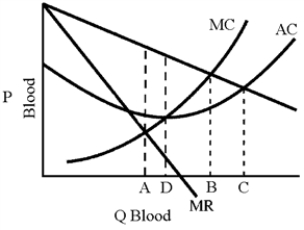 -The Red Cross is virtually the only operator of blood banks in the United States.In Figure 11-1 are the demand and cost curves facing the Red Cross blood bank.If the Red Cross were to set price and quantity at the level that it would obtain in the long run in a competitive industry, how much blood would it sell?
 (Multiple Choice)
4.9/5 (77)
(77) Why does perfect competition shun advertising? Does advertising benefit a monopoly?
(Essay)
4.9/5 (71)
(71) 
Filters
- Essay(0)
- Multiple Choice(0)
- Short Answer(0)
- True False(0)
- Matching(0)