



 Chat with AI
Exam 35: International Trade and Comparative Advantage

Exam 1: What Is Economics232 Questions
Exam 2: The Economy: Myth and Reality155 Questions
Exam 3: The Fundamental Economic Problem: Scarcity and Choice255 Questions
Exam 4: Supply and Demand: an Initial Look313 Questions
Exam 5: Consumer Choice: Individual and Market Demand206 Questions
Exam 6: Demand and Elasticity214 Questions
Exam 7: Production, Inputs, and Cost: Building Blocks for Supply Analysis221 Questions
Exam 8: Output, Price, and Profit: the Importance of Marginal Analysis194 Questions
Exam 9: Securities: Business Finance and the Economy: the Tail That Wags the Dog203 Questions
Exam 10: The Firm and the Industry Under Perfect Competition212 Questions
Exam 11: Monopoly208 Questions
Exam 12: Between Competition and Monopoly230 Questions
Exam 13: Limiting Market Power: Regulation and Antitrust155 Questions
Exam 14: The Case for Free Markets: the Price System225 Questions
Exam 15: The Shortcomings of Free Markets219 Questions
Exam 16: Externalities, the Environment, and Natural Resources222 Questions
Exam 17: Taxation and Resource Allocation221 Questions
Exam 18: Pricing the Factors of Production233 Questions
Exam 19: Labor and Entrepreneurship: the Human Inputs271 Questions
Exam 20: Poverty, Inequality, and Discrimination172 Questions
Exam 21: Is Useconomic Leadership Threatened75 Questions
Exam 22: An Introduction to Macroeconomics216 Questions
Exam 23: The Goals of Macroeconomic Policy212 Questions
Exam 24: Economic Growth: Theory and Policy228 Questions
Exam 25: Aggregate Demand and the Powerful Consumer219 Questions
Exam 26: Demand-Side Equilibrium: Unemployment or Inflation216 Questions
Exam 27: Bringing in the Supply Side: Unemployment and Inflation228 Questions
Exam 28: Managing Aggregate Demand: Fiscal Policy210 Questions
Exam 29: Money and the Banking System224 Questions
Exam 30: Monetary Policy: Conventional and Unconventional210 Questions
Exam 31: He Financial Crisis and the Great Recession66 Questions
Exam 32: The Debate Over Monetary and Fiscal Policy219 Questions
Exam 33: Budget Deficits in the Short and Long Run215 Questions
Exam 34: The Trade-Off Between Inflation and Unemployment219 Questions
Exam 35: International Trade and Comparative Advantage223 Questions
Exam 36: The International Monetary System: Order or Disorder218 Questions
Exam 37: Exchange Rates and the Macroeconomy219 Questions
Select questions type


If a nation imposes a tariff on imports, the portion of the tax paid by citizens depends upon
(Multiple Choice)
4.9/5  (73)
(73) What is an export subsidy?
Discuss some of the recent examples where such subsidies were controversial.
(Essay)
4.8/5 (76)
(76)  -In Figure 22-9, at price OC
If all countries produce the goods for which they have comparative advantages, all countries benefit with the increased production of goods with no additional resources being used.
(True/False)
5.0/5 (97)
(97) The danger of using the national defense argument to protect domestic industries necessary to wage war is that
(Multiple Choice)
4.9/5 (79)
(79) Is the call for protection on the basis of "infant industry" valid?
(Multiple Choice)
4.8/5 (71)
(71) Figure 22-8
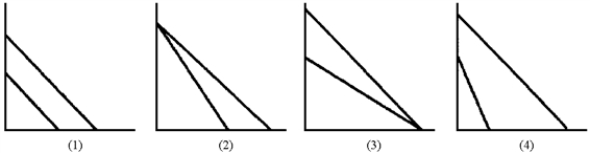 -Figure 22-8 has four sets of production possibility curves for two hypothetical countries.In which case will there be no advantage to trade between the two countries?
 (Multiple Choice)
4.8/5 (71)
(71) A country's comparative advantage can be illustrated by the graph of the production possibilities frontier.
(True/False)
4.8/5 (92)
(92) Foreign competition will always put a domestic industry at a disadvantage.This leads to massive trade adjustment assistance on the part of each country.
(True/False)
4.7/5 (85)
(85) Quebec is capable of producing 10,000 pallets of wood shingles or 8,000 barrels of maple syrup.Vermont is capable of producing 12,000 pallets of wood shingles or 12,000 barrels of maple syrup.
a.Graph these production possibilities curves.Indicate from the slope, which has the absolute advantage, which the comparative advantage, and whether there are gains from trade.
b.Assume that Vermont and Quebec each specializes in the good in which they have a comparative advantage.Suppose that Vermont and Quebec decide to trade 5,000 pallets of shingles for 5,000 barrels of syrup.Indicate this on the graph.How does this affect the well being of the two societies? Explain.
(Essay)
4.8/5 (75)
(75) An export subsidy helps reduce the selling price of a product by allowing individual producers to charge less and still cover all of their production costs.
(True/False)
4.8/5 (69)
(69) A country that must inhibit imports should give preference to
(Multiple Choice)
4.9/5 (81)
(81) Any restriction of international trade that is accomplished by a quota can also be accomplished by a tariff.
(True/False)
4.9/5 (78)
(78) Suppose that Captain Canada can produce 100 hockey sticks or 10 gallons of maple syrup in a typical work week, while Captain Germany can produce 90 hockey sticks or 10 gallons of maple syrup in a typical work week.From these numbers, we can conclude
(Multiple Choice)
4.9/5 (75)
(75)
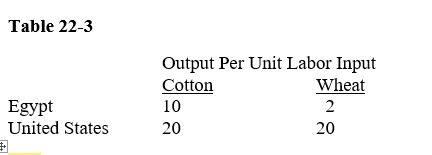 -The data in Table 22-3 indicate that the United States has
 (Multiple Choice)
5.0/5 (82)
(82) Comparing international trade with trade among the different states of the United States shows that
(Multiple Choice)
5.0/5 (78)
(78) From 1975 to 2008, which of the following countries experienced greater wage increases than the U.S.?
(Multiple Choice)
4.9/5 (67)
(67) At least two demand curves are present in an international equilibrium model.
(True/False)
4.9/5 (88)
(88) 
Filters
- Essay(0)
- Multiple Choice(0)
- Short Answer(0)
- True False(0)
- Matching(0)