



 Chat with AI
Exam 35: International Trade and Comparative Advantage

Exam 1: What Is Economics232 Questions
Exam 2: The Economy: Myth and Reality155 Questions
Exam 3: The Fundamental Economic Problem: Scarcity and Choice255 Questions
Exam 4: Supply and Demand: an Initial Look313 Questions
Exam 5: Consumer Choice: Individual and Market Demand206 Questions
Exam 6: Demand and Elasticity214 Questions
Exam 7: Production, Inputs, and Cost: Building Blocks for Supply Analysis221 Questions
Exam 8: Output, Price, and Profit: the Importance of Marginal Analysis194 Questions
Exam 9: Securities: Business Finance and the Economy: the Tail That Wags the Dog203 Questions
Exam 10: The Firm and the Industry Under Perfect Competition212 Questions
Exam 11: Monopoly208 Questions
Exam 12: Between Competition and Monopoly230 Questions
Exam 13: Limiting Market Power: Regulation and Antitrust155 Questions
Exam 14: The Case for Free Markets: the Price System225 Questions
Exam 15: The Shortcomings of Free Markets219 Questions
Exam 16: Externalities, the Environment, and Natural Resources222 Questions
Exam 17: Taxation and Resource Allocation221 Questions
Exam 18: Pricing the Factors of Production233 Questions
Exam 19: Labor and Entrepreneurship: the Human Inputs271 Questions
Exam 20: Poverty, Inequality, and Discrimination172 Questions
Exam 21: Is Useconomic Leadership Threatened75 Questions
Exam 22: An Introduction to Macroeconomics216 Questions
Exam 23: The Goals of Macroeconomic Policy212 Questions
Exam 24: Economic Growth: Theory and Policy228 Questions
Exam 25: Aggregate Demand and the Powerful Consumer219 Questions
Exam 26: Demand-Side Equilibrium: Unemployment or Inflation216 Questions
Exam 27: Bringing in the Supply Side: Unemployment and Inflation228 Questions
Exam 28: Managing Aggregate Demand: Fiscal Policy210 Questions
Exam 29: Money and the Banking System224 Questions
Exam 30: Monetary Policy: Conventional and Unconventional210 Questions
Exam 31: He Financial Crisis and the Great Recession66 Questions
Exam 32: The Debate Over Monetary and Fiscal Policy219 Questions
Exam 33: Budget Deficits in the Short and Long Run215 Questions
Exam 34: The Trade-Off Between Inflation and Unemployment219 Questions
Exam 35: International Trade and Comparative Advantage223 Questions
Exam 36: The International Monetary System: Order or Disorder218 Questions
Exam 37: Exchange Rates and the Macroeconomy219 Questions
Select questions type


When other nations Orient "dump" products on the U.S.market, they
(Multiple Choice)
5.0/5  (75)
(75) The world price of a commodity will settle at the level where
(Multiple Choice)
4.9/5 (75)
(75) Figure 22-7
 -In Figure 22-7, CF has the same slope as BG.AB and CD are the production possibilities of Pestoland and Pastaland, respectively.If both countries are given the opportunity to trade at prices indicated by CF,
 (Multiple Choice)
4.9/5 (70)
(70) Voluntary exchange is based on the principle that all parties must gain from trade.
(True/False)
4.8/5 (80)
(80) Wages in most other countries have increased as a percentage of U.S.wages in the past 33 years.
(True/False)
4.7/5 (90)
(90) A common fallacy that is used to oppose trade is the idea that
(Multiple Choice)
5.0/5 (84)
(84) If Brazil voluntarily ships coffee to the United States in return for airplanes,
(Multiple Choice)
4.9/5 (80)
(80) The Trade Adjustment Assistance program is intended to help
(Multiple Choice)
4.9/5 (67)
(67) If Japan imposes a quota on imports of rice, the effect will be
(Multiple Choice)
4.7/5 (97)
(97) Why is comparative advantage rather than absolute advantage the basis for trade?
(Essay)
4.8/5 (86)
(86) Even though international trade is more complicated, supply and demand are still at the center of the price determination mechanism.
(True/False)
4.8/5 (71)
(71) A country can gain by importing a good that it can make itself if
(Multiple Choice)
4.8/5 (86)
(86) If two countries have production possibilities curves with different slopes, there is no possibility for gains from trade.
(True/False)
4.8/5 (78)
(78) What is strategic trade policy?
What are the pros and cons of such a policy by a nation in its dealings with other nations?
(Essay)
4.9/5 (95)
(95) If the supply curve of a commodity is upward sloping, and the producing country begins to export more in a pure free trade system, the domestic price of the commodity will
(Multiple Choice)
4.8/5 (85)
(85) 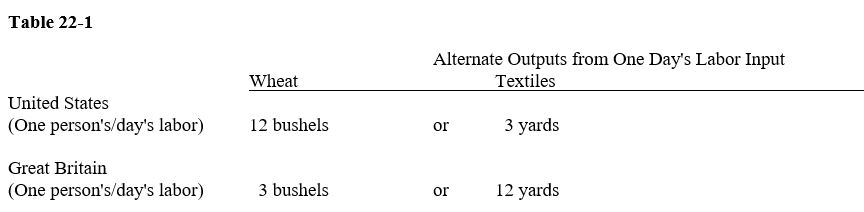 -From Table 22-1, the United States
Japan and China produce guns and rice.The country with the lowest opportunity cost of guns (in terms of rice) will
(Multiple Choice)
4.8/5 (82)
(82) Colombia produces coffee with less labor and land than any other country; it therefore surely has
(Multiple Choice)
4.9/5 (86)
(86) 
Filters
- Essay(0)
- Multiple Choice(0)
- Short Answer(0)
- True False(0)
- Matching(0)