



 Chat with AI
Exam 35: International Trade and Comparative Advantage

Exam 1: What Is Economics232 Questions
Exam 2: The Economy: Myth and Reality155 Questions
Exam 3: The Fundamental Economic Problem: Scarcity and Choice255 Questions
Exam 4: Supply and Demand: an Initial Look313 Questions
Exam 5: Consumer Choice: Individual and Market Demand206 Questions
Exam 6: Demand and Elasticity214 Questions
Exam 7: Production, Inputs, and Cost: Building Blocks for Supply Analysis221 Questions
Exam 8: Output, Price, and Profit: the Importance of Marginal Analysis194 Questions
Exam 9: Securities: Business Finance and the Economy: the Tail That Wags the Dog203 Questions
Exam 10: The Firm and the Industry Under Perfect Competition212 Questions
Exam 11: Monopoly208 Questions
Exam 12: Between Competition and Monopoly230 Questions
Exam 13: Limiting Market Power: Regulation and Antitrust155 Questions
Exam 14: The Case for Free Markets: the Price System225 Questions
Exam 15: The Shortcomings of Free Markets219 Questions
Exam 16: Externalities, the Environment, and Natural Resources222 Questions
Exam 17: Taxation and Resource Allocation221 Questions
Exam 18: Pricing the Factors of Production233 Questions
Exam 19: Labor and Entrepreneurship: the Human Inputs271 Questions
Exam 20: Poverty, Inequality, and Discrimination172 Questions
Exam 21: Is Useconomic Leadership Threatened75 Questions
Exam 22: An Introduction to Macroeconomics216 Questions
Exam 23: The Goals of Macroeconomic Policy212 Questions
Exam 24: Economic Growth: Theory and Policy228 Questions
Exam 25: Aggregate Demand and the Powerful Consumer219 Questions
Exam 26: Demand-Side Equilibrium: Unemployment or Inflation216 Questions
Exam 27: Bringing in the Supply Side: Unemployment and Inflation228 Questions
Exam 28: Managing Aggregate Demand: Fiscal Policy210 Questions
Exam 29: Money and the Banking System224 Questions
Exam 30: Monetary Policy: Conventional and Unconventional210 Questions
Exam 31: He Financial Crisis and the Great Recession66 Questions
Exam 32: The Debate Over Monetary and Fiscal Policy219 Questions
Exam 33: Budget Deficits in the Short and Long Run215 Questions
Exam 34: The Trade-Off Between Inflation and Unemployment219 Questions
Exam 35: International Trade and Comparative Advantage223 Questions
Exam 36: The International Monetary System: Order or Disorder218 Questions
Exam 37: Exchange Rates and the Macroeconomy219 Questions
Select questions type


Variability in exchange rates of currencies used in international trade
(Multiple Choice)
4.8/5  (91)
(91) An export subsidy is a payment by the government to exporters to permit them to charge lower prices.
(True/False)
4.8/5 (72)
(72) William Safire argues that a unilateral free trade policy is a disaster if
(Multiple Choice)
4.9/5 (78)
(78) Figure 22-3
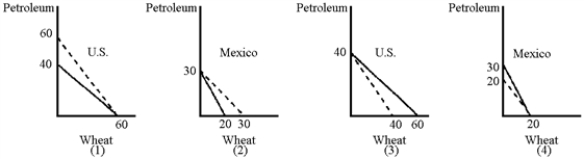 -In Figure 22-3, the solid lines represent the respective production possibilities curves for the United States and Mexico.Which graphs show the correct consumption possibilities curves (dashed lines) after an agreement is reached to trade 1 unit of wheat for 1 unit of petroleum?
 (Multiple Choice)
4.9/5 (86)
(86) The supply-demand mechanism will bring an international market into equilibrium
(Multiple Choice)
4.8/5 (72)
(72) Figure 22-4
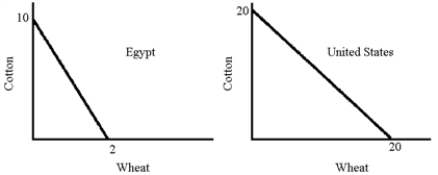 -In Figure 22-4, the opportunity cost of a unit of wheat in terms of cotton is
 (Multiple Choice)
4.7/5 (78)
(78) Suppose that the United States can make 15 cars or 20 bottles of wine with one year's worth of labor.France can make 10 cars or 18 bottles of wine with one year's worth of labor.From these numbers, we can conclude that
(Multiple Choice)
4.8/5 (78)
(78) If a nation has an absolute advantage in the production of some commodity, it
(Multiple Choice)
4.8/5 (98)
(98) If a nation can produce greater quantities of a good than another nation, it has a(n)
(Multiple Choice)
4.8/5 (86)
(86) Figure 22-7
 -In Figure 22-7, it is probably true that wages are
 (Multiple Choice)
5.0/5 (75)
(75) Which of the following is an extreme form of risk associated with investing in a foreign country?
(Multiple Choice)
4.9/5 (86)
(86) The U.S.government uses export subsidies extensively to stimulate exports.
(True/False)
4.8/5 (87)
(87) In William Safire's 1983 essay, "Smoot-Hawley Lives," he argues that the United States should
(Multiple Choice)
4.8/5 (80)
(80) Suppose that a tariff is imposed on imports of minivans.Show graphically what the effect is in terms of price and quantity of imports.Be sure that your graph is completely and correctly labeled.What determines how much of the tariff is paid by the buyers of the minivans?
(Essay)
5.0/5 (92)
(92) If England uses one week's time to produce ten yards of cloth or two barrels of wine and Portugal uses one week's time to produce twelve yards of cloth or six barrels of wine, England has the comparative advantage in both goods.
(True/False)
4.8/5 (85)
(85) The basic concept behind strategic trade policy is that free trade is the best policy to pursue, but some countries don't play by those rules.Therefore,
(Multiple Choice)
4.7/5 (83)
(83) Compare and contrast the effects of a quota and a tariff on imports.Be sure to include both short-run and long-run effects in your answer.
(Essay)
4.8/5 (87)
(87) 
Filters
- Essay(0)
- Multiple Choice(0)
- Short Answer(0)
- True False(0)
- Matching(0)