



 Chat with AI
Exam 35: International Trade and Comparative Advantage

Exam 1: What Is Economics232 Questions
Exam 2: The Economy: Myth and Reality155 Questions
Exam 3: The Fundamental Economic Problem: Scarcity and Choice255 Questions
Exam 4: Supply and Demand: an Initial Look313 Questions
Exam 5: Consumer Choice: Individual and Market Demand206 Questions
Exam 6: Demand and Elasticity214 Questions
Exam 7: Production, Inputs, and Cost: Building Blocks for Supply Analysis221 Questions
Exam 8: Output, Price, and Profit: the Importance of Marginal Analysis194 Questions
Exam 9: Securities: Business Finance and the Economy: the Tail That Wags the Dog203 Questions
Exam 10: The Firm and the Industry Under Perfect Competition212 Questions
Exam 11: Monopoly208 Questions
Exam 12: Between Competition and Monopoly230 Questions
Exam 13: Limiting Market Power: Regulation and Antitrust155 Questions
Exam 14: The Case for Free Markets: the Price System225 Questions
Exam 15: The Shortcomings of Free Markets219 Questions
Exam 16: Externalities, the Environment, and Natural Resources222 Questions
Exam 17: Taxation and Resource Allocation221 Questions
Exam 18: Pricing the Factors of Production233 Questions
Exam 19: Labor and Entrepreneurship: the Human Inputs271 Questions
Exam 20: Poverty, Inequality, and Discrimination172 Questions
Exam 21: Is Useconomic Leadership Threatened75 Questions
Exam 22: An Introduction to Macroeconomics216 Questions
Exam 23: The Goals of Macroeconomic Policy212 Questions
Exam 24: Economic Growth: Theory and Policy228 Questions
Exam 25: Aggregate Demand and the Powerful Consumer219 Questions
Exam 26: Demand-Side Equilibrium: Unemployment or Inflation216 Questions
Exam 27: Bringing in the Supply Side: Unemployment and Inflation228 Questions
Exam 28: Managing Aggregate Demand: Fiscal Policy210 Questions
Exam 29: Money and the Banking System224 Questions
Exam 30: Monetary Policy: Conventional and Unconventional210 Questions
Exam 31: He Financial Crisis and the Great Recession66 Questions
Exam 32: The Debate Over Monetary and Fiscal Policy219 Questions
Exam 33: Budget Deficits in the Short and Long Run215 Questions
Exam 34: The Trade-Off Between Inflation and Unemployment219 Questions
Exam 35: International Trade and Comparative Advantage223 Questions
Exam 36: The International Monetary System: Order or Disorder218 Questions
Exam 37: Exchange Rates and the Macroeconomy219 Questions
Select questions type


The logic of why international trade increases well-being is
(Multiple Choice)
4.8/5  (91)
(91) If Argentina has a large amount of farmland and Great Britain has many factories,
(Multiple Choice)
4.8/5 (84)
(84) "Dumping" means destroying goods to prevent driving down the price.
(True/False)
5.0/5 (74)
(74) The way in which a country benefits from trade is that it can
(Multiple Choice)
4.9/5 (85)
(85) Mercantilist policy is to do everything it can to promote exports and to discourage imports.
(True/False)
4.9/5 (74)
(74) A tariff on imports affects foreign suppliers ____; a quota affects foreign suppliers ____.
(Multiple Choice)
4.8/5 (68)
(68) Quebec is capable of producing 10 pallets of wood shingles or 8 barrels of maple syrup with a unit of labor.Vermont is capable of producing 12 pallets of wood shingles or 12 barrels of maple syrup with a unit of labor.Assume that this is typical of the labor force as a whole.Which location has the absolute advantage and which has the comparative advantage, in the production of each good?
Can these locations reap gains from trade?
(Essay)
4.8/5 (66)
(66) Figure 22-5
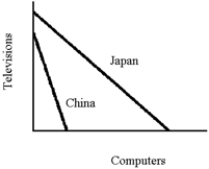 -From the graph in Figure 22-5 (curves show output per unit of labor input), one can infer that
 (Multiple Choice)
4.8/5 (58)
(58) Figure 22-6
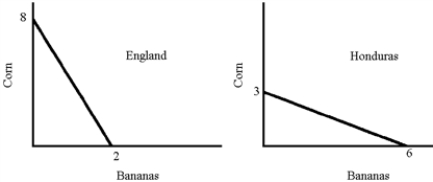 -From the graph in Figure 22-6, the opportunity cost of a unit of bananas is
 (Multiple Choice)
4.7/5 (74)
(74) David Ricardo discovered that two countries can still gain by trading even if one country is more efficient in the production of every commodity.Ricardo's discovery is called the law of
(Multiple Choice)
4.8/5 (73)
(73) One of the main reasons that people want to limit imports is the
(Multiple Choice)
4.8/5 (88)
(88) Discuss national defense, infant industry, and strategic trade as arguments for protection.
(Essay)
4.9/5 (77)
(77) Comparative advantage is illustrated by the slopes of production possibilities frontiers.
(True/False)
4.8/5 (66)
(66) Suppose that the citizens of South Dakota decided to limit imports of citrus fruit from Florida and California on the grounds that climatic differences give those two states an unfair advantage in the production of those products.How would the analysis used to explain international trade apply?
(Essay)
4.8/5 (85)
(85) 
Filters
- Essay(0)
- Multiple Choice(0)
- Short Answer(0)
- True False(0)
- Matching(0)