



 Chat with AI
Exam 4: Supply and Demand: an Initial Look

Exam 1: What Is Economics232 Questions
Exam 2: The Economy: Myth and Reality155 Questions
Exam 3: The Fundamental Economic Problem: Scarcity and Choice255 Questions
Exam 4: Supply and Demand: an Initial Look313 Questions
Exam 5: Consumer Choice: Individual and Market Demand206 Questions
Exam 6: Demand and Elasticity214 Questions
Exam 7: Production, Inputs, and Cost: Building Blocks for Supply Analysis221 Questions
Exam 8: Output, Price, and Profit: the Importance of Marginal Analysis194 Questions
Exam 9: Securities: Business Finance and the Economy: the Tail That Wags the Dog203 Questions
Exam 10: The Firm and the Industry Under Perfect Competition212 Questions
Exam 11: Monopoly208 Questions
Exam 12: Between Competition and Monopoly230 Questions
Exam 13: Limiting Market Power: Regulation and Antitrust155 Questions
Exam 14: The Case for Free Markets: the Price System225 Questions
Exam 15: The Shortcomings of Free Markets219 Questions
Exam 16: Externalities, the Environment, and Natural Resources222 Questions
Exam 17: Taxation and Resource Allocation221 Questions
Exam 18: Pricing the Factors of Production233 Questions
Exam 19: Labor and Entrepreneurship: the Human Inputs271 Questions
Exam 20: Poverty, Inequality, and Discrimination172 Questions
Exam 21: Is Useconomic Leadership Threatened75 Questions
Exam 22: An Introduction to Macroeconomics216 Questions
Exam 23: The Goals of Macroeconomic Policy212 Questions
Exam 24: Economic Growth: Theory and Policy228 Questions
Exam 25: Aggregate Demand and the Powerful Consumer219 Questions
Exam 26: Demand-Side Equilibrium: Unemployment or Inflation216 Questions
Exam 27: Bringing in the Supply Side: Unemployment and Inflation228 Questions
Exam 28: Managing Aggregate Demand: Fiscal Policy210 Questions
Exam 29: Money and the Banking System224 Questions
Exam 30: Monetary Policy: Conventional and Unconventional210 Questions
Exam 31: He Financial Crisis and the Great Recession66 Questions
Exam 32: The Debate Over Monetary and Fiscal Policy219 Questions
Exam 33: Budget Deficits in the Short and Long Run215 Questions
Exam 34: The Trade-Off Between Inflation and Unemployment219 Questions
Exam 35: International Trade and Comparative Advantage223 Questions
Exam 36: The International Monetary System: Order or Disorder218 Questions
Exam 37: Exchange Rates and the Macroeconomy219 Questions
Select questions type


The price of one good produced by a multiproduct industry rises.For another good produced by that industry
(Multiple Choice)
4.8/5  (69)
(69) During the Revolutionary War, the Pennsylvania legislature attempted to help the Continental Army by enacting
(Multiple Choice)
4.7/5 (82)
(82) Figure 4-8
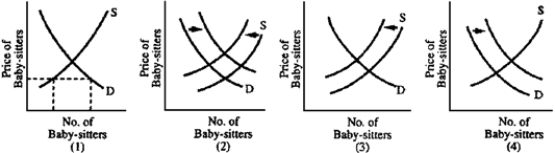 -Women today are having more babies than women did fifteen years ago.The result is that mothers today have trouble finding baby-sitters and are shocked at what they must pay for child care.Which graph in Figure 4-8 best illustrates how the situation has changed?
 (Multiple Choice)
4.9/5 (80)
(80) If price rises, what happens to quantity supplied for a product?
(Multiple Choice)
4.7/5 (74)
(74) The quantity of goods exchanged in a market will be below the equilibrium quantity
(Multiple Choice)
4.9/5 (79)
(79) The removal in 1966 of the requirement that Catholics eat fish on Fridays was followed by a 12.5 percent fall in prices of fresh fish.From this it can be deduced that the
(Multiple Choice)
4.7/5 (72)
(72) Governments of market-oriented economies never tamper with the price mechanism.
(True/False)
4.8/5 (70)
(70) Give an example of a price ceiling.Draw a corresponding diagram and explain why there is a continuing shortage.
(Essay)
4.8/5 (82)
(82) Figure 4-21
 -At price P₃ in Figure 4-21, what will tend to happen?
 (Multiple Choice)
4.9/5 (76)
(76) Price floors set a legal minimum price on a product or commodity.
(True/False)
4.8/5 (86)
(86) The demand by sterile couples for babies to adopt has grown rapidly, while the supply has dwindled because of improved contraception, liberal abortion laws, and an increase in the probability that unwed mothers will keep their children.It violates the law to sell human beings at any age, but for every twenty legal adoptions there seemingly is one baby sale at a price up to $50,000.The generic term economists apply to the market produced by this type of shortage is
(Multiple Choice)
4.9/5 (72)
(72) When price is above the equilibrium level, suppliers offer more than demanders wish to buy.
(True/False)
4.8/5 (81)
(81) As more firms are attracted to an industry, the supply curve can be expected to shift to the right.
(True/False)
4.9/5 (78)
(78) A change in the price of important inputs will change the quantity supplied but will not shift the supply curve.
(True/False)
4.8/5 (79)
(79) Figure 4-16
 -Assume that Figure 4-16 shows the supply of soda.An increase in the price of syrup used in the production of soda will shift supply from
 (Multiple Choice)
4.8/5 (68)
(68) If oranges and grapefruit are close substitutes, an increase in the price of oranges will shift the demand curve of
(Multiple Choice)
5.0/5 (72)
(72) Which of the following would be most likely to cause an outward shift of the demand curve for electricity?
(Multiple Choice)
4.7/5 (85)
(85) A government policy that prevents the price of a good or service from falling below a specified level is called a price floor and usually results in
(Multiple Choice)
5.0/5 (78)
(78) 
Filters
- Essay(0)
- Multiple Choice(0)
- Short Answer(0)
- True False(0)
- Matching(0)