



 Chat with AI
Exam 4: Supply and Demand: an Initial Look

Exam 1: What Is Economics232 Questions
Exam 2: The Economy: Myth and Reality155 Questions
Exam 3: The Fundamental Economic Problem: Scarcity and Choice255 Questions
Exam 4: Supply and Demand: an Initial Look313 Questions
Exam 5: Consumer Choice: Individual and Market Demand206 Questions
Exam 6: Demand and Elasticity214 Questions
Exam 7: Production, Inputs, and Cost: Building Blocks for Supply Analysis221 Questions
Exam 8: Output, Price, and Profit: the Importance of Marginal Analysis194 Questions
Exam 9: Securities: Business Finance and the Economy: the Tail That Wags the Dog203 Questions
Exam 10: The Firm and the Industry Under Perfect Competition212 Questions
Exam 11: Monopoly208 Questions
Exam 12: Between Competition and Monopoly230 Questions
Exam 13: Limiting Market Power: Regulation and Antitrust155 Questions
Exam 14: The Case for Free Markets: the Price System225 Questions
Exam 15: The Shortcomings of Free Markets219 Questions
Exam 16: Externalities, the Environment, and Natural Resources222 Questions
Exam 17: Taxation and Resource Allocation221 Questions
Exam 18: Pricing the Factors of Production233 Questions
Exam 19: Labor and Entrepreneurship: the Human Inputs271 Questions
Exam 20: Poverty, Inequality, and Discrimination172 Questions
Exam 21: Is Useconomic Leadership Threatened75 Questions
Exam 22: An Introduction to Macroeconomics216 Questions
Exam 23: The Goals of Macroeconomic Policy212 Questions
Exam 24: Economic Growth: Theory and Policy228 Questions
Exam 25: Aggregate Demand and the Powerful Consumer219 Questions
Exam 26: Demand-Side Equilibrium: Unemployment or Inflation216 Questions
Exam 27: Bringing in the Supply Side: Unemployment and Inflation228 Questions
Exam 28: Managing Aggregate Demand: Fiscal Policy210 Questions
Exam 29: Money and the Banking System224 Questions
Exam 30: Monetary Policy: Conventional and Unconventional210 Questions
Exam 31: He Financial Crisis and the Great Recession66 Questions
Exam 32: The Debate Over Monetary and Fiscal Policy219 Questions
Exam 33: Budget Deficits in the Short and Long Run215 Questions
Exam 34: The Trade-Off Between Inflation and Unemployment219 Questions
Exam 35: International Trade and Comparative Advantage223 Questions
Exam 36: The International Monetary System: Order or Disorder218 Questions
Exam 37: Exchange Rates and the Macroeconomy219 Questions
Select questions type


The more firms that are attracted to an industry, the greater will be the quantity of product supplied at any given price.
(True/False)
4.9/5  (68)
(68) A severe freeze has once again damaged the Florida orange crop.The impact on the market for oranges will be a leftward shift in
(Multiple Choice)
4.9/5 (75)
(75) Regulations are sometimes used to "correct" the failures of a market mechanism.
(True/False)
4.9/5 (86)
(86) The following price-quantity coordinates for gold used by U.S.dentists were observed: P = $875/ounce, Q = 342,000; P = $200/ounce, Q = 706,000.These points most likely lie along the
(Multiple Choice)
4.9/5 (66)
(66) A change in the price of a good has no effect on the supply schedule.
(True/False)
4.7/5 (79)
(79) Figure 4-12
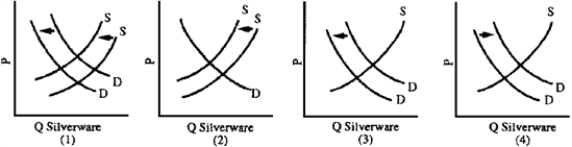 -The silverware industry has been in serious decline since the 1980s.Family dining habits are less formal so people purchase less silverware.Also, in 2006-2008, the price of silver increased from $5 to $20 per ounce.Which graph in Figure 4-12 best illustrates these developments?
 (Multiple Choice)
4.8/5 (93)
(93) Economists generally recognize that rent controls cause shortages in housing, yet rent controls tend to persist.Why does this occur?
(Multiple Choice)
4.7/5 (67)
(67) Normally, to the extent that a governmental control mechanism succeeds in affecting price, it can be expected to lead to a corresponding
(Multiple Choice)
4.8/5 (75)
(75) A price ceiling is only effective if it is above the market equilibrium.
(True/False)
4.8/5 (73)
(73) Assuming that resources are specialized, the opportunity cost of an item increases as production of it rises.Therefore, we expect that firms will produce more if
(Multiple Choice)
4.9/5 (86)
(86) The imposition of price ceilings on a market often results in
(Multiple Choice)
4.9/5 (78)
(78) Figure 4-11
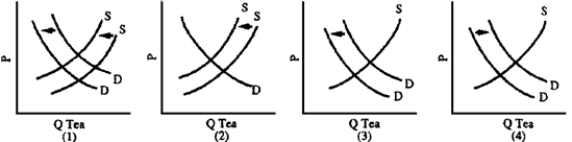 -The Russian government has restricted sugar availability to reduce the supply of illegal liquor (sugar is used to increase alcohol content).Russians also like to sweeten their tea with jam, another sugar product.Which graph in Figure 4-11 depicts the impact of sugar rationing on the Russian tea market?
 (Multiple Choice)
4.9/5 (81)
(81) A demand schedule's position is determined partly by the supply of a good.
(True/False)
4.8/5 (78)
(78) For more than a thousand years, the Catholic Church required its members to abstain from meat on Fridays.Catholics customarily ate fish on Friday.After 1966 abstinence from meat on Fridays was no longer required.Consequently, the
(Multiple Choice)
5.0/5 (81)
(81) Price controls usually enhance efficiency in the allocation of resources.
(True/False)
4.8/5 (77)
(77) A change in the price of hamburgers will change the supply of hot dogs.
(True/False)
4.9/5 (89)
(89) 
Filters
- Essay(0)
- Multiple Choice(0)
- Short Answer(0)
- True False(0)
- Matching(0)