



 Chat with AI
Exam 4: Supply and Demand: an Initial Look

Exam 1: What Is Economics232 Questions
Exam 2: The Economy: Myth and Reality155 Questions
Exam 3: The Fundamental Economic Problem: Scarcity and Choice255 Questions
Exam 4: Supply and Demand: an Initial Look313 Questions
Exam 5: Consumer Choice: Individual and Market Demand206 Questions
Exam 6: Demand and Elasticity214 Questions
Exam 7: Production, Inputs, and Cost: Building Blocks for Supply Analysis221 Questions
Exam 8: Output, Price, and Profit: the Importance of Marginal Analysis194 Questions
Exam 9: Securities: Business Finance and the Economy: the Tail That Wags the Dog203 Questions
Exam 10: The Firm and the Industry Under Perfect Competition212 Questions
Exam 11: Monopoly208 Questions
Exam 12: Between Competition and Monopoly230 Questions
Exam 13: Limiting Market Power: Regulation and Antitrust155 Questions
Exam 14: The Case for Free Markets: the Price System225 Questions
Exam 15: The Shortcomings of Free Markets219 Questions
Exam 16: Externalities, the Environment, and Natural Resources222 Questions
Exam 17: Taxation and Resource Allocation221 Questions
Exam 18: Pricing the Factors of Production233 Questions
Exam 19: Labor and Entrepreneurship: the Human Inputs271 Questions
Exam 20: Poverty, Inequality, and Discrimination172 Questions
Exam 21: Is Useconomic Leadership Threatened75 Questions
Exam 22: An Introduction to Macroeconomics216 Questions
Exam 23: The Goals of Macroeconomic Policy212 Questions
Exam 24: Economic Growth: Theory and Policy228 Questions
Exam 25: Aggregate Demand and the Powerful Consumer219 Questions
Exam 26: Demand-Side Equilibrium: Unemployment or Inflation216 Questions
Exam 27: Bringing in the Supply Side: Unemployment and Inflation228 Questions
Exam 28: Managing Aggregate Demand: Fiscal Policy210 Questions
Exam 29: Money and the Banking System224 Questions
Exam 30: Monetary Policy: Conventional and Unconventional210 Questions
Exam 31: He Financial Crisis and the Great Recession66 Questions
Exam 32: The Debate Over Monetary and Fiscal Policy219 Questions
Exam 33: Budget Deficits in the Short and Long Run215 Questions
Exam 34: The Trade-Off Between Inflation and Unemployment219 Questions
Exam 35: International Trade and Comparative Advantage223 Questions
Exam 36: The International Monetary System: Order or Disorder218 Questions
Exam 37: Exchange Rates and the Macroeconomy219 Questions
Select questions type


In January, 2,500 quarts of ice cream are sold in Boston at $2 a quart.In February, 3,000 quarts are sold at $2.50 a quart.This change in quantity sold and price may have been caused by
(Multiple Choice)
4.8/5  (85)
(85) Technological advances that allow a good to be produced at a lower cost will shift the demand curve rightward.
(True/False)
4.9/5 (82)
(82) The demand for a textbook written by Schwarz and Mobley is Q = 20,000 − 50P; supply is Q = 2,000 + 100P.Students complain about the high price of textbooks, resulting in a price ceiling and, unfortunately, a shortage of texts.Below what price will shortages occur?
(Essay)
4.9/5 (83)
(83) If new manufacturers enter the computer industry, then, holding all other things constant,
(Multiple Choice)
4.9/5 (80)
(80) The Red Jacket Mountain View Inn in New Hampshire charges $159 per room in the winter ski season and $114 during the summer months.The number of rooms and operating costs are constant year round.These prices indicate
(Multiple Choice)
4.9/5 (86)
(86) The demand for computers has risen dramatically at the same time that the unit cost of production has decreased.As a result, we can expect
(Multiple Choice)
4.8/5 (75)
(75) An increase in the price of gasoline shifts the demand for tires to the
(Multiple Choice)
4.9/5 (87)
(87) To construct a supply curve, an economist needs data on price and quantity.Each point on the supply curve is
(Multiple Choice)
4.8/5 (88)
(88) An increase in supply will have what effect on equilibrium price and quantity?
(Multiple Choice)
4.8/5 (76)
(76) Figure 4-18
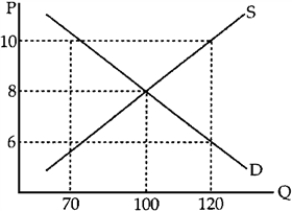 -In Figure 4-18, there would be a surplus of T-shirts if the price were
 (Multiple Choice)
4.9/5 (91)
(91) Figure 4-23
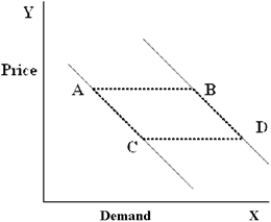 -In Figure 4-23, which movement will be caused by changes in income?
 (Multiple Choice)
4.9/5 (69)
(69) Suppose that in a free market 2,000 patients purchase an operation to receive an artificial heart at a price of $500,000 per operation.Without the heart, each patient will die.The government decides this price is too high and imposes a maximum price of $200,000.Everything else equal,
(Multiple Choice)
4.9/5 (69)
(69) 
Filters
- Essay(0)
- Multiple Choice(0)
- Short Answer(0)
- True False(0)
- Matching(0)