



 Chat with AI
Exam 4: Supply and Demand: an Initial Look

Exam 1: What Is Economics232 Questions
Exam 2: The Economy: Myth and Reality155 Questions
Exam 3: The Fundamental Economic Problem: Scarcity and Choice255 Questions
Exam 4: Supply and Demand: an Initial Look313 Questions
Exam 5: Consumer Choice: Individual and Market Demand206 Questions
Exam 6: Demand and Elasticity214 Questions
Exam 7: Production, Inputs, and Cost: Building Blocks for Supply Analysis221 Questions
Exam 8: Output, Price, and Profit: the Importance of Marginal Analysis194 Questions
Exam 9: Securities: Business Finance and the Economy: the Tail That Wags the Dog203 Questions
Exam 10: The Firm and the Industry Under Perfect Competition212 Questions
Exam 11: Monopoly208 Questions
Exam 12: Between Competition and Monopoly230 Questions
Exam 13: Limiting Market Power: Regulation and Antitrust155 Questions
Exam 14: The Case for Free Markets: the Price System225 Questions
Exam 15: The Shortcomings of Free Markets219 Questions
Exam 16: Externalities, the Environment, and Natural Resources222 Questions
Exam 17: Taxation and Resource Allocation221 Questions
Exam 18: Pricing the Factors of Production233 Questions
Exam 19: Labor and Entrepreneurship: the Human Inputs271 Questions
Exam 20: Poverty, Inequality, and Discrimination172 Questions
Exam 21: Is Useconomic Leadership Threatened75 Questions
Exam 22: An Introduction to Macroeconomics216 Questions
Exam 23: The Goals of Macroeconomic Policy212 Questions
Exam 24: Economic Growth: Theory and Policy228 Questions
Exam 25: Aggregate Demand and the Powerful Consumer219 Questions
Exam 26: Demand-Side Equilibrium: Unemployment or Inflation216 Questions
Exam 27: Bringing in the Supply Side: Unemployment and Inflation228 Questions
Exam 28: Managing Aggregate Demand: Fiscal Policy210 Questions
Exam 29: Money and the Banking System224 Questions
Exam 30: Monetary Policy: Conventional and Unconventional210 Questions
Exam 31: He Financial Crisis and the Great Recession66 Questions
Exam 32: The Debate Over Monetary and Fiscal Policy219 Questions
Exam 33: Budget Deficits in the Short and Long Run215 Questions
Exam 34: The Trade-Off Between Inflation and Unemployment219 Questions
Exam 35: International Trade and Comparative Advantage223 Questions
Exam 36: The International Monetary System: Order or Disorder218 Questions
Exam 37: Exchange Rates and the Macroeconomy219 Questions
Select questions type


Figure 4-14
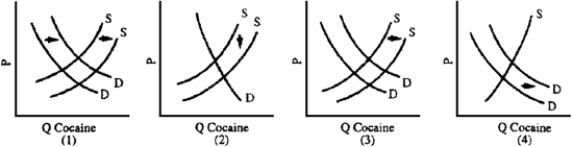 -Frustrated by the cost and ineffectiveness of the war on drugs, the U.S.government could consider "decriminalization" of the use and sale of cocaine.Critics contend that lower prices will expand drug use and that decriminalization will remove the stigma and danger from arrest associated with drug use, thus further increasing the demand and number of addicts.Which graph in Figure 4-14 best illustrates the critics' case?
 (Multiple Choice)
4.9/5  (64)
(64) What is the economic reasoning behind the proposal to legalize drugs?
(Multiple Choice)
4.8/5 (88)
(88) Which of the following is the correct way to describe equilibrium in a market?
(Multiple Choice)
4.9/5 (82)
(82) Exhibit 4-1
The following are the equations for the supply and demand curves in the market for weezils:
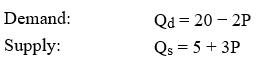 where Qd is the quantity demanded, Qs is the quantity supplied, and P is the price per weezil in dollars.
-Refer to Exhibit 4-1.If consumers decide that they want 20 percent fewer weezils at every price, the equation for the new demand curve for weezils will be
where Qd is the quantity demanded, Qs is the quantity supplied, and P is the price per weezil in dollars.
-Refer to Exhibit 4-1.If consumers decide that they want 20 percent fewer weezils at every price, the equation for the new demand curve for weezils will be (Multiple Choice)
4.7/5 (79)
(79) Explain the effect of the following changes on equilibrium price and quantity of a commodity:(a)increase in average incomes.(b)increase in population.
(Essay)
4.7/5 (84)
(84) Producers were accused of price gouging as the price of bottled water soared after Hurricane Andrew.Consumers clamored for price controls to keep bottled water at pre-Andrew levels.Use supply and demand analysis to graphically show the effect of setting a price ceiling on bottled water after Hurricane Andrew at the pre-hurricane equilibrium price.Use your graph to assist in explaining the likely unintended effects of such a price control.Be sure that your graph is completely and correctly labeled.
(Essay)
4.8/5 (72)
(72) From 2007 to 2008, the Federal Reserve System reduced interest rates, the price that borrowers pay.As a result, economists expected that the supply of money would
(Multiple Choice)
4.8/5 (75)
(75) A supply curve slopes upward because quantity supplied is higher when price is higher.
(True/False)
4.8/5 (88)
(88) Change in the price of a good causes the demand schedule for that good to shift.
(True/False)
4.9/5 (85)
(85)  -Which price in Figure 4-21 is equilibrium?
Scarcity and choice are the basic problems of economics; the supply and demand mechanism is the basic investigative tool of economics.
(True/False)
4.8/5 (76)
(76) The position of a demand curve is unaffected by changes in the price of the good.
(True/False)
5.0/5 (80)
(80) A shift in the demand curve for sailboats resulting from an increase in incomes will lead to
(Multiple Choice)
4.8/5 (77)
(77) If demand increases, the equilibrium price and equilibrium quantity will both fall, everything else being equal.
(True/False)
4.7/5 (78)
(78) 
Filters
- Essay(0)
- Multiple Choice(0)
- Short Answer(0)
- True False(0)
- Matching(0)