



 Chat with AI
Exam 4: Supply and Demand: an Initial Look

Exam 1: What Is Economics232 Questions
Exam 2: The Economy: Myth and Reality155 Questions
Exam 3: The Fundamental Economic Problem: Scarcity and Choice255 Questions
Exam 4: Supply and Demand: an Initial Look313 Questions
Exam 5: Consumer Choice: Individual and Market Demand206 Questions
Exam 6: Demand and Elasticity214 Questions
Exam 7: Production, Inputs, and Cost: Building Blocks for Supply Analysis221 Questions
Exam 8: Output, Price, and Profit: the Importance of Marginal Analysis194 Questions
Exam 9: Securities: Business Finance and the Economy: the Tail That Wags the Dog203 Questions
Exam 10: The Firm and the Industry Under Perfect Competition212 Questions
Exam 11: Monopoly208 Questions
Exam 12: Between Competition and Monopoly230 Questions
Exam 13: Limiting Market Power: Regulation and Antitrust155 Questions
Exam 14: The Case for Free Markets: the Price System225 Questions
Exam 15: The Shortcomings of Free Markets219 Questions
Exam 16: Externalities, the Environment, and Natural Resources222 Questions
Exam 17: Taxation and Resource Allocation221 Questions
Exam 18: Pricing the Factors of Production233 Questions
Exam 19: Labor and Entrepreneurship: the Human Inputs271 Questions
Exam 20: Poverty, Inequality, and Discrimination172 Questions
Exam 21: Is Useconomic Leadership Threatened75 Questions
Exam 22: An Introduction to Macroeconomics216 Questions
Exam 23: The Goals of Macroeconomic Policy212 Questions
Exam 24: Economic Growth: Theory and Policy228 Questions
Exam 25: Aggregate Demand and the Powerful Consumer219 Questions
Exam 26: Demand-Side Equilibrium: Unemployment or Inflation216 Questions
Exam 27: Bringing in the Supply Side: Unemployment and Inflation228 Questions
Exam 28: Managing Aggregate Demand: Fiscal Policy210 Questions
Exam 29: Money and the Banking System224 Questions
Exam 30: Monetary Policy: Conventional and Unconventional210 Questions
Exam 31: He Financial Crisis and the Great Recession66 Questions
Exam 32: The Debate Over Monetary and Fiscal Policy219 Questions
Exam 33: Budget Deficits in the Short and Long Run215 Questions
Exam 34: The Trade-Off Between Inflation and Unemployment219 Questions
Exam 35: International Trade and Comparative Advantage223 Questions
Exam 36: The International Monetary System: Order or Disorder218 Questions
Exam 37: Exchange Rates and the Macroeconomy219 Questions
Select questions type


Rent controls encourage investment in housing because they bring stability to the market.
(True/False)
4.8/5  (68)
(68) As price increases, additional suppliers are willing to produce a commodity.
(True/False)
4.8/5 (85)
(85) Some hotels in Myrtle Beach, South Carolina charge over $200 a night in the summer but sometimes as little as $99 a night in the winter.Use supply and demand analysis, including graphical and verbal explanation, for these winter "sales."
(Essay)
4.7/5 (78)
(78) The ____ the demand curve for a good, the ____ the change in equilibrium quantity after a shift of the supply curve.
(Multiple Choice)
4.8/5 (77)
(77) Which of the following suggests that the "laws" of supply and demand are being disobeyed?
(Multiple Choice)
5.0/5 (89)
(89) While demand shifts have an effect on equilibrium price and quantity, supply shifts have no such effect.
(True/False)
4.9/5 (73)
(73) A demand schedule is a table showing how the ____ of some product during a specified period of time changes as ____ changes, holding all other determinants of quantity demanded constant.
(Multiple Choice)
4.9/5 (88)
(88) American consumers decide to boycott grapes in support of the farm workers' union.Everything else being equal, the
(Multiple Choice)
5.0/5 (92)
(92) Which of the following will shift the demand curve for milk?
(Multiple Choice)
4.7/5 (83)
(83) If the price of hamburger rises, we would expect the demand for steak to shift to the right.
(True/False)
4.7/5 (86)
(86) An increase in demand will have what effect on equilibrium price and quantity?
(Multiple Choice)
4.8/5 (83)
(83) Rent controls and controls on other prices often aggravate the very problem they are intended to solve.
(True/False)
4.9/5 (90)
(90) 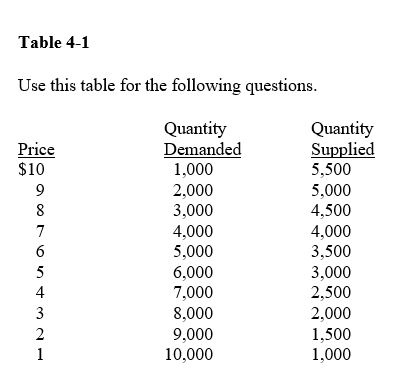 -Refer to Table 4-1.At $10, what is the surplus?
From 2007 to 2008, the Federal Reserve System reduced interest rates, the price which borrowers pay.As a result, economists expected the quantity of money demanded to
(Multiple Choice)
4.8/5 (77)
(77) 
Filters
- Essay(0)
- Multiple Choice(0)
- Short Answer(0)
- True False(0)
- Matching(0)