



 Chat with AI
Exam 14: Cardiovascular Physiology

Exam 1: Introduction to Physiology69 Questions
Exam 2: Molecular Interactions149 Questions
Exam 3: Compartmentation: Cells and Tissues160 Questions
Exam 4: Energy and Cellular Metabolism147 Questions
Exam 5: Membrane Dynamics144 Questions
Exam 6: Communication, Integration, and Homeostasis82 Questions
Exam 7: Introduction to the Endocrine System76 Questions
Exam 8: Neurons: Cellular and Network Properties229 Questions
Exam 9: The Central Nervous System107 Questions
Exam 10: Sensory Physiology175 Questions
Exam 11: Efferent Division: Autonomic and Somatic Motor Control78 Questions
Exam 12: Muscles106 Questions
Exam 13: Integrative Physiology I: Control of Body Movement76 Questions
Exam 14: Cardiovascular Physiology191 Questions
Exam 15: Blood Flow and the Control of Blood Pressure125 Questions
Exam 16: Blood114 Questions
Exam 17: Mechanics of Breathing118 Questions
Exam 18: Gas Exchange and Transport87 Questions
Exam 19: The Kidneys76 Questions
Exam 20: Integrative Physiology II: Fluid and Electrolyte Balance83 Questions
Exam 21: The Digestive System140 Questions
Exam 22: Metabolism and Energy Balance133 Questions
Exam 23: Endocrine Control of Growth and Metabolism100 Questions
Exam 24: The Immune System120 Questions
Exam 25: Integrative Physiology III: Exercise62 Questions
Exam 26: Reproduction and Development124 Questions
Select questions type


The action potentials of myocardial autorhythmic cells, are due to a combination of increasing Na²⁺ ________ and decreasing K⁺ ________.
(Multiple Choice)
4.9/5  (78)
(78) Left ventricular pressure is higher than pressure in the aorta during
(Multiple Choice)
4.9/5 (79)
(79) The term used to describe the amount of blood in the ventricle available to be pumped out of the heart during the next contraction is
(Multiple Choice)
5.0/5 (90)
(90) If blood pressure doubled at the same time that the peripheral resistance doubled, the blood flow through a vessel would be
(Multiple Choice)
4.7/5 (78)
(78) The chambers of the heart that pump blood into the arteries are the ________.
(Short Answer)
4.8/5 (82)
(82) Explain what is meant by the terms respiratory pump and skeletal muscle pump.Why are these important to the cardiovascular system?
(Essay)
4.8/5 (90)
(90) Miguel is a 25-year-old jogger with a target heart rate of 125 bpm.His resting pulse is 70 bpm.His blood volume is approximately 6.8 liters.At rest, his cardiac output is 6.3 liters/min.
A.What must his stroke volume be?
B.What might his EDV and ESV be?
C.During his workout, his heart rate increases to 125 bpm and his cardiac output to 12,500 mL/min.Do his SV, EDV, and ESV change with exercise?
(Essay)
4.7/5 (78)
(78) You are constructing working models of the heart for extra credit.Your first attempt failed because the cells separated from each other during beating.What structures did you omit, and why did this allow the heart to fall apart? You omitted the gap junctions in your second attempt.How would a real heart fail to function normally without gap junctions?
(Essay)
4.8/5 (78)
(78) A heart with cells contracting rapidly in a disorganized manner, with no effective pumping action, is said to be in ________.
(Short Answer)
4.9/5 (75)
(75) A person has a total blood volume of 5 L.Of this total, 4 liters is contained in the systemic circulation and 1 L in the pulmonary circulation.If the person has a cardiac output of 5 L/min:
A.how long will it take for a drop of blood leaving the left ventricle to return to the heart?
B.how long will it take a drop of blood to go from the right ventricle to the left ventricle?
(Essay)
4.8/5 (71)
(71) If there is a blockage between the AV node and the AV bundle, how will this affect the appearance of the electrocardiogram?
(Multiple Choice)
4.9/5 (83)
(83) ________ are blood vessels that carry blood away from the heart.
(Short Answer)
4.9/5 (77)
(77) If the membranes of the cardiac muscle cells in the SA node become more permeable to potassium ions,
(Multiple Choice)
4.8/5 (70)
(70) Match the change with the cardiovascular event described.
-During fasting, some capillary beds in the digestive tract are closed and therefore have no blood flow.Others are open to meet the minimal need of the tract for blood flow.During eating and as long as food is present in the tract, all capillary beds open to flow.What happens to total cross-sectional area of vessels in the digestive tract?
(Multiple Choice)
4.7/5 (65)
(65) Using the figure below (Fig.14.18 from your text), calculate the following values:
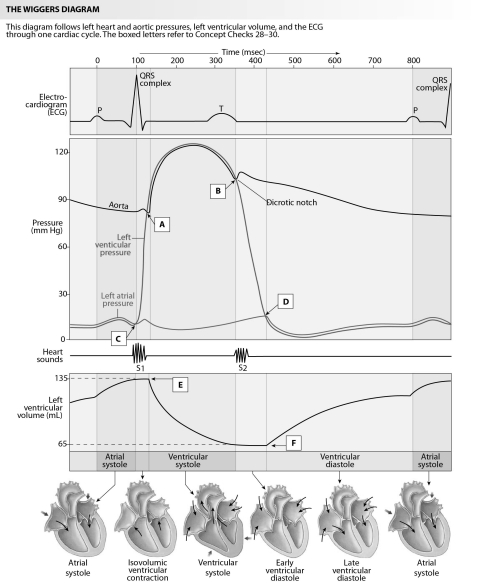 A.Heart rate
B.Stroke volume
C.Cardiac output
D.Mean Arterial Pressure
A.Heart rate
B.Stroke volume
C.Cardiac output
D.Mean Arterial Pressure (Essay)
4.7/5 (77)
(77) 
Filters
- Essay(0)
- Multiple Choice(0)
- Short Answer(0)
- True False(0)
- Matching(0)