



 Chat with AI
Exam 2: Behavioral science

Exam 1: Anatomy291 Questions
Exam 2: Behavioral science240 Questions
Exam 3: Biochemistry156 Questions
Exam 4: Biostatistics117 Questions
Exam 5: Embryology52 Questions
Exam 6: Genetics103 Questions
Exam 7: Histology24 Questions
Exam 8: Immunology129 Questions
Exam 9: Microbiology336 Questions
Exam 10: Pathology816 Questions
Exam 11: Pathophysiology464 Questions
Exam 12: Pharmacology538 Questions
Exam 13: Physiology272 Questions
Select questions type


A 52-year-old man comes to the office for follow-up to discuss the results of his colonoscopy. The physician informs the patient that a cancerous polyp was removed and that there is no evidence of invasive cancer at the resection margins. He is then reassured that he has an excellent prognosis. In response, the patient curses and shouts angrily, "Are you telling me I should be happy that you found cancer in the first place? You don't know what you're doing!" Which of the following is the most appropriate response to the patient?
(Multiple Choice)
4.8/5  (89)
(89) A 22-year-old woman is hospitalized due to suicidal ideation. The patient describes feelings of intense sadness, emptiness, and despair for the past week following the breakup of her month-long romantic relationship. For the past week, she has had difficulty falling and staying asleep but has had no change in appetite, energy level, or concentration. She feels betrayed by her boyfriend and is furious at her parents for turning against her. Since the breakup, the patient has been going to bars, engaging in unsafe sex, and drinking excessively. She describes having intense mood swings since adolescence and has a history of 2 suicide attempts involving an overdose of sleeping pills. Which of the following is the most likely diagnosis?
(Multiple Choice)
4.7/5 (84)
(84) A 29-year-old woman comes to the office due to persistent fatigue over the last 4 years. She has also felt unhappy during this period, ever since being let go from her previous job. The patient describes her fatigue as "having little energy to do things." When asked what she enjoys, she replies that "everything in life is a chore" and that she feels hopeless that her life will improve. The patient has no suicidal thoughts, problems with concentration, or changes in appetite or sleeping patterns. She used marijuana as a teenager and drinks 1 or 2 glasses of wine on weekends. Detailed workup, including urine toxicology screen, is negative. Which of the following is the most likely diagnosis?
(Multiple Choice)
4.8/5 (87)
(87) An 82-year-old man is brought to the office by his daughter due to behavioral changes. She reports that over the past year her father has become increasingly paranoid and frequently talks out loud as if in conversation when no one else is present. The daughter says, "During a recent argument, he accused me of being an imposter and stealing his personal items. Also, he used to be very clean, but his personal hygiene has gotten really bad. He also stopped watching baseball, which used to be his favorite hobby." The patient's medical history is significant for hypertension, hypercholesterolemia, and type 2 diabetes mellitus. Medications include lisinopril, simvastatin, and metformin. The patient has been unable to live independently for the past 2 years due to increasing forgetfulness and an inability to perform self-care. Vital signs are stable, and physical examination and laboratory evaluation are unremarkable. Which of the following is the most likely explanation for this patient's behavior?
(Multiple Choice)
4.9/5 (67)
(67) A 25-year-old woman comes to the office to follow up type 1 diabetes mellitus. She takes long- and short- acting insulin with good glycemic control and has no diabetes-related complications. She also has a history of hypothyroidism for which she takes levothyroxine. The patient has been covered under her parent's medical insurance for the last several years, but she recently started working full time for a company that provides a broad variety of employee insurance choices. She requests advice in choosing a health insurance plan. The patient has no disability and says that her main priority is low monthly payments. Which of the following insurance options would be most appropriate for this patient?
(Multiple Choice)
4.8/5 (81)
(81) A 27-year-old man is brought to a family therapist by his wife following a violent outburst in which he nearly injured her. They were having what seemed like a minor argument over a miscommunication about her being late when he suddenly flew into a rage, started shouting, and threw several plates against the wall. His wife is now threatening to leave him because similar episodes keep happening despite his promise to control his anger. The patient is remorseful and says, "I have been getting into trouble because of my temper since high school. Once I get angry, I feel out of control and it's impossible to stop." The patient has no medical history. He drinks beer and uses cannabis to relax approximately 2-3 times a month. Which of the following is the most likely diagnosis in this patient?
(Multiple Choice)
4.8/5 (76)
(76) A 49-year-old man comes to the office due to dysuria and hematuria. Vital signs are within normal limits and physical examination is unremarkable; urinalysis shows gross hematuria but is otherwise normal. The physician discusses potential causes and the need for a cystoscopy. The patient is told what to expect during the procedure and is given written information and a referral list with instructions on how to schedule an appointment with a urologist. He anxiously glances over the papers, saying he will make an appointment soon. Office staff had informed the physician that the patient was unable to follow the directions on the sign-in sheet and declined to fill out paperwork. Which of the following physician responses is the most appropriate at this time?
(Multiple Choice)
4.9/5 (75)
(75) A 66-year-old, previously healthy woman is admitted to the hospital due to recurrent hemoptysis. Chest x-ray obtained in the emergency department shows a 10-cm perihilar mass in the right lung. The patient undergoes bronchoscopic biopsy, which reveals non-small cell lung cancer. When entering her room to disclose the biopsy results, the physician sees the patient eating lunch with family members and friends who have been at her bedside since admission. They all appear anxious, and the patient tearfully tells the physician, "I've been dreading this moment. I think I already know what my test results are." Which of the following responses by the physician is most appropriate?
(Multiple Choice)
4.8/5 (75)
(75) A 54-year-old man comes to the office for an initial appointment to evaluate lower back pain. The patient's medical record shows that he has seen several physicians for back pain treatment. He has been prescribed multiple pain medications and physical rehabilitation services but often stopped prematurely or did not follow through with recommendations. At the beginning of the visit the patient says, "I'm tired of living with back pain, and I haven't been able to work in years. Nothing has helped me-at this point I might as well just give up and go on disability." Which of the following statements is the most appropriate initial response to this patient?
(Multiple Choice)
4.8/5 (92)
(92) A 14-year-old boy is brought to the office by his mother for a 6-month checkup for asthma. Although the patient's asthma is generally well controlled with long-acting agents, he has episodes of exercise-induced bronchoconstriction for which he was prescribed a short-acting beta agonist. His mother became concerned after the physical education teacher called from school saying that her son was refusing to participate in class. When asked about this, the patient said that it was easier to avoid exercising than to use an inhaler at school. Family history is significant for chronic obstructive pulmonary disease (COPD) in his maternal grandfather, heart disease in his father, and generalized anxiety disorder in his mother. Vital signs and physical examination are within normal limits. Which of the following factors would most likely increase this patient's adherence with bronchodilator administration?
(Multiple Choice)
4.8/5 (78)
(78) A 52-year-old woman comes to the office for a checkup. Her medical problems include hypertension and hypercholesterolemia. The patient has a long-standing relationship with her primary care physician, who has treated her children as well. During the examination, she confides that she has been "down" since her youngest child left for college 2 months ago. The patient is worried about her daughter being away from home for the first time and whether she will be successful at school. At work, the patient occasionally has lapses of concentration when worrying about whether her daughter is okay, but it has not affected her productivity. She says, "I still enjoy going out with my husband but all we do is talk about our kids." The patient has occasional insomnia and tension headaches but notes that these are nothing new. Physical examination is normal. Which of the following is the most likely explanation for this patient's condition?
(Multiple Choice)
4.9/5 (78)
(78) A 4-year-old boy is brought to the emergency department by his mother due to an asthma exacerbation. He has a history of poorly controlled asthma, with nonadherence to medication and follow-up visits. The mother works 2 jobs to support the family and says she has difficulty bringing the patient to appointments. On physical examination, a well-demarcated, round burn mark is seen on the patient's thigh. When asked about the burn, the patient says, "That happens every time I'm bad. My dad told me." His mother corrects him and says that it was an accident resulting from the boy "playing with the cigarette lighter in the car." Which of the following is the best next step in management of this patient?
(Multiple Choice)
4.9/5 (82)
(82) A 2-year-old boy is brought to the clinic by his mother, who is concerned about his language development. She says, "I know that children speak at different ages and he is still young, but I am concerned that his speech isn't progressing and that he needs to interact with other children more. His day care teacher says that he is shy and sits in a corner playing with his favorite truck. We have also been busy with a recent move and have not given him as much attention, which doesn't help." The patient's birth history, medical history, and audiology screening are unremarkable. His mother is 6 months pregnant with her second child, and the family moved to a new home 3 months ago. In the examination room, the patient sits in a corner, avoiding eye contact with the doctor and repeatedly spinning the wheels of a toy truck. He does not respond to his name. He makes occasional grunting sounds but says no fully formed words. When his mother tries to take his truck away, he begins screaming and pulls it back. Which of the following is the most likely diagnosis in this patient?
(Multiple Choice)
5.0/5 (93)
(93) A physician working on a rehabilitation unit discovers that a patient is experiencing an acute allergic reaction to a medication. The physician calls for nursing assistance. When the nurse arrives, the physician instructs the nurse to administer "25 mg of diphenhydramine IV push". Which of the following responses from the nurse ensures a lower risk of communication errors?
(Multiple Choice)
4.8/5 (68)
(68) A 55-year-old woman with advanced metastatic breast cancer comes to the emergency department for evaluation of dyspnea and tachycardia. The resident evaluates the patient and orders an echocardiogram, which confirms the presence of a pericardial effusion. The surgery team is consulted, and the surgical attending informs the patient that a pericardiocentesis is necessary. The attending surgeon then receives an urgent page and asks the resident to obtain informed consent for the procedure. The surgery resident has neither observed nor performed a pericardiocentesis but has recently read an article about malignant pericardial effusions. Which of the following is the most appropriate course of action by the resident?
(Multiple Choice)
4.8/5 (74)
(74) A 30-year-old man comes to the office due to depression. He describes a 4-week history of severely depressed mood, loss of motivation, loss of interest, and sleeping 12 hours a day. The patient has difficulty concentrating and worries that it is interfering with his work. He is pessimistic about the future but has no suicidal thoughts. The patient had a previous depressive episode in his 20s that responded rapidly to sertraline. He felt "really good and energetic" after a few days of treatment but discontinued the antidepressant a week later as he did not feel that he needed it. He drinks 1 or 2 beers on social occasions. Physical examination is normal. Which of the following would be most important to assess prior to initiating pharmacologic treatment for this patient?
(Multiple Choice)
4.9/5 (84)
(84) A 70-year-old woman comes to the physician for a new patient visit. She reports intermittent headaches and poor sleep. During review of systems, she also describes a sensation of incomplete emptying of the bladder and constipation. The patient has a history of migraines and chronic insomnia. Her other medical problems include hypercholesterolemia and osteoarthritis. Her medications include amitriptyline prescribed for migraines, simvastatin, diclofenac, and over-the-counter diphenhydramine for insomnia. Which of the following is the most appropriate next step in management of this patient?
(Multiple Choice)
4.9/5 (85)
(85) A 29-year-old man comes to the urgent care clinic for evaluation of a sore throat and nasal congestion. After waiting for 2 hours, he is taken to an examination room. Vital signs are within normal limits. When the physician enters the room, the patient loudly says, "I've been here for hours, and there were barely any people in the waiting room. I'm missing work to be here." In addition to thanking the patient for waiting, which of the following initial responses by the physician is most appropriate?
(Multiple Choice)
4.8/5 (70)
(70) A 21-year-old woman comes to the office due to constipation and vague abdominal pain. She says, "For the last few months I have felt bloated and my stomach doesn't feel right." Review of systems is notable for irregular menses and occasional fatigue. Medical history is significant for a broken femur at age 6 but is otherwise noncontributory. Family history is significant for Graves disease in her father and primary myelofibrosis in her paternal grandmother. The patient smokes a pack of cigarettes daily and drinks wine when relaxing with friends. She does not use illicit drugs. Temperature is 37.2 C (99 F), blood pressure is 90/60 mm Hg, pulse is 118/min, and respirations are 16/min. BMI is 25.6 kg/m2. Physical examination shows eroded enamel of the teeth.Laboratory results are as follows: 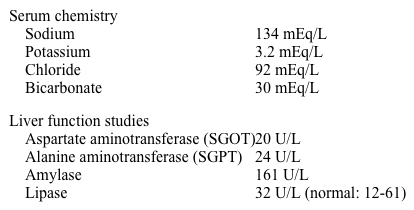 Which of the following is the most likely cause of this patient's condition?
 (Multiple Choice)
4.8/5 (79)
(79) A 63-year-old woman with a history of metastatic breast cancer comes to the office due to depressed mood. Over the past month, the patient has become increasingly sad and frequently cries when thinking about her poor prognosis and dying. She has lost 4.5 kg (10 lb) over the past month. Her energy level is low, and she has difficulty falling asleep and frequent nighttime awakenings. The patient has become very withdrawn, doesn't answer the phone, and no longer looks forward to family visits. She feels bad about not wanting to be around her grandchildren. On mental status examination, the patient is alert and oriented with depressed mood and affect. She has no suicidal ideation. Which of the following symptoms is most indicative of major depressive disorder in this patient?
(Multiple Choice)
4.7/5 (83)
(83) 
Filters
- Essay(0)
- Multiple Choice(0)
- Short Answer(0)
- True False(0)
- Matching(0)