



 Chat with AI
Exam 26: Monetary Policy

Exam 1: Introducing the Economic Way of Thinking85 Questions
Exam 2: Production Possibilities Opportunity Cost and Economic Growth107 Questions
Exam 3: Market Demand and Supply176 Questions
Exam 4: Markets in Action137 Questions
Exam 5: Price Elasticity of Demand and Supply151 Questions
Exam 6: Consumer Choice Theory96 Questions
Exam 7: Production Costs131 Questions
Exam 8: Perfect Competition126 Questions
Exam 9: Monopoly81 Questions
Exam 10: Monopolistic Competition and Oligopoly97 Questions
Exam 11: Labor Markets105 Questions
Exam 12: Income Distribution Poverty and Discrimination57 Questions
Exam 13: Antitrust and Regulation96 Questions
Exam 14: Environmental Economics47 Questions
Exam 15: Gross Domestic Product109 Questions
Exam 16: Business Cycles and Unemployment94 Questions
Exam 17: Inflation56 Questions
Exam 18: The Keynesian Model111 Questions
Exam 19: The Keynesian Model in Action105 Questions
Exam 20: Aggregate Demand and Supply94 Questions
Exam 21: Fiscal Policy108 Questions
Exam 22: The Public Sector55 Questions
Exam 23: Federal Deficits Surpluses and the National Debt42 Questions
Exam 24: Money and the Federal Reserve System75 Questions
Exam 25: Money Creation117 Questions
Exam 26: Monetary Policy106 Questions
Exam 27: The Phillips Curve and Expectations Theory59 Questions
Exam 28: International Trade and Finance127 Questions
Exam 29: Economies in Transition46 Questions
Exam 30: Growth and the Less Developed Countries55 Questions
Exam 31: Understanding Direct and Inverse Relationships between Variables172 Questions
Select questions type


One reason that people hold money is to pay for unexpected car repairs and other unpredictable expenses. This motive for holding money is called:
(Multiple Choice)
4.8/5  (80)
(80) Keynesians identify three principal motives for demanding money. They are the:
(Multiple Choice)
4.8/5 (81)
(81) According to Keynesian economists, which of the following is not a consequence of increasing the money supply?
(Multiple Choice)
4.9/5 (73)
(73) A decrease in the interest rate, other things being equal, causes a(n):
(Multiple Choice)
4.9/5 (67)
(67) Exhibit 16-6 Money, investment and product markets
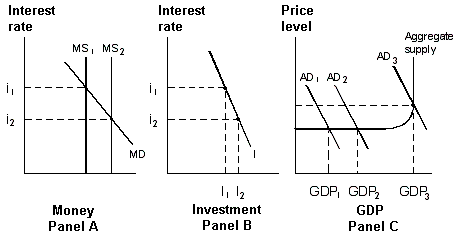 In Exhibit 16-6, if the Fed believes the economy is at AD3, how might it engineer a decline in the price level?
 (Multiple Choice)
4.8/5 (77)
(77) Which of the following policies would be most likely to reduce the rate of inflation?
(Multiple Choice)
4.9/5 (83)
(83) Assume the Fed decreases the money supply and the demand for money curve is fixed. In response, people will:
(Multiple Choice)
4.8/5 (73)
(73) Monetarists reject using discretionary monetary policy as an effective stabilization tool because they believe:
(Multiple Choice)
4.9/5 (80)
(80) If at the prevailing interest rate the quantity of money demanded is $2 trillion, and the supply of money is $1.5 trillion, then which of the following is true ?
(Multiple Choice)
4.9/5 (72)
(72) Which economic theory argues that changes in velocity are predictable and the crowding-out effect is substantial?
(Multiple Choice)
4.9/5 (84)
(84) The quantity theory of money assumes that the velocity of money:
(Multiple Choice)
4.7/5 (91)
(91) Exhibit 16-5 Money, investment and product markets
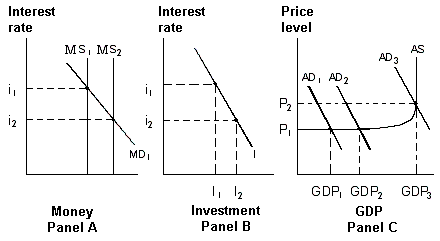 In Exhibit 16-5, when the money supply increases from MS1 to MS2, the equilibrium interest rate:
 (Multiple Choice)
4.8/5 (81)
(81) Which type of demand for money causes the demand for money curve to slope downward?
(Multiple Choice)
4.9/5 (80)
(80) Which of the following explains why the demand for money curve has an inverse relationship between the interest rates and the quantity of money demanded?
(Multiple Choice)
4.8/5 (79)
(79) Keynes called the money people hold in order to pay unforeseen or unexpected expenses the:
(Multiple Choice)
4.8/5 (68)
(68) 
Filters
- Essay(0)
- Multiple Choice(0)
- Short Answer(0)
- True False(0)
- Matching(0)