



 Chat with AI
Exam 11: Labor Markets

Exam 1: Introducing the Economic Way of Thinking85 Questions
Exam 2: Production Possibilities Opportunity Cost and Economic Growth107 Questions
Exam 3: Market Demand and Supply176 Questions
Exam 4: Markets in Action137 Questions
Exam 5: Price Elasticity of Demand and Supply151 Questions
Exam 6: Consumer Choice Theory96 Questions
Exam 7: Production Costs131 Questions
Exam 8: Perfect Competition126 Questions
Exam 9: Monopoly81 Questions
Exam 10: Monopolistic Competition and Oligopoly97 Questions
Exam 11: Labor Markets105 Questions
Exam 12: Income Distribution Poverty and Discrimination57 Questions
Exam 13: Antitrust and Regulation96 Questions
Exam 14: Environmental Economics47 Questions
Exam 15: Gross Domestic Product109 Questions
Exam 16: Business Cycles and Unemployment94 Questions
Exam 17: Inflation56 Questions
Exam 18: The Keynesian Model111 Questions
Exam 19: The Keynesian Model in Action105 Questions
Exam 20: Aggregate Demand and Supply94 Questions
Exam 21: Fiscal Policy108 Questions
Exam 22: The Public Sector55 Questions
Exam 23: Federal Deficits Surpluses and the National Debt42 Questions
Exam 24: Money and the Federal Reserve System75 Questions
Exam 25: Money Creation117 Questions
Exam 26: Monetary Policy106 Questions
Exam 27: The Phillips Curve and Expectations Theory59 Questions
Exam 28: International Trade and Finance127 Questions
Exam 29: Economies in Transition46 Questions
Exam 30: Growth and the Less Developed Countries55 Questions
Exam 31: Understanding Direct and Inverse Relationships between Variables172 Questions
Select questions type


Exhibit 11-13 A monopsonist's supply and marginal revenue product data
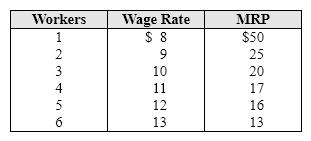 Use Exhibit 11-13. What wage rate will the monopsonist pay the workers?
Free
(Multiple Choice)
4.9/5  (82)
(82) Correct Answer: Verified
C
According to the economic theory of labor markets, if unions are successful in raising wages, with no accompanying increase in labor productivity, then which of the following is true ?
Free
(Multiple Choice)
4.8/5 (77)
(77) Correct Answer:Verified
VerifiedA
BigBiz, a local monopsonist, currently hires 50 workers and pays them $6 per hour. To attract an additional worker to its labor force, BigBiz would have to raise the wage rate to $6.25 per hour. What is BigBiz's marginal factor cost?
Free
(Multiple Choice)
4.8/5 (78)
(78) Correct Answer:Verified
VerifiedC
Which of the following will decrease the demand for fast-food burger workers' labor?
(Multiple Choice)
4.7/5 (83)
(83) Exhibit 11-13 A monopsonist's supply and marginal revenue product data
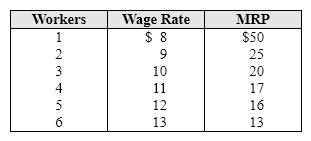 In Exhibit 11-13, how many workers will the monopsonist hire?
 (Multiple Choice)
4.9/5 (92)
(92) The following chart indicates the reductions in total losses due to theft if a jewelry store hires additional security guards.
 If the security guards can be hired for $45 per day, how many guards should the shop hire?
 (Multiple Choice)
4.9/5 (72)
(72) A union may attempt to obtain stricter certification requirements or longer apprenticeships. These changes would raise workers' wages because they:
(Multiple Choice)
5.0/5 (74)
(74) A decrease in the marginal product of labor would be represented by a(n):
(Multiple Choice)
5.0/5 (80)
(80) Suppose the price of HD televisions decreases. As a result, the
(Multiple Choice)
4.8/5 (71)
(71) What happens to the marginal product of labor when the market price of the good produced increases?
(Multiple Choice)
4.9/5 (83)
(83) A worker's accumulated investment in education, training, experience, and health is called:
(Multiple Choice)
4.9/5 (69)
(69) Lorna's Lumberyard is a monopsony. Lorna estimates that at a wage of $10, 100 workers would be willing to work for her. Similarly, at a wage of $12, 200 workers would be willing to work. Her marginal factor cost is:
(Multiple Choice)
4.8/5 (88)
(88) Describe the two basic strategies of unions in increasing wage rates for their members.
(Essay)
4.8/5 (69)
(69) Which of the following is the best example of an investment in human capital?
(Multiple Choice)
4.9/5 (75)
(75) 
Filters
- Essay(0)
- Multiple Choice(0)
- Short Answer(0)
- True False(0)
- Matching(0)