



 Chat with AI
Exam 11: Labor Markets

Exam 1: Introducing the Economic Way of Thinking85 Questions
Exam 2: Production Possibilities Opportunity Cost and Economic Growth107 Questions
Exam 3: Market Demand and Supply176 Questions
Exam 4: Markets in Action137 Questions
Exam 5: Price Elasticity of Demand and Supply151 Questions
Exam 6: Consumer Choice Theory96 Questions
Exam 7: Production Costs131 Questions
Exam 8: Perfect Competition126 Questions
Exam 9: Monopoly81 Questions
Exam 10: Monopolistic Competition and Oligopoly97 Questions
Exam 11: Labor Markets105 Questions
Exam 12: Income Distribution Poverty and Discrimination57 Questions
Exam 13: Antitrust and Regulation96 Questions
Exam 14: Environmental Economics47 Questions
Exam 15: Gross Domestic Product109 Questions
Exam 16: Business Cycles and Unemployment94 Questions
Exam 17: Inflation56 Questions
Exam 18: The Keynesian Model111 Questions
Exam 19: The Keynesian Model in Action105 Questions
Exam 20: Aggregate Demand and Supply94 Questions
Exam 21: Fiscal Policy108 Questions
Exam 22: The Public Sector55 Questions
Exam 23: Federal Deficits Surpluses and the National Debt42 Questions
Exam 24: Money and the Federal Reserve System75 Questions
Exam 25: Money Creation117 Questions
Exam 26: Monetary Policy106 Questions
Exam 27: The Phillips Curve and Expectations Theory59 Questions
Exam 28: International Trade and Finance127 Questions
Exam 29: Economies in Transition46 Questions
Exam 30: Growth and the Less Developed Countries55 Questions
Exam 31: Understanding Direct and Inverse Relationships between Variables172 Questions
Select questions type


Exhibit 11-12 A monopsonist
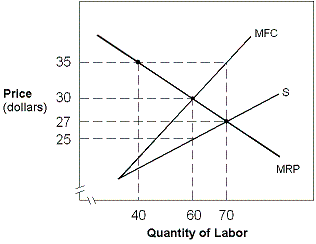 In Exhibit 11-12, we know this exhibit shows a monopsonistic labor market because:
 (Multiple Choice)
4.9/5  (80)
(80) Suppose a firm can hire 100 workers at $8.00 per hour but must pay $8.05 per hour to hire 101 workers. Marginal factor cost (MFC) for the 101st worker is approximately equal to:
(Multiple Choice)
4.9/5 (83)
(83) An increase in demand for French fries will cause equilibrium wage rates:
(Multiple Choice)
5.0/5 (62)
(62) Exhibit 11-2 Labor and output data
 In Exhibit 11-2, if product price is fixed at $5, the MRP of the third worker is equal to:
 (Multiple Choice)
4.9/5 (79)
(79) Exhibit 11-4 Supply and demand curves for food servers
 If the equilibrium wage rate in Exhibit 11-4 increased, the cause could be that:
 (Multiple Choice)
4.9/5 (76)
(76) If an employer currently finds that the MRP of its labor resources equals $67, and the MFC equals $56, what would you advise the firm to do?
(Multiple Choice)
4.9/5 (74)
(74) If a union is able to successfully lobby Congress to limit imports of rival products, and thus to raise the demand (and thus price) for the goods or services they make, then which of the following best describes the outcome?
(Multiple Choice)
4.8/5 (89)
(89) If cats become a more popular pet in the United States than they are now, what can we expect to happen to the market for cat food workers?
(Multiple Choice)
4.7/5 (88)
(88) Which of the following is the most accurate definition of a worker's marginal revenue product?
(Multiple Choice)
4.7/5 (74)
(74) Exhibit 11-11 Labor wage and cost data
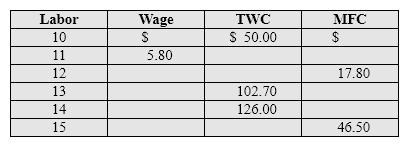 In Exhibit 11-11, the total wage cost of hiring 12 employees is equal to:
 (Multiple Choice)
4.8/5 (82)
(82) Exhibit 11-4 Supply and demand curves for food servers
 In Exhibit 11-4, suppose that in the interest of boosting incomes of the working poor, Congress imposes a minimum wage of $6.00 per hour. This minimum wage rate creates a(n):
 (Multiple Choice)
4.8/5 (71)
(71) Harold Brown runs a company that sells encyclopedia sets for $250 each. When he employs 10 workers, they can sell 60 sets per week, while only 54 sets are sold when 9 workers are employed. What is the weekly marginal revenue product of the tenth worker?
(Multiple Choice)
4.9/5 (79)
(79) Exhibit 11-8 A labor market
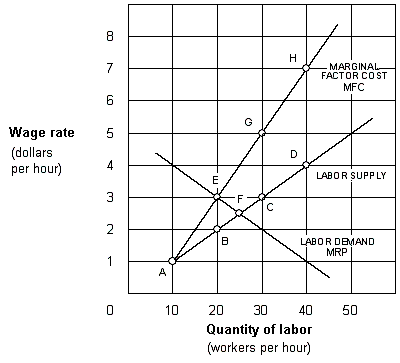 If the labor market shown in Exhibit 11-8 is competitive, the wage rate and number of workers employed will be determined at point:
(Multiple Choice)
4.8/5 (88)
(88) Given the same marginal revenue product (MRP) and supply curves, the equilibrium quantity of labor employed in a monopsonistic labor market will be:
(Multiple Choice)
4.9/5 (82)
(82) In Exhibit 11-5, at what wage rate will the firms stop hiring these workers?
(Multiple Choice)
4.9/5 (86)
(86) Explain how the presence of a superstar basketball player can increase the marginal revenue product of the other players on the team.
(Essay)
4.8/5 (71)
(71) 
Filters
- Essay(0)
- Multiple Choice(0)
- Short Answer(0)
- True False(0)
- Matching(0)