



 Chat with AI
Exam 16: Business Cycles and Unemployment

Exam 1: Introducing the Economic Way of Thinking85 Questions
Exam 2: Production Possibilities Opportunity Cost and Economic Growth107 Questions
Exam 3: Market Demand and Supply176 Questions
Exam 4: Markets in Action137 Questions
Exam 5: Price Elasticity of Demand and Supply151 Questions
Exam 6: Consumer Choice Theory96 Questions
Exam 7: Production Costs131 Questions
Exam 8: Perfect Competition126 Questions
Exam 9: Monopoly81 Questions
Exam 10: Monopolistic Competition and Oligopoly97 Questions
Exam 11: Labor Markets105 Questions
Exam 12: Income Distribution Poverty and Discrimination57 Questions
Exam 13: Antitrust and Regulation96 Questions
Exam 14: Environmental Economics47 Questions
Exam 15: Gross Domestic Product109 Questions
Exam 16: Business Cycles and Unemployment94 Questions
Exam 17: Inflation56 Questions
Exam 18: The Keynesian Model111 Questions
Exam 19: The Keynesian Model in Action105 Questions
Exam 20: Aggregate Demand and Supply94 Questions
Exam 21: Fiscal Policy108 Questions
Exam 22: The Public Sector55 Questions
Exam 23: Federal Deficits Surpluses and the National Debt42 Questions
Exam 24: Money and the Federal Reserve System75 Questions
Exam 25: Money Creation117 Questions
Exam 26: Monetary Policy106 Questions
Exam 27: The Phillips Curve and Expectations Theory59 Questions
Exam 28: International Trade and Finance127 Questions
Exam 29: Economies in Transition46 Questions
Exam 30: Growth and the Less Developed Countries55 Questions
Exam 31: Understanding Direct and Inverse Relationships between Variables172 Questions
Select questions type


Variables that change before real GDP changes are measured by the:

Free
(Multiple Choice)
4.9/5  (98)
(98) Correct Answer: Verified
D
What is full employment? What are the different kinds of unemployment? What constitutes the natural (normal) rate of unemployment?
Free
(Essay)
5.0/5 (87)
(87) Correct Answer:Verified
VerifiedFull employment exists when approximately 95 percent of the civilian labor force is employed. This implies a natural rate of unemployment of approximately 5 percent. The natural rate of unemployment consists of the frictionally and structurally unemployed. The only other type of unemployment is cyclical unemployment.
Which of the following is not a lagging indicator?
Free
(Multiple Choice)
4.9/5 (91)
(91) Correct Answer:Verified
VerifiedB
Exhibit 6-1 Business cycle
 In Exhibit 6-1, the recovery phase of the business cycle can be represented by points:
 (Multiple Choice)
4.9/5 (76)
(76) Which one of the following people is not a member of the labor force?
(Multiple Choice)
4.8/5 (77)
(77) The period of declining growth in real GDP between the peak of the business cycle and the trough is called a(n):
(Multiple Choice)
4.8/5 (80)
(80) Susan Greenberg, who works in a typewriter factory, becomes unemployed because people start buying personal computers instead of typewriters. Susan can best be described as:
(Multiple Choice)
4.8/5 (82)
(82) Exhibit 16-2 Unemployment categories
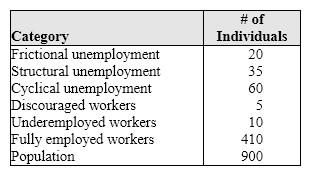 Using the information in Exhibit 16-2, the natural rate of unemployment is
 (Multiple Choice)
4.9/5 (69)
(69) Martin Shore lost his job when General Motors closed down its local plant. He has been visiting the personnel offices of the other factories in the area, looking for a new job. He is:
(Multiple Choice)
4.9/5 (79)
(79) Consider a broom factory that permanently closes because of foreign competition. If the broom factory's workers cannot find new jobs because their skills are no longer marketable, then they are classified as:
(Multiple Choice)
4.8/5 (87)
(87) Exhibit 6-1 Business cycle
 In Exhibit 6-1, point E represents:
 (Multiple Choice)
4.9/5 (70)
(70) Which of the following is a leading business cycle indicator?
(Multiple Choice)
4.9/5 (89)
(89) Bob is unemployed because his skills have become obsolete due to technological advances. This is ____ unemployment.
(Multiple Choice)
4.8/5 (72)
(72) Exhibit 16-2 Unemployment categories
 Find the BLS's rate of unemployment from the following data: frictional unemployment = 150, structural unemployment = 200, cyclical unemployment = 225, discouraged workers = 25, underemployed workers = 75, fully employed workers = 850, total population = 2,000.
 (Multiple Choice)
4.9/5 (70)
(70) Consider an economy made up of 100 people, 60 of whom old jobs, 10 of whom are looking for work, and 15 of whom are retired. The number counted as unemployed is:
(Multiple Choice)
5.0/5 (69)
(69) What generally causes the business cycle? What are the four phases of a single business cycle? What are the problems associated with the business cycle?
(Essay)
4.8/5 (94)
(94) 
Filters
- Essay(0)
- Multiple Choice(0)
- Short Answer(0)
- True False(0)
- Matching(0)