



 Chat with AI
Exam 4: Markets in Action

Exam 1: Introducing the Economic Way of Thinking85 Questions
Exam 2: Production Possibilities Opportunity Cost and Economic Growth107 Questions
Exam 3: Market Demand and Supply176 Questions
Exam 4: Markets in Action137 Questions
Exam 5: Price Elasticity of Demand and Supply151 Questions
Exam 6: Consumer Choice Theory96 Questions
Exam 7: Production Costs131 Questions
Exam 8: Perfect Competition126 Questions
Exam 9: Monopoly81 Questions
Exam 10: Monopolistic Competition and Oligopoly97 Questions
Exam 11: Labor Markets105 Questions
Exam 12: Income Distribution Poverty and Discrimination57 Questions
Exam 13: Antitrust and Regulation96 Questions
Exam 14: Environmental Economics47 Questions
Exam 15: Gross Domestic Product109 Questions
Exam 16: Business Cycles and Unemployment94 Questions
Exam 17: Inflation56 Questions
Exam 18: The Keynesian Model111 Questions
Exam 19: The Keynesian Model in Action105 Questions
Exam 20: Aggregate Demand and Supply94 Questions
Exam 21: Fiscal Policy108 Questions
Exam 22: The Public Sector55 Questions
Exam 23: Federal Deficits Surpluses and the National Debt42 Questions
Exam 24: Money and the Federal Reserve System75 Questions
Exam 25: Money Creation117 Questions
Exam 26: Monetary Policy106 Questions
Exam 27: The Phillips Curve and Expectations Theory59 Questions
Exam 28: International Trade and Finance127 Questions
Exam 29: Economies in Transition46 Questions
Exam 30: Growth and the Less Developed Countries55 Questions
Exam 31: Understanding Direct and Inverse Relationships between Variables172 Questions
Select questions type


Much of the nation's coal is extracted by strip mining. This process leaves a huge barren hole in the ground when complete, and the cost of replanting the trees is approximately $10 per ton of coal. Burning the coal for electricity causes air pollution. No one knows how much damage the air pollution causes, but we know that for another $10 per ton the power plant can be outfitted with a pollution control device. What is one measure of the true social cost of coal fired electricity, in dollars per ton?

Free
(Multiple Choice)
4.9/5  (93)
(93) Correct Answer: Verified
D
If a price ceiling is imposed, then:
Free
(Multiple Choice)
5.0/5 (93)
(93) Correct Answer:Verified
VerifiedC
Exhibit 4-7 Demand and supply schedules for movie tickets
Price
Quantity
Demanded
Quantity
Supplied
$10
200
500
8
240
470
6
370
420
4
390
390
2
410
310
In Exhibit 4-7, a 100 unit decrease in quantity demanded at every price level would cause the new equilibrium price to become:
|
| Quantity | Quantity |
| $10 | 200 | 500 |
| 8 | 240 | 470 |
| 6 | 370 | 420 |
| 4 | 390 | 390 |
| 2 | 410 | 310 |
Free
(Multiple Choice)
4.8/5 (85)
(85) Correct Answer:Verified
VerifiedD
The minimum price for a good set by the government above the equilibrium price is called a:
(Multiple Choice)
4.7/5 (87)
(87) When the consumption of a good generates an external benefit:
(Multiple Choice)
4.7/5 (68)
(68) After a hurricane in Florida knocked out the regional water supply for several days, the demand for bottled water increased sharply. In a market economy, how will this increase in demand affect the equilibrium price and quantity of bottled water?
(Multiple Choice)
4.7/5 (82)
(82) Exhibit 4-5 Supply and demand curves for computers
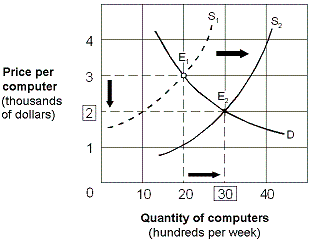 Which of the following changes could cause the computer market to change as shown in Exhibit 4-5?
 (Multiple Choice)
4.9/5 (86)
(86) Exhibit 4-3 Supply and demand curves
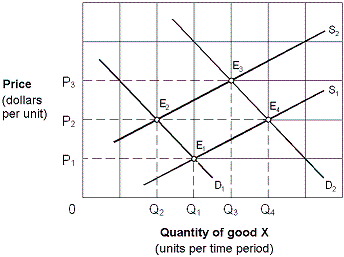 In Exhibit 4-3, an increase in demand would cause a movement from which equilibrium point to another, other things being equal?
 (Multiple Choice)
4.9/5 (86)
(86) Exhibit 4-3 Supply and demand curves
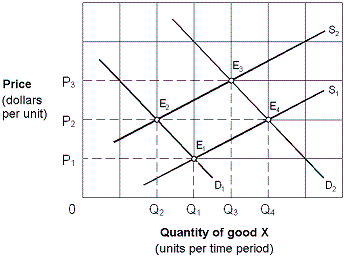 Initially the market shown in Exhibit 4-3 is in equilibrium at P2, Q2 (E2). Changes in market conditions result in a new equilibrium at P2, Q4 (E4). This change is stated as a(n):
 (Multiple Choice)
4.7/5 (77)
(77) Cindy discovers that when she goes to the beach, she does not have to bring her radio. She can put her blanket near someone who has a radio and listen all day (without having to carry her radio, get sand in her speakers, or buy new batteries). This is an example of:
(Multiple Choice)
4.8/5 (96)
(96) Exhibit 4-8 Demand and supply curves
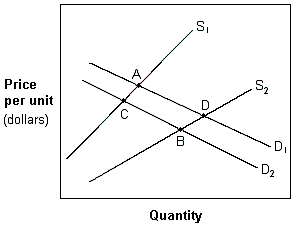 In Exhibit 4-8, a movement from A to B in which price has decreased and quantity has increased is best explained by a(n):
 (Multiple Choice)
4.8/5 (73)
(73) When airplanes take off and land at Logan airport, residents of East Boston complain about the noise. The same planes make the same noise during the trip to Boston from Paris, but there are no ____ for most of the trip because ____.
(Multiple Choice)
4.8/5 (82)
(82) Consider the market for chicken. Assuming that chicken and beef are substitutes, an increase in the price of beef will:
(Multiple Choice)
4.9/5 (79)
(79) Exhibit 4-1 Supply and demand data
Price
Quantity
demanded
Quantity
supplied
$1.00
500
50
1.50
450
150
2.00
400
250
2.50
300
300
3.00
150
350
In Exhibit 4-1, suppose that a reduction in the price of an important input used to produce the good causes an increase in quantity supplied of 150 units at every price level. Assuming that demand does not change, the new equilibrium price will be:
|
| Quantity | Quantity |
| $1.00 | 500 | 50 |
| 1.50 | 450 | 150 |
| 2.00 | 400 | 250 |
| 2.50 | 300 | 300 |
| 3.00 | 150 | 350 |
(Multiple Choice)
4.8/5 (82)
(82) Consider the market for grapes. An increase in the wage paid to grape pickers will cause the:
(Multiple Choice)
4.9/5 (60)
(60) When there are positive externalities associated with the consumption of a good, we can expect the market:
(Multiple Choice)
4.8/5 (82)
(82) Ceteris paribus , if consumer tastes change so that more people are eating broccoli, then what will happen to the market equilibrium for cabbage, a substitute good for broccoli?
(Multiple Choice)
4.8/5 (69)
(69) If the equilibrium price of aspirin is $2.50 and a price ceiling is imposed at $3.00, the market will have a(n):
(Multiple Choice)
4.8/5 (77)
(77) 
Filters
- Essay(0)
- Multiple Choice(0)
- Short Answer(0)
- True False(0)
- Matching(0)