



 Chat with AI
Exam 4: Markets in Action

Exam 1: Introducing the Economic Way of Thinking85 Questions
Exam 2: Production Possibilities Opportunity Cost and Economic Growth107 Questions
Exam 3: Market Demand and Supply176 Questions
Exam 4: Markets in Action137 Questions
Exam 5: Price Elasticity of Demand and Supply151 Questions
Exam 6: Consumer Choice Theory96 Questions
Exam 7: Production Costs131 Questions
Exam 8: Perfect Competition126 Questions
Exam 9: Monopoly81 Questions
Exam 10: Monopolistic Competition and Oligopoly97 Questions
Exam 11: Labor Markets105 Questions
Exam 12: Income Distribution Poverty and Discrimination57 Questions
Exam 13: Antitrust and Regulation96 Questions
Exam 14: Environmental Economics47 Questions
Exam 15: Gross Domestic Product109 Questions
Exam 16: Business Cycles and Unemployment94 Questions
Exam 17: Inflation56 Questions
Exam 18: The Keynesian Model111 Questions
Exam 19: The Keynesian Model in Action105 Questions
Exam 20: Aggregate Demand and Supply94 Questions
Exam 21: Fiscal Policy108 Questions
Exam 22: The Public Sector55 Questions
Exam 23: Federal Deficits Surpluses and the National Debt42 Questions
Exam 24: Money and the Federal Reserve System75 Questions
Exam 25: Money Creation117 Questions
Exam 26: Monetary Policy106 Questions
Exam 27: The Phillips Curve and Expectations Theory59 Questions
Exam 28: International Trade and Finance127 Questions
Exam 29: Economies in Transition46 Questions
Exam 30: Growth and the Less Developed Countries55 Questions
Exam 31: Understanding Direct and Inverse Relationships between Variables172 Questions
Select questions type


Exhibit 4-3 Supply and demand curves
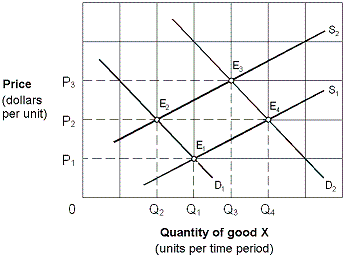 The market shown in Exhibit 4-3 is initially in equilibrium at E4. Changes in market conditions result in a new equilibrium at E3. This change is stated as a(n):
 (Multiple Choice)
4.9/5  (79)
(79) What are market failures? Discuss examples of market failures. What can government do to improve the results of market failures?
(Essay)
5.0/5 (81)
(81) Exhibit 4-2 Supply and demand curves
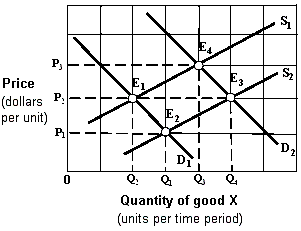 The market shown in Exhibit 4-2 is initially in equilibrium at point E3. Union negotiations for workers producing good X result in a wage increase. Other things being equal, which of the following is the new equilibrium after this wage increase is in effect?
 (Multiple Choice)
4.7/5 (81)
(81) Exhibit 4-3 Supply and demand curves
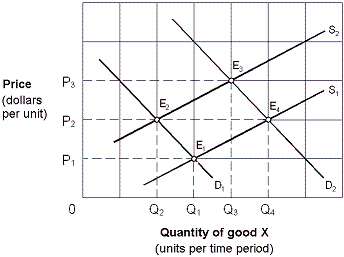 In Exhibit 4-3, which of the following might cause a shift from S2 to S1?
 (Multiple Choice)
4.9/5 (88)
(88) The government would use production taxes to remedy the problem of substantial:
(Multiple Choice)
4.9/5 (81)
(81) Which of the following is the most likely effect of lower apple juice prices on the price and quantity purchased of orange juice, a substitute product?
(Multiple Choice)
5.0/5 (75)
(75) Suppose the market for "soda X" is in equilibrium. If the FDA announced today that this soda has been proven to cause a fatal disease, what would be most likely to happen to the equilibrium price and equilibrium quantity of soda X?
(Multiple Choice)
4.8/5 (71)
(71) Exhibit 4-6 Demand and supply curves
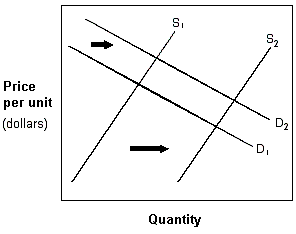 In Exhibit 4-6, the demand curve has shifted from D1 to D2 and, simultaneously, the supply curve has shifted from S1 to S2. Describe these actions in this market.
 (Multiple Choice)
4.8/5 (87)
(87) A competitive market economy is unlikely to provide an efficient quantity of some public goods because:
(Multiple Choice)
4.7/5 (84)
(84) If the demand for a good decreased, what would be the effect on the equilibrium price and quantity?
(Multiple Choice)
4.8/5 (90)
(90) If there is a decrease in demand for lettuce, we would expect:
(Multiple Choice)
4.8/5 (92)
(92) Exhibit 4-3 Supply and demand curves
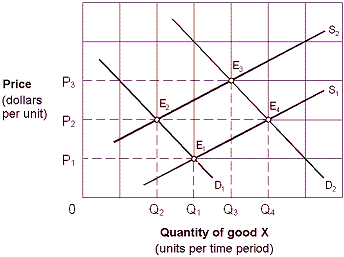 Beginning from an equilibrium at point E2 in Exhibit 4-3, an increase in demand for good X, other things being equal, would move the equilibrium point to:
 (Multiple Choice)
4.8/5 (71)
(71) Most economists believe that there are positive externalities in education. One can conclude that a free market would fail to give the socially optimal outcome because the equilibrium:
(Multiple Choice)
4.8/5 (71)
(71) The city of Logan Square needs $40 million for a network of streetlights. There are 20,000 residents in the Logan Square neighborhood, meaning the cost for each resident is $2,000. Mr. Miller refuses to donate $2,000 towards the project. This is an example of the problems encountered with:
(Multiple Choice)
4.8/5 (78)
(78) If a government imposed price ceiling legally sets the price of beef below market equilibrium, which of the following will most likely happen?
(Multiple Choice)
4.9/5 (80)
(80) 
Filters
- Essay(0)
- Multiple Choice(0)
- Short Answer(0)
- True False(0)
- Matching(0)