



 Chat with AI
Exam 4: Markets in Action

Exam 1: Introducing the Economic Way of Thinking85 Questions
Exam 2: Production Possibilities Opportunity Cost and Economic Growth107 Questions
Exam 3: Market Demand and Supply176 Questions
Exam 4: Markets in Action137 Questions
Exam 5: Price Elasticity of Demand and Supply151 Questions
Exam 6: Consumer Choice Theory96 Questions
Exam 7: Production Costs131 Questions
Exam 8: Perfect Competition126 Questions
Exam 9: Monopoly81 Questions
Exam 10: Monopolistic Competition and Oligopoly97 Questions
Exam 11: Labor Markets105 Questions
Exam 12: Income Distribution Poverty and Discrimination57 Questions
Exam 13: Antitrust and Regulation96 Questions
Exam 14: Environmental Economics47 Questions
Exam 15: Gross Domestic Product109 Questions
Exam 16: Business Cycles and Unemployment94 Questions
Exam 17: Inflation56 Questions
Exam 18: The Keynesian Model111 Questions
Exam 19: The Keynesian Model in Action105 Questions
Exam 20: Aggregate Demand and Supply94 Questions
Exam 21: Fiscal Policy108 Questions
Exam 22: The Public Sector55 Questions
Exam 23: Federal Deficits Surpluses and the National Debt42 Questions
Exam 24: Money and the Federal Reserve System75 Questions
Exam 25: Money Creation117 Questions
Exam 26: Monetary Policy106 Questions
Exam 27: The Phillips Curve and Expectations Theory59 Questions
Exam 28: International Trade and Finance127 Questions
Exam 29: Economies in Transition46 Questions
Exam 30: Growth and the Less Developed Countries55 Questions
Exam 31: Understanding Direct and Inverse Relationships between Variables172 Questions
Select questions type


Which of the following would generate positive externalities?
(Multiple Choice)
4.9/5  (87)
(87) Rent control applies to about two-thirds of the private rental housing in New York City. Economic theory suggests that a below-equilibrium price established by rent control:
(Multiple Choice)
4.8/5 (87)
(87) If an increase in the government-imposed minimum wage pushes the price (wage) of unskilled labor above market equilibrium, which of the following will most likely occur in the unskilled labor market?
(Multiple Choice)
4.7/5 (89)
(89) Exhibit 4-2 Supply and demand curves
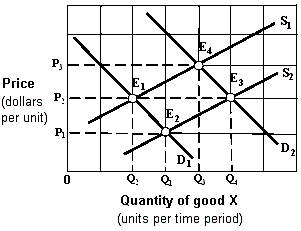 The market shown in Exhibit 4-2 is initially in equilibrium at E1. Changes in market conditions result in a new equilibrium at E2. This change is stated as a(n):
 (Multiple Choice)
4.8/5 (83)
(83) Which of the following would be a private cost to a cigarette manufacturer?
(Multiple Choice)
4.8/5 (92)
(92) Suppose the government imposes a per unit tax on an item whose production process creates a negative externality. Suppose the tax is exactly the value of the marginal externality cost. If the government now uses the tax revenue to clean up pollution from this process, the market will:
(Multiple Choice)
4.8/5 (79)
(79) People who enjoy the benefits of a public good without paying for them are called:
(Multiple Choice)
4.9/5 (82)
(82) Exhibit 4-2 Supply and demand curves
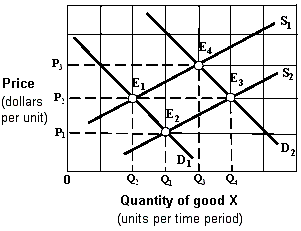 In Exhibit 4-2, a decrease in quantity demanded would cause a movement from which equilibrium point to another, other things being equal?
 (Multiple Choice)
4.8/5 (94)
(94) Ceteris paribus , an increase in the supply of a good causes which of the following?
(Multiple Choice)
4.8/5 (83)
(83) Which of the following correctly describes the external benefit resulting from an individual's purchase of a winter flu shot?
(Multiple Choice)
4.8/5 (89)
(89) How would a decrease in the price of the feed grains used to feed cattle affect the market for beef?
(Multiple Choice)
4.8/5 (75)
(75) Exhibit 4-6 Demand and supply curves
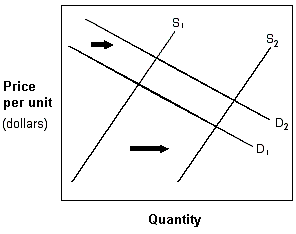 If the market demand and supply curves shift as given in Exhibit 4-6, the resulting new equilibrium will show a(n):
 (Multiple Choice)
4.9/5 (77)
(77) If the equilibrium price of good X is $4 and a price ceiling is imposed at $5, the result will be a(n):
(Multiple Choice)
4.9/5 (73)
(73) Price floors are instituted because the government wants to:
(Multiple Choice)
4.8/5 (69)
(69) Stuart tells his student government representative at his college to propose rent controls on local rental housing as a way to help students afford rental housing. Maria disagrees with Stuart, saying rent controls will make students worse off. Who is correct and why?Economic theory suggests that this policy would harm students as a whole despite the fact that some students who are able to find housing at the reduced price would benefit. Which of the following are some of the offsetting secondary effects of the rent controls that would work to the disadvantage of students?
(Multiple Choice)
4.8/5 (85)
(85) If we observe a decrease in the price of a good and an increase in the amount of the good bought and sold, this could be explained by a(n):
(Multiple Choice)
5.0/5 (73)
(73) Exhibit 4-10 Supply and demand data for apricots
Bushels demanded
per month
Price per
bushel
Bushels supplied
per month
50
$5
80
55
4
75
60
3
70
65
2
65
70
1
55
In Exhibit 4-10, assume that the government initially sets a price floor of $4 for apricots, and then removes the $4 price floor. What effect will this price change have?
| Bushels demanded | Price per | Bushels supplied |
| 50 | $5 | 80 |
| 55 | 4 | 75 |
| 60 | 3 | 70 |
| 65 | 2 | 65 |
| 70 | 1 | 55 |
(Multiple Choice)
4.8/5 (83)
(83) 
Filters
- Essay(0)
- Multiple Choice(0)
- Short Answer(0)
- True False(0)
- Matching(0)