



 Chat with AI
Exam 21: Fiscal Policy

Exam 1: Introducing the Economic Way of Thinking85 Questions
Exam 2: Production Possibilities Opportunity Cost and Economic Growth107 Questions
Exam 3: Market Demand and Supply176 Questions
Exam 4: Markets in Action137 Questions
Exam 5: Price Elasticity of Demand and Supply151 Questions
Exam 6: Consumer Choice Theory96 Questions
Exam 7: Production Costs131 Questions
Exam 8: Perfect Competition126 Questions
Exam 9: Monopoly81 Questions
Exam 10: Monopolistic Competition and Oligopoly97 Questions
Exam 11: Labor Markets105 Questions
Exam 12: Income Distribution Poverty and Discrimination57 Questions
Exam 13: Antitrust and Regulation96 Questions
Exam 14: Environmental Economics47 Questions
Exam 15: Gross Domestic Product109 Questions
Exam 16: Business Cycles and Unemployment94 Questions
Exam 17: Inflation56 Questions
Exam 18: The Keynesian Model111 Questions
Exam 19: The Keynesian Model in Action105 Questions
Exam 20: Aggregate Demand and Supply94 Questions
Exam 21: Fiscal Policy108 Questions
Exam 22: The Public Sector55 Questions
Exam 23: Federal Deficits Surpluses and the National Debt42 Questions
Exam 24: Money and the Federal Reserve System75 Questions
Exam 25: Money Creation117 Questions
Exam 26: Monetary Policy106 Questions
Exam 27: The Phillips Curve and Expectations Theory59 Questions
Exam 28: International Trade and Finance127 Questions
Exam 29: Economies in Transition46 Questions
Exam 30: Growth and the Less Developed Countries55 Questions
Exam 31: Understanding Direct and Inverse Relationships between Variables172 Questions
Select questions type


Describe appropriate discretionary fiscal policy according to Keynesian economics to smooth out the business cycle.

Free
(Essay)
4.9/5  (89)
(89) Correct Answer: Verified
The government should increase its spending and/or reduce taxes (run a deficit), or increase government spending and taxes by the same amount to combat a recession. The government should do just the opposite to combat inflation during an economic expansion.
The sum of the marginal propensity to consume (MPC) and the marginal propensity to save (MPS) always equals:
Free
(Multiple Choice)
4.9/5 (78)
(78) Correct Answer:Verified
VerifiedA
The Laffer curve shows as tax rates rise, tax revenue:
Free
(Multiple Choice)
4.9/5 (84)
(84) Correct Answer:Verified
VerifiedD
Exhibit 11-8 Aggregate demand and supply curves
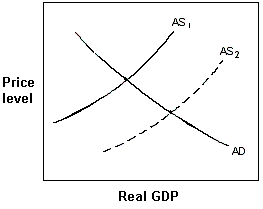 In Exhibit 11-8, supply-siders claimed that the shift from AS1 to AS2 would occur if the government:
 (Multiple Choice)
4.9/5 (91)
(91) When the economy enters a recession, automatic stabilizers create:
(Multiple Choice)
4.8/5 (85)
(85) If the MPC is 0.80, and if the goal is to increase real GDP by $200 million, then by how much would government spending have to change to generate this increase in real GDP?
(Multiple Choice)
4.9/5 (89)
(89) Which of the following is an example of an automatic stabilizer?
(Multiple Choice)
4.8/5 (73)
(73) On a graph showing the influence of automatic stabilizers on the economy, tax revenues and real GDP have a(n):
(Multiple Choice)
4.7/5 (78)
(78) "Lower marginal tax rates encourage people to work, save, and invest, resulting in more output and a larger tax base." This statement most closely reflects which of the following schools of economic thought?
(Multiple Choice)
4.9/5 (83)
(83) When the government levies a $100 million tax on people's income and puts the $100 million back into the economy in the form of a spending program, such as new interstate highway construction, the:
(Multiple Choice)
4.8/5 (77)
(77) Suppose the government of a small island country does not currently have any automatic stabilizers in place but they decide to implement them with the expectation of an impending recession. Which of the following would be most effective?
(Multiple Choice)
4.8/5 (71)
(71) An increase in government spending by $100 would, if the MPC = 0.90, result in an increase in real GDP by:
(Multiple Choice)
5.0/5 (83)
(83) The change in saving divided by the change in income is the:
(Multiple Choice)
5.0/5 (79)
(79) Automatic stabilizers create ________ during recessions from increased government spending on welfare and unemployment insurance, and reduced tax revenues, and create _________ during peak growth periods of the economy from reduced government welfare spending and increased tax revenues.
(Multiple Choice)
5.0/5 (85)
(85) Supply-side policy suggests that if we _______ taxes of workers, the _________ labor will increase, causing equilibrium wages to ________.
(Multiple Choice)
4.8/5 (79)
(79) Contractionary fiscal policy is deliberate government action to influence aggregate demand and the level of real GDP through:
(Multiple Choice)
4.8/5 (83)
(83) A change in government spending and/or taxes as the result of legislation is called:
(Multiple Choice)
4.8/5 (78)
(78) 
Filters
- Essay(0)
- Multiple Choice(0)
- Short Answer(0)
- True False(0)
- Matching(0)