



 Chat with AI
Exam 21: Fiscal Policy

Exam 1: Introducing the Economic Way of Thinking85 Questions
Exam 2: Production Possibilities Opportunity Cost and Economic Growth107 Questions
Exam 3: Market Demand and Supply176 Questions
Exam 4: Markets in Action137 Questions
Exam 5: Price Elasticity of Demand and Supply151 Questions
Exam 6: Consumer Choice Theory96 Questions
Exam 7: Production Costs131 Questions
Exam 8: Perfect Competition126 Questions
Exam 9: Monopoly81 Questions
Exam 10: Monopolistic Competition and Oligopoly97 Questions
Exam 11: Labor Markets105 Questions
Exam 12: Income Distribution Poverty and Discrimination57 Questions
Exam 13: Antitrust and Regulation96 Questions
Exam 14: Environmental Economics47 Questions
Exam 15: Gross Domestic Product109 Questions
Exam 16: Business Cycles and Unemployment94 Questions
Exam 17: Inflation56 Questions
Exam 18: The Keynesian Model111 Questions
Exam 19: The Keynesian Model in Action105 Questions
Exam 20: Aggregate Demand and Supply94 Questions
Exam 21: Fiscal Policy108 Questions
Exam 22: The Public Sector55 Questions
Exam 23: Federal Deficits Surpluses and the National Debt42 Questions
Exam 24: Money and the Federal Reserve System75 Questions
Exam 25: Money Creation117 Questions
Exam 26: Monetary Policy106 Questions
Exam 27: The Phillips Curve and Expectations Theory59 Questions
Exam 28: International Trade and Finance127 Questions
Exam 29: Economies in Transition46 Questions
Exam 30: Growth and the Less Developed Countries55 Questions
Exam 31: Understanding Direct and Inverse Relationships between Variables172 Questions
Select questions type


"Last month unemployment fell to 4 percent, its lowest level in years. The economy is growing rapidly, but consumer prices have risen at an annual rate of 10 percent during the last six months." Which of the following policies would be most appropriate under these circumstances?
(Multiple Choice)
4.8/5  (67)
(67) Those who favor government policies to stimulate the economy by creating incentives for individuals and businesses to increase their productive efforts are supporting:
(Multiple Choice)
4.8/5 (81)
(81) Exhibit 11-6 Aggregate demand and supply model
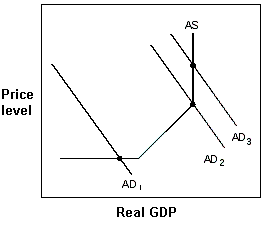 In Exhibit 11-6, if the aggregate demand curve is at AD2, the government should:
 (Multiple Choice)
4.7/5 (87)
(87) If an economy were experiencing a high rate of unemployment as the result of insufficient aggregate demand, a Keynesian economist would favor:
(Multiple Choice)
4.8/5 (74)
(74) Appropriate supply-side policy (or policies) during a recession would be to do which of the following?
(Multiple Choice)
4.7/5 (84)
(84) Automatic stabilizers "lean against the prevailing wind" of the business cycle because:
(Multiple Choice)
4.8/5 (89)
(89) Exhibit 11-2 Aggregate demand and supply model
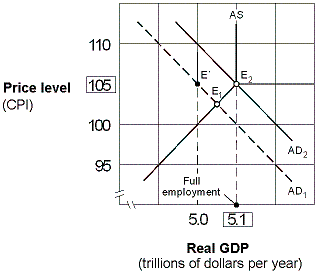 Suppose the economy in Exhibit 11-2 is in equilibrium at point E1 and the marginal propensity to consume (MPC) is 0.75. Following Keynesian economics, the federal government can move the economy to full employment at point E2 by:
 (Multiple Choice)
4.8/5 (67)
(67) In the _______ range of the aggregate supply curve, expansionary fiscal policy that causes aggregate ______ to increase will lead to a higher price level and a higher equilibrium level of real GDP.
(Multiple Choice)
4.9/5 (82)
(82) If the economy is experiencing unemployment, then the most appropriate government policy would be to:
(Multiple Choice)
4.9/5 (73)
(73) During the Reagan administration, the Laffer curve was used to argue that:
(Multiple Choice)
4.8/5 (76)
(76) Automatic stabilizers stabilize the level of real GDP because:
(Multiple Choice)
4.9/5 (79)
(79) Keynesian analysis stresses that a tax cut that increases the government's budget deficit or reduces its budget surplus:
(Multiple Choice)
4.9/5 (80)
(80) When an economy dips into recession, automatic stabilizers will:
(Multiple Choice)
4.9/5 (76)
(76) Exhibit 11-1 Disposable income and consumption data
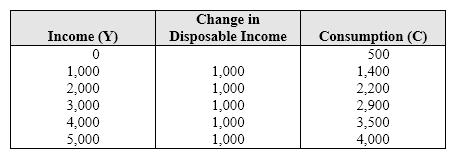 In Exhibit 11-1, when disposable income is increased from $2,000 to $3,000 to $4,000,
 (Multiple Choice)
4.9/5 (85)
(85) According to supply-side economists, lowering corporate income taxes:
(Multiple Choice)
4.8/5 (69)
(69) Because of the automatic stabilizers, a decline in the level of economic activity will cause:
(Multiple Choice)
4.8/5 (83)
(83) When both inflation and unemployment are concerns, supply-side economists argue in favor of policies to shift the
(Multiple Choice)
4.8/5 (82)
(82) Suppose the economy was at full employment GDP and then consumer optimism soars. If automatic stabilizers are in place, the stabilizers will result in:
(Multiple Choice)
4.8/5 (88)
(88) Assume the marginal propensity to consume (MPC) is 0.80 and the government increases taxes by $100 billion. The aggregate demand curve will shift to the:
(Multiple Choice)
4.7/5 (96)
(96) 
Filters
- Essay(0)
- Multiple Choice(0)
- Short Answer(0)
- True False(0)
- Matching(0)