



 Chat with AI
Exam 28: International Trade and Finance

Exam 1: Introducing the Economic Way of Thinking85 Questions
Exam 2: Production Possibilities Opportunity Cost and Economic Growth107 Questions
Exam 3: Market Demand and Supply176 Questions
Exam 4: Markets in Action137 Questions
Exam 5: Price Elasticity of Demand and Supply151 Questions
Exam 6: Consumer Choice Theory96 Questions
Exam 7: Production Costs131 Questions
Exam 8: Perfect Competition126 Questions
Exam 9: Monopoly81 Questions
Exam 10: Monopolistic Competition and Oligopoly97 Questions
Exam 11: Labor Markets105 Questions
Exam 12: Income Distribution Poverty and Discrimination57 Questions
Exam 13: Antitrust and Regulation96 Questions
Exam 14: Environmental Economics47 Questions
Exam 15: Gross Domestic Product109 Questions
Exam 16: Business Cycles and Unemployment94 Questions
Exam 17: Inflation56 Questions
Exam 18: The Keynesian Model111 Questions
Exam 19: The Keynesian Model in Action105 Questions
Exam 20: Aggregate Demand and Supply94 Questions
Exam 21: Fiscal Policy108 Questions
Exam 22: The Public Sector55 Questions
Exam 23: Federal Deficits Surpluses and the National Debt42 Questions
Exam 24: Money and the Federal Reserve System75 Questions
Exam 25: Money Creation117 Questions
Exam 26: Monetary Policy106 Questions
Exam 27: The Phillips Curve and Expectations Theory59 Questions
Exam 28: International Trade and Finance127 Questions
Exam 29: Economies in Transition46 Questions
Exam 30: Growth and the Less Developed Countries55 Questions
Exam 31: Understanding Direct and Inverse Relationships between Variables172 Questions
Select questions type


Suppose that Spain has a comparative advantage in hats and Portugal has a comparative advantage in doormats. Under a system of free trade, each country specializes and then trades with the other. If the price starts at four hats per doormat, and then increases to five hats per doormat, then:

Free
(Multiple Choice)
4.8/5  (92)
(92) Correct Answer: Verified
D
If nation A has a comparative advantage over nation B in the production of a product, this implies:
Free
(Multiple Choice)
4.8/5 (72)
(72) Correct Answer:Verified
VerifiedB
Exhibit 15-4 Coffee and tea output (pounds per hour)
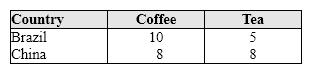 If specialization were carried out by each country in Exhibit 15-4 on the basis of comparative advantage, then:
Free
(Multiple Choice)
4.9/5 (72)
(72) Correct Answer:Verified
VerifiedD
Comparative advantage explains why a nation will benefit from trade when:
(Multiple Choice)
4.8/5 (75)
(75) If a box of Swiss chocolate priced at 100 francs can be purchased for $50, the exchange rate is:
(Multiple Choice)
4.9/5 (67)
(67) Exhibit 15-1 Production possibilities curves
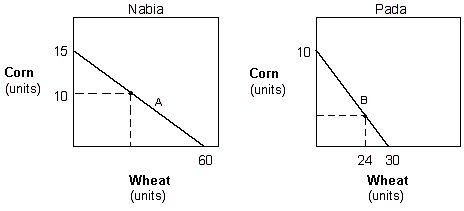 In Exhibit 15-1, the production possibilities curves of wheat and corn for Nabia and Pada are presented. Suppose Nabia produces at point A on its PPC. How many units of wheat is the country able to produce?
 (Multiple Choice)
4.7/5 (87)
(87) Absolute advantage occurs when one nation can produce a good ____ its trading partners.
(Multiple Choice)
4.8/5 (82)
(82) An import quota on a product protects domestic industries by:
(Multiple Choice)
4.8/5 (82)
(82) An appreciation in the U.S. dollar benefits which of the following groups of people?
(Multiple Choice)
4.8/5 (71)
(71) The primary benefits derived from tariffs usually accrue to the:
(Multiple Choice)
4.8/5 (75)
(75) Exhibit 15-1 Production possibilities curves
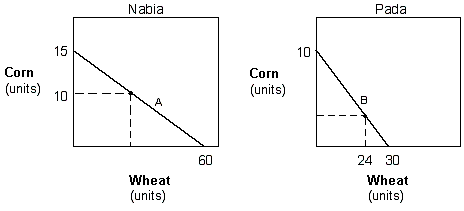 In Exhibit 15-1, the production possibilities curves of wheat and corn for Nabia and Pada are presented. Suppose Pada produces at point B on its PPC. How much corn is the country able to produce?
 (Multiple Choice)
4.8/5 (91)
(91) Which of the following would be expected if the tariff on foreign-produced shoes were decreased?
(Multiple Choice)
4.7/5 (69)
(69) International trade has the potential to ____ the availability of goods and services to ____.
(Multiple Choice)
4.9/5 (78)
(78) One big difference between tariffs and quotas is that tariffs:
(Multiple Choice)
4.8/5 (84)
(84) 
Filters
- Essay(0)
- Multiple Choice(0)
- Short Answer(0)
- True False(0)
- Matching(0)