



 Chat with AI
Exam 28: International Trade and Finance

Exam 1: Introducing the Economic Way of Thinking85 Questions
Exam 2: Production Possibilities Opportunity Cost and Economic Growth107 Questions
Exam 3: Market Demand and Supply176 Questions
Exam 4: Markets in Action137 Questions
Exam 5: Price Elasticity of Demand and Supply151 Questions
Exam 6: Consumer Choice Theory96 Questions
Exam 7: Production Costs131 Questions
Exam 8: Perfect Competition126 Questions
Exam 9: Monopoly81 Questions
Exam 10: Monopolistic Competition and Oligopoly97 Questions
Exam 11: Labor Markets105 Questions
Exam 12: Income Distribution Poverty and Discrimination57 Questions
Exam 13: Antitrust and Regulation96 Questions
Exam 14: Environmental Economics47 Questions
Exam 15: Gross Domestic Product109 Questions
Exam 16: Business Cycles and Unemployment94 Questions
Exam 17: Inflation56 Questions
Exam 18: The Keynesian Model111 Questions
Exam 19: The Keynesian Model in Action105 Questions
Exam 20: Aggregate Demand and Supply94 Questions
Exam 21: Fiscal Policy108 Questions
Exam 22: The Public Sector55 Questions
Exam 23: Federal Deficits Surpluses and the National Debt42 Questions
Exam 24: Money and the Federal Reserve System75 Questions
Exam 25: Money Creation117 Questions
Exam 26: Monetary Policy106 Questions
Exam 27: The Phillips Curve and Expectations Theory59 Questions
Exam 28: International Trade and Finance127 Questions
Exam 29: Economies in Transition46 Questions
Exam 30: Growth and the Less Developed Countries55 Questions
Exam 31: Understanding Direct and Inverse Relationships between Variables172 Questions
Select questions type


Exhibit 15-4 Coffee and tea output (pounds per hour)
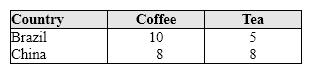 As shown in Exhibit 15-4, compared to Brazil, China has a comparative advantage in the production of:
 (Multiple Choice)
4.8/5  (78)
(78) When Brazil can generate a product using fewer labor hours and resources than the United States, an economist would say that Brazil had:
(Multiple Choice)
5.0/5 (88)
(88) If one country can produce a good with fewer resources than another country, this is called:
(Multiple Choice)
4.9/5 (69)
(69) If a country has a lower opportunity cost of producing oranges, then this is:
(Multiple Choice)
4.9/5 (85)
(85) Discuss the determinants of a nation's exchange rate value for its currency in foreign exchange markets. What happens to a nation's balance of trade if the nation's currency appreciates? Why?
(Essay)
4.7/5 (85)
(85) A tariff has the effect of granting ____ a larger share of the domestic market.
(Multiple Choice)
4.8/5 (78)
(78) When the value of our goods exports is less than the value of our goods imports,
(Multiple Choice)
5.0/5 (73)
(73) An increase in the equilibrium price of Japanese yen per dollar could be caused by a(n):
(Multiple Choice)
4.8/5 (84)
(84) Which of the following transactions would be excluded in the capital account?
(Multiple Choice)
4.9/5 (101)
(101) Which of the following would be recorded in the U.S. goods export account?
(Multiple Choice)
4.9/5 (62)
(62) If foreign exchange rates are determined by the interaction of supply and demand forces for the various currencies, then the exchange rate is:
(Multiple Choice)
4.8/5 (55)
(55) Exhibit 15-4 Coffee and tea output (pounds per hour)
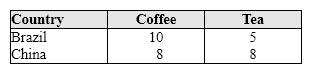 As shown in Exhibit 15-4, the opportunity cost to Brazil of producing one pound of coffee is:
 (Multiple Choice)
4.8/5 (79)
(79) If a hotel room priced at 120,000 Venezuela bolivar per night can be purchased for 80 U.S. dollars, the exchange rate is:
(Multiple Choice)
4.8/5 (71)
(71) Expenditures for services such as tourism, income for foreign investment, and foreign gifts are tabulated in the:
(Multiple Choice)
4.8/5 (76)
(76) Exhibit 15-6 Dollars per British pound
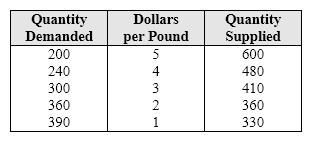 In Exhibit 15-6, the equilibrium exchange rate is:
 (Multiple Choice)
4.9/5 (73)
(73) Which of the following will most likely cause a nation's currency to appreciate on the foreign exchange market?
(Multiple Choice)
4.8/5 (70)
(70) 
Filters
- Essay(0)
- Multiple Choice(0)
- Short Answer(0)
- True False(0)
- Matching(0)