



 Chat with AI
Exam 9: Monopoly

Exam 1: Introducing the Economic Way of Thinking85 Questions
Exam 2: Production Possibilities Opportunity Cost and Economic Growth107 Questions
Exam 3: Market Demand and Supply176 Questions
Exam 4: Markets in Action137 Questions
Exam 5: Price Elasticity of Demand and Supply151 Questions
Exam 6: Consumer Choice Theory96 Questions
Exam 7: Production Costs131 Questions
Exam 8: Perfect Competition126 Questions
Exam 9: Monopoly81 Questions
Exam 10: Monopolistic Competition and Oligopoly97 Questions
Exam 11: Labor Markets105 Questions
Exam 12: Income Distribution Poverty and Discrimination57 Questions
Exam 13: Antitrust and Regulation96 Questions
Exam 14: Environmental Economics47 Questions
Exam 15: Gross Domestic Product109 Questions
Exam 16: Business Cycles and Unemployment94 Questions
Exam 17: Inflation56 Questions
Exam 18: The Keynesian Model111 Questions
Exam 19: The Keynesian Model in Action105 Questions
Exam 20: Aggregate Demand and Supply94 Questions
Exam 21: Fiscal Policy108 Questions
Exam 22: The Public Sector55 Questions
Exam 23: Federal Deficits Surpluses and the National Debt42 Questions
Exam 24: Money and the Federal Reserve System75 Questions
Exam 25: Money Creation117 Questions
Exam 26: Monetary Policy106 Questions
Exam 27: The Phillips Curve and Expectations Theory59 Questions
Exam 28: International Trade and Finance127 Questions
Exam 29: Economies in Transition46 Questions
Exam 30: Growth and the Less Developed Countries55 Questions
Exam 31: Understanding Direct and Inverse Relationships between Variables172 Questions
Select questions type


A monopolist faces a downward-sloping demand curve because:

Free
(Multiple Choice)
4.8/5  (91)
(91) Correct Answer: Verified
D
An example of price discrimination is the price charged for:
Free
(Multiple Choice)
4.9/5 (80)
(80) Correct Answer:Verified
VerifiedC
Why can a monopoly earn economic profits in the long run?
Free
(Essay)
4.8/5 (81)
(81) Correct Answer:Verified
VerifiedBecause a monopoly experiences very strong barriers to entry, keeping potential competitors out of its market, it can earn economic profits in the long run. Barriers to entry may include economies of scale, financial and technological barriers to entry, sole ownership over a strategic resource, and even government laws and regulation.
Which of the following factors is not a barrier limiting the entry of potential competitors into a market?
(Multiple Choice)
4.7/5 (78)
(78) Suppose there are four buyers all considering purchasing round-trip airfare from Boston to Miami with the following price elasticities of demand for this purchase: Buyer A: 1.5, Buyer B: 0.7, Buyer C: 1.0, Buyer D: 2.3. If the airline knows of these elasticities and practices price discrimination, which buyer will pay the highest price for the airfare?
(Multiple Choice)
4.8/5 (77)
(77) Comparing a perfectly competitive market to a monopoly, which of the following is true ?
(Multiple Choice)
4.8/5 (68)
(68) Which of the following is true for a monopolist but not for a firm in perfect competition?
(Multiple Choice)
4.7/5 (79)
(79) At a price of $5, 24 units of the good would be sold; at a price of $7, 25 units of output would be sold. The marginal revenue of the 25th unit of output is:
(Multiple Choice)
4.7/5 (86)
(86) Alcoa had a monopoly in the U.S. aluminum market from the late nineteenth century until the end of World War II. Which barrier to entry was the source of Alcoa's monopoly power?
(Multiple Choice)
4.9/5 (87)
(87) At the level of output where the marginal cost and marginal revenue curves intersect, two firms demand curves pass above their average total cost curve. One firms is a monopoly and the other is perfectly competitive. Which statement is true for both firms?
(Multiple Choice)
4.7/5 (75)
(75) Exhibit 9-4 Demand and cost curves for a monopolist
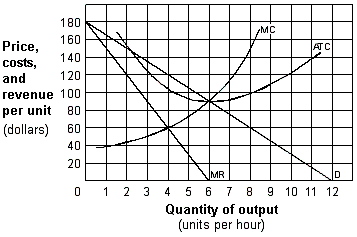 As shown in Exhibit 9-4, in order to maximize its profit (or minimize its loss), how much output should the monopoly produce?
 (Multiple Choice)
4.9/5 (91)
(91) If pizza used to be produced in a perfectly competitive market, and now the pizza market has become a monopoly, we can expect:
(Multiple Choice)
4.9/5 (89)
(89) A monopoly sets a market price that is higher than the marginal cost of production. This fact implies that a monopoly's allocation of resources is:
(Multiple Choice)
4.7/5 (73)
(73) Economists do not think price discrimination is unfair because
(Multiple Choice)
5.0/5 (74)
(74) Exhibit 9-7 Monopolist
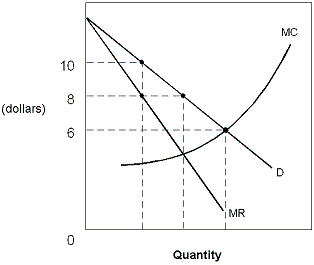 According to the information provided in Exhibit 9-7, if the Rudd Ice Company is a monopoly and is currently charging a price of $10, what would you advise Rudd to do?
 (Multiple Choice)
4.9/5 (92)
(92) 
Filters
- Essay(0)
- Multiple Choice(0)
- Short Answer(0)
- True False(0)
- Matching(0)