



 Chat with AI
Exam 9: Monopoly

Exam 1: Introducing the Economic Way of Thinking85 Questions
Exam 2: Production Possibilities Opportunity Cost and Economic Growth107 Questions
Exam 3: Market Demand and Supply176 Questions
Exam 4: Markets in Action137 Questions
Exam 5: Price Elasticity of Demand and Supply151 Questions
Exam 6: Consumer Choice Theory96 Questions
Exam 7: Production Costs131 Questions
Exam 8: Perfect Competition126 Questions
Exam 9: Monopoly81 Questions
Exam 10: Monopolistic Competition and Oligopoly97 Questions
Exam 11: Labor Markets105 Questions
Exam 12: Income Distribution Poverty and Discrimination57 Questions
Exam 13: Antitrust and Regulation96 Questions
Exam 14: Environmental Economics47 Questions
Exam 15: Gross Domestic Product109 Questions
Exam 16: Business Cycles and Unemployment94 Questions
Exam 17: Inflation56 Questions
Exam 18: The Keynesian Model111 Questions
Exam 19: The Keynesian Model in Action105 Questions
Exam 20: Aggregate Demand and Supply94 Questions
Exam 21: Fiscal Policy108 Questions
Exam 22: The Public Sector55 Questions
Exam 23: Federal Deficits Surpluses and the National Debt42 Questions
Exam 24: Money and the Federal Reserve System75 Questions
Exam 25: Money Creation117 Questions
Exam 26: Monetary Policy106 Questions
Exam 27: The Phillips Curve and Expectations Theory59 Questions
Exam 28: International Trade and Finance127 Questions
Exam 29: Economies in Transition46 Questions
Exam 30: Growth and the Less Developed Countries55 Questions
Exam 31: Understanding Direct and Inverse Relationships between Variables172 Questions
Select questions type


Which barrier to entry results in the creation of a natural monopoly?
(Multiple Choice)
4.8/5  (76)
(76) Exhibit 9-7 Monopolist
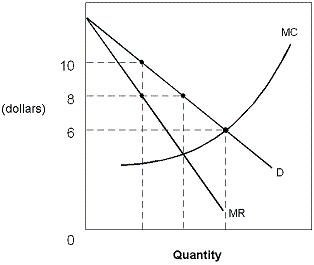 If the profit-maximizing monopoly in Exhibit 9-7 becomes a profit-maximizing perfectly competitive market, the price will go from
 (Multiple Choice)
4.9/5 (84)
(84) Exhibit 9-2 Demand and cost information for a monopoly
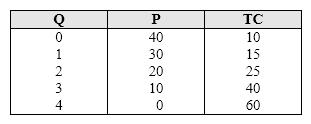 Refer to Exhibit 9-2. Using the rule that focuses on the marginal approach to maximizing profits, the monopolist maximizes profit by choosing price equal to:
 (Multiple Choice)
4.7/5 (81)
(81) The act of buying a commodity in one market at a lower price and selling it in another market at a higher price is known as:
(Multiple Choice)
4.9/5 (73)
(73) If marginal cost exceeds marginal revenue, a profit-maximizing monopolist will:
(Multiple Choice)
4.9/5 (80)
(80) Exhibit 3 Demand and cost curves for GeneTech, a monopolist with a patented vaccine
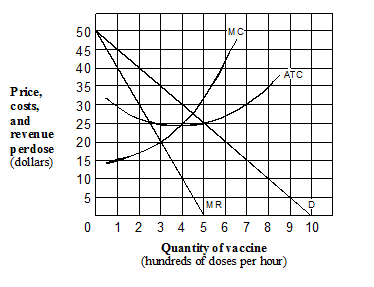 Consider Exhibit 9-3. Suppose GeneTech's patent expires and the market for the vaccine becomes perfectly competitive. Which of the following price and quantity combinations would be most likely?
 (Multiple Choice)
4.9/5 (78)
(78) A monopoly firm can sell its fourth unit of output for a price of $250. To sell more than five units, it must expect to receive a price:
(Multiple Choice)
4.8/5 (86)
(86) Monopolists are criticized because they are inefficient. What is meant by this statement?
(Multiple Choice)
4.9/5 (87)
(87) Which of the following distinguishes a natural monopoly from monopoly caused by ownership of a vital resource?
(Multiple Choice)
4.9/5 (81)
(81) Exhibit 9-7 Monopolist
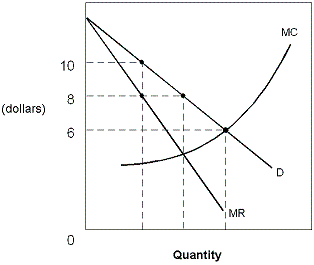 According to the information provided in Exhibit 9-7, if the Rudd Ice Company is a monopoly and is currently charging a price of $6, what would you advise Rudd to do?
 (Multiple Choice)
4.8/5 (62)
(62) Suppose a single firm can produce 100 units at an average cost of $15. If two firms produce 50 units each, the total cost rises to $2,500. Which of the following is true about this market?
(Multiple Choice)
4.9/5 (82)
(82) What is a natural monopoly? Why is government justified in regulating a natural monopoly?
(Essay)
4.8/5 (87)
(87) A price-discriminating monopoly charges the lowest price to the group that:
(Multiple Choice)
4.8/5 (88)
(88) An example of price discrimination is the price charged for:
(Multiple Choice)
4.9/5 (86)
(86) Exhibit 9-1 Monopolist's demand curve
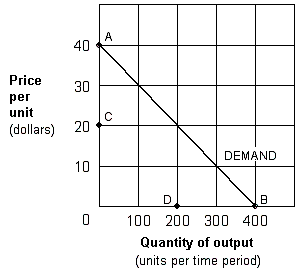 In Exhibit 9-1, the marginal revenue curve corresponding to the monopolist's demand curve would be a straight line drawn between points:
 (Multiple Choice)
4.8/5 (85)
(85) Ricky and Anita are 10 year-olds who have a lemonade stand on a busy beach and would like to practice price discrimination. They know that they are the only sellers of lemonade on the beach and that adults have a less elastic demand for lemonade than kids so they decide to sell their lemonade for $0.25 to kids and $0.50 to adults. Will their price discrimination be successful? Why or why not?
(Multiple Choice)
4.8/5 (75)
(75) 
Filters
- Essay(0)
- Multiple Choice(0)
- Short Answer(0)
- True False(0)
- Matching(0)