



 Chat with AI
Exam 9: Monopoly

Exam 1: Introducing the Economic Way of Thinking85 Questions
Exam 2: Production Possibilities Opportunity Cost and Economic Growth107 Questions
Exam 3: Market Demand and Supply176 Questions
Exam 4: Markets in Action137 Questions
Exam 5: Price Elasticity of Demand and Supply151 Questions
Exam 6: Consumer Choice Theory96 Questions
Exam 7: Production Costs131 Questions
Exam 8: Perfect Competition126 Questions
Exam 9: Monopoly81 Questions
Exam 10: Monopolistic Competition and Oligopoly97 Questions
Exam 11: Labor Markets105 Questions
Exam 12: Income Distribution Poverty and Discrimination57 Questions
Exam 13: Antitrust and Regulation96 Questions
Exam 14: Environmental Economics47 Questions
Exam 15: Gross Domestic Product109 Questions
Exam 16: Business Cycles and Unemployment94 Questions
Exam 17: Inflation56 Questions
Exam 18: The Keynesian Model111 Questions
Exam 19: The Keynesian Model in Action105 Questions
Exam 20: Aggregate Demand and Supply94 Questions
Exam 21: Fiscal Policy108 Questions
Exam 22: The Public Sector55 Questions
Exam 23: Federal Deficits Surpluses and the National Debt42 Questions
Exam 24: Money and the Federal Reserve System75 Questions
Exam 25: Money Creation117 Questions
Exam 26: Monetary Policy106 Questions
Exam 27: The Phillips Curve and Expectations Theory59 Questions
Exam 28: International Trade and Finance127 Questions
Exam 29: Economies in Transition46 Questions
Exam 30: Growth and the Less Developed Countries55 Questions
Exam 31: Understanding Direct and Inverse Relationships between Variables172 Questions
Select questions type


A monopolist earning economic profit in the short run determines that at its present level of output, marginal revenue is $23 and marginal cost is $30. Which of the following should the firm do to increase profit?
(Multiple Choice)
4.9/5  (73)
(73) Suppose that a study of changes in admission prices reveals that when the price of admission to the museum increases by 10%, adults reduce their ticket purchases by 10%, senior citizens reduce their ticket purchases by 20%, college students reduce their ticket purchases by 25%, and children reduce their ticket purchases by 30%. If the cost of having a person visit the museum is the same regardless of whether the person is an adult, senior citizen, college student, or child, which of the following pricing schemes is the most likely to be used by the museum and why?
(Multiple Choice)
4.8/5 (82)
(82) Which of the following statements accurately describes a difference between a firm that is a monopolist and one that is a competitive price taker?
(Multiple Choice)
4.9/5 (88)
(88) Why do economies of scale and monopoly power exist with network goods?
(Multiple Choice)
4.8/5 (86)
(86) Suppose a perfectly competitive market results in a long-run equilibrium price of $8 and quantity of 500. If this same market were a monopoly, which of the following price and quantity combinations would be the most likely?
(Multiple Choice)
4.8/5 (76)
(76) Exhibit 3 Demand and cost curves for GeneTech, a monopolist with a patented vaccine
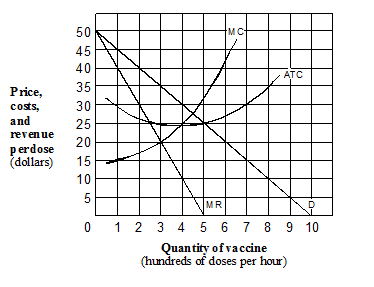 In Exhibit 9-3, what is the maximum hourly profit that GeneTech can earn from its vaccine?
 (Multiple Choice)
4.9/5 (78)
(78) To maximize its profit, a monopoly should choose a price where demand is:
(Multiple Choice)
4.8/5 (77)
(77) Which of the following firms best fits the definition of a monopoly?
(Multiple Choice)
4.9/5 (68)
(68) Exhibit 3 Demand and cost curves for GeneTech, a monopolist with a patented vaccine
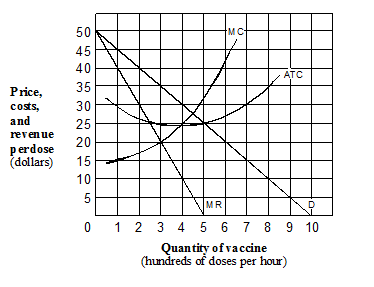 In Exhibit 9-3, how much vaccine should GeneTech produce to maximize its profit?
 (Multiple Choice)
4.8/5 (81)
(81) In contrast to a perfectly competitive firm, a monopolist operates in the long run
(Multiple Choice)
4.8/5 (76)
(76) Which of the following describes the monopoly market structure?
(Multiple Choice)
4.9/5 (89)
(89) Which of the following does not represent an arbitrage transaction?
(Multiple Choice)
4.8/5 (74)
(74) Kayla and Kevin are friends who go together to a used textbook seller who has two copies of the biology book that they both need for their class this semester. The cost to the seller of acquiring the books was $25 each and no other students will need this book. Kayla states that she is willing to pay $40 for the book, while Kevin says he is willing to pay $80. Which of the following describes the most likely conclusion to this scenario?
(Multiple Choice)
4.9/5 (71)
(71) Because monopolists are protected by high barriers to entry, they:
(Multiple Choice)
4.8/5 (74)
(74) Exhibit 9-4 Demand and cost curves for a monopolist
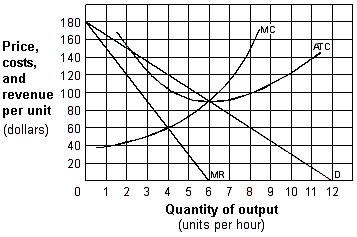 As shown in Exhibit 9-4, in order to maximize its profit (or minimize its loss), what price should the monopoly charge for its product?
 (Multiple Choice)
4.8/5 (82)
(82) Which of the following correctly describes price discrimination?
(Multiple Choice)
5.0/5 (94)
(94) 
Filters
- Essay(0)
- Multiple Choice(0)
- Short Answer(0)
- True False(0)
- Matching(0)