



 Chat with AI
Exam 6: Consumer Choice Theory

Exam 1: Introducing the Economic Way of Thinking85 Questions
Exam 2: Production Possibilities Opportunity Cost and Economic Growth107 Questions
Exam 3: Market Demand and Supply176 Questions
Exam 4: Markets in Action137 Questions
Exam 5: Price Elasticity of Demand and Supply151 Questions
Exam 6: Consumer Choice Theory96 Questions
Exam 7: Production Costs131 Questions
Exam 8: Perfect Competition126 Questions
Exam 9: Monopoly81 Questions
Exam 10: Monopolistic Competition and Oligopoly97 Questions
Exam 11: Labor Markets105 Questions
Exam 12: Income Distribution Poverty and Discrimination57 Questions
Exam 13: Antitrust and Regulation96 Questions
Exam 14: Environmental Economics47 Questions
Exam 15: Gross Domestic Product109 Questions
Exam 16: Business Cycles and Unemployment94 Questions
Exam 17: Inflation56 Questions
Exam 18: The Keynesian Model111 Questions
Exam 19: The Keynesian Model in Action105 Questions
Exam 20: Aggregate Demand and Supply94 Questions
Exam 21: Fiscal Policy108 Questions
Exam 22: The Public Sector55 Questions
Exam 23: Federal Deficits Surpluses and the National Debt42 Questions
Exam 24: Money and the Federal Reserve System75 Questions
Exam 25: Money Creation117 Questions
Exam 26: Monetary Policy106 Questions
Exam 27: The Phillips Curve and Expectations Theory59 Questions
Exam 28: International Trade and Finance127 Questions
Exam 29: Economies in Transition46 Questions
Exam 30: Growth and the Less Developed Countries55 Questions
Exam 31: Understanding Direct and Inverse Relationships between Variables172 Questions
Select questions type


If total utility is falling, marginal utility is:

Free
(Multiple Choice)
4.9/5  (85)
(85) Correct Answer: Verified
B
The principle of diminishing marginal utility says that:
Free
(Multiple Choice)
4.9/5 (92)
(92) Correct Answer:Verified
VerifiedC
Melinda considers lattes and coffee to be good substitutes. Suppose the price of milk, a key ingredient used to produce lattes, falls. According to the income effect, which of the following is most likely to occur?
Free
(Multiple Choice)
4.8/5 (80)
(80) Correct Answer:Verified
VerifiedC
The fact that a gallon of gasoline commands a higher market price than a gallon of water indicates that:
(Multiple Choice)
4.9/5 (84)
(84) Assume the price of Advil increases. As a result, you decrease the quantity of Advil purchased each month and purchase more Tylenol. This is an example of the:
(Multiple Choice)
4.9/5 (68)
(68) If a consumer wishes to maximize satisfaction given limited income and MUx/Px
(Multiple Choice)
4.8/5 (64)
(64) The marginal utilities associated with the first 4 units of consumption of good Y are 10, 12, 9, and 7, respectively. What is the total utility associated with the third unit?
(Multiple Choice)
4.8/5 (93)
(93) Assume the total utilities corresponding to the first four units of a product consumed are 8, 12, 14, 15, respectively. The marginal utility of the third unit consumed is:
(Multiple Choice)
4.8/5 (77)
(77) Eric is maximizing his total utility through his choices of two goods: clothes and food. His marginal utility of clothes is 60 and his marginal utility of food is 12. The price of clothes is $20. What must be the price of food?
(Multiple Choice)
4.9/5 (85)
(85) Which of the following is the best example of the substitution effect?
(Multiple Choice)
4.8/5 (86)
(86) Suppose that the price of telephones decreases. If more are purchased then:
(Multiple Choice)
4.9/5 (69)
(69) Exhibit 6-7 Marginal utility for sandwiches and sodas
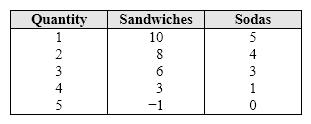 Refer to Exhibit 6-7. If price of a sandwich is $1, the price of a soda is $1, and income is $5, Marian should buy ____ sandwiches and ____ sodas.
 (Multiple Choice)
4.9/5 (82)
(82) If Mr. Smith thinks the last dollar spent on shirts yields less satisfaction than the last dollar spent on cola, and Mr. Smith is a utility-maximizing consumer, he should:
(Multiple Choice)
4.9/5 (79)
(79) Exhibit 6-7 Marginal utility for sandwiches and sodas
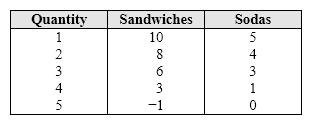 Refer to Exhibit 6-7. Diminishing marginal utility for sandwiches sets in after the ____ sandwich.
 (Multiple Choice)
4.9/5 (85)
(85) Use the idea of interpersonal comparisons of utility to argue for a progressive income tax system where people in higher income brackets are charged higher tax rates on their extra income.
(Essay)
4.9/5 (68)
(68) Exhibit 6-3 Marginal utility data for goods X and Y
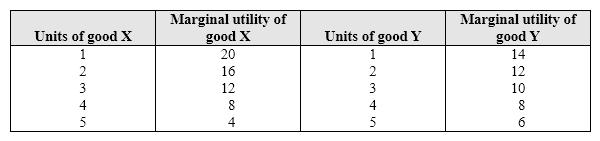 As shown in Exhibit 6-3, assume that the price of both goods is $1 per total unit, and your budget is $8. If you consume 4 units of good X and 1 unit of good Y. To maximize utility, you should consume:
 (Multiple Choice)
4.8/5 (80)
(80) Exhibit 6-2 Total utility for hamburgers, fries, and Cokes
 In Exhibit 6-2, assume that the price of hamburgers is $2 each, fries cost 50 cents each, and Cokes cost $1 each. Suppose the consumer has $6 to spend on hamburgers, fries, and Cokes. In the consumer equilibrium, what is the marginal utility per dollar for each of the three goods?
 (Multiple Choice)
4.9/5 (87)
(87) As more Big Macs are consumed each day, the marginal utility that a person gets from each additional Big Mac:
(Multiple Choice)
4.8/5 (64)
(64) 
Filters
- Essay(0)
- Multiple Choice(0)
- Short Answer(0)
- True False(0)
- Matching(0)