



 Chat with AI
Exam 6: Consumer Choice Theory

Exam 1: Introducing the Economic Way of Thinking85 Questions
Exam 2: Production Possibilities Opportunity Cost and Economic Growth107 Questions
Exam 3: Market Demand and Supply176 Questions
Exam 4: Markets in Action137 Questions
Exam 5: Price Elasticity of Demand and Supply151 Questions
Exam 6: Consumer Choice Theory96 Questions
Exam 7: Production Costs131 Questions
Exam 8: Perfect Competition126 Questions
Exam 9: Monopoly81 Questions
Exam 10: Monopolistic Competition and Oligopoly97 Questions
Exam 11: Labor Markets105 Questions
Exam 12: Income Distribution Poverty and Discrimination57 Questions
Exam 13: Antitrust and Regulation96 Questions
Exam 14: Environmental Economics47 Questions
Exam 15: Gross Domestic Product109 Questions
Exam 16: Business Cycles and Unemployment94 Questions
Exam 17: Inflation56 Questions
Exam 18: The Keynesian Model111 Questions
Exam 19: The Keynesian Model in Action105 Questions
Exam 20: Aggregate Demand and Supply94 Questions
Exam 21: Fiscal Policy108 Questions
Exam 22: The Public Sector55 Questions
Exam 23: Federal Deficits Surpluses and the National Debt42 Questions
Exam 24: Money and the Federal Reserve System75 Questions
Exam 25: Money Creation117 Questions
Exam 26: Monetary Policy106 Questions
Exam 27: The Phillips Curve and Expectations Theory59 Questions
Exam 28: International Trade and Finance127 Questions
Exam 29: Economies in Transition46 Questions
Exam 30: Growth and the Less Developed Countries55 Questions
Exam 31: Understanding Direct and Inverse Relationships between Variables172 Questions
Select questions type


Exhibit 6-6 Marginal utility for data for clothes and amusement
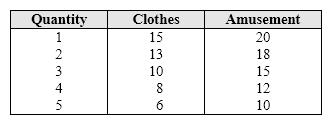 Refer to Exhibit 6-6. Clothes and amusements are priced at $10 each. The marginal utility per dollar for the first unit of amusement is:
 (Multiple Choice)
4.8/5  (82)
(82) Exhibit 6-7 Marginal utility for sandwiches and sodas
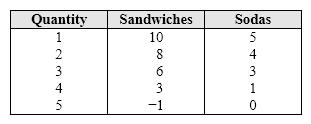 Refer to Exhibit 6-7. If the price of a sandwich is $1 and the price of a soda is $1, Marian should spend her first dollar on a ____ and her second dollar on a ____.
 (Multiple Choice)
4.9/5 (67)
(67) According to the law of diminishing marginal utility, the marginal utility curve is
(Multiple Choice)
4.8/5 (90)
(90) When Pepsi becomes more expensive relative to other beverages, people will purchase less Pepsi. This observation is known as the:
(Multiple Choice)
4.8/5 (72)
(72) Assume a consumer purchases a combination of goods X and Y such that MUx / Px = 20 units of utility per dollar and MUy / Py = 10 units of utility per dollar. To maximize utility, the consumers should buy:
(Multiple Choice)
4.8/5 (93)
(93) Michael spends $10 a month on Pez dispensers and Superman action figures. His marginal-utility-to-price ratio for the Pez dispensers is 40, while his marginal-utility-to-price ratio for Superman action figures is 47. Explain why Michael is not maximizing his utility and how can he change his behavior to increase his utility?
(Essay)
4.8/5 (77)
(77) Assume the total utilities corresponding to the first four units of a product consumed are 8, 12, 14, and 15, respectively. The marginal utility of the second unit consumed is:
(Multiple Choice)
4.8/5 (65)
(65) If the first four units of a good consumed have marginal utilities of 8, 4, 2, and 1, respectively, this trend is an indication of the:
(Multiple Choice)
4.8/5 (75)
(75) Bonnie gets her hair cut at her usual salon and is very happy with the results. Later that afternoon, she goes to the mall and sees that a hair salon is giving away free haircuts only on that day. If Bonnie does not take advantage of the giveaway, it is because the:
(Multiple Choice)
5.0/5 (78)
(78) Consider a consumer who spends all income on only two goods: pizza and soda. An extra slice of pizza would give the consumer 60 extra utils, while an extra can of soda would give the consumer 20 extra utils. Pizza costs $3 per slice, and soda costs $1 per can. In this situation, the consumer:
(Multiple Choice)
4.9/5 (76)
(76) Assume the price of Nikes decreases. As a result, consumers increase the quantity of Nikes purchased each year and purchase fewer Reeboks. This is an example of the:
(Multiple Choice)
4.8/5 (61)
(61) Which of the following most directly reflects the law of diminishing marginal utility?
(Multiple Choice)
5.0/5 (80)
(80) If Jane's marginal benefit as a consumer in the jeans market is larger than the price of a pair of jeans:
(Multiple Choice)
4.8/5 (74)
(74) A consumer buys only food and clothing. If the quantity of food bought increases while that of clothing remains the same, the marginal utility of food will:
(Multiple Choice)
4.7/5 (84)
(84) 
Filters
- Essay(0)
- Multiple Choice(0)
- Short Answer(0)
- True False(0)
- Matching(0)