



 Chat with AI
Exam 6: Consumer Choice Theory

Exam 1: Introducing the Economic Way of Thinking85 Questions
Exam 2: Production Possibilities Opportunity Cost and Economic Growth107 Questions
Exam 3: Market Demand and Supply176 Questions
Exam 4: Markets in Action137 Questions
Exam 5: Price Elasticity of Demand and Supply151 Questions
Exam 6: Consumer Choice Theory96 Questions
Exam 7: Production Costs131 Questions
Exam 8: Perfect Competition126 Questions
Exam 9: Monopoly81 Questions
Exam 10: Monopolistic Competition and Oligopoly97 Questions
Exam 11: Labor Markets105 Questions
Exam 12: Income Distribution Poverty and Discrimination57 Questions
Exam 13: Antitrust and Regulation96 Questions
Exam 14: Environmental Economics47 Questions
Exam 15: Gross Domestic Product109 Questions
Exam 16: Business Cycles and Unemployment94 Questions
Exam 17: Inflation56 Questions
Exam 18: The Keynesian Model111 Questions
Exam 19: The Keynesian Model in Action105 Questions
Exam 20: Aggregate Demand and Supply94 Questions
Exam 21: Fiscal Policy108 Questions
Exam 22: The Public Sector55 Questions
Exam 23: Federal Deficits Surpluses and the National Debt42 Questions
Exam 24: Money and the Federal Reserve System75 Questions
Exam 25: Money Creation117 Questions
Exam 26: Monetary Policy106 Questions
Exam 27: The Phillips Curve and Expectations Theory59 Questions
Exam 28: International Trade and Finance127 Questions
Exam 29: Economies in Transition46 Questions
Exam 30: Growth and the Less Developed Countries55 Questions
Exam 31: Understanding Direct and Inverse Relationships between Variables172 Questions
Select questions type


If water is essential for life, while diamonds are not, then why is water cheaper than diamonds?
(Multiple Choice)
4.8/5  (77)
(77) Assume the price of pizza decreases. As a result, your real income increases and you increase the quantity of pizza purchased each month. This is an example of the:
(Multiple Choice)
4.7/5 (71)
(71) When a reduction in the price of a good allows a consumer to purchase more of all goods, this effect is called the:
(Multiple Choice)
4.8/5 (74)
(74) Exhibit 6-2 Total utility for hamburgers, fries, and Cokes
 In Exhibit 6-2, assume that the price of hamburgers is $2 each, fries cost 50 cents each, and Cokes cost $1 each. Suppose the consumer has $6 to spend on hamburgers, fries, and Cokes. Which of the following meals gives the consumer the most utility?
 (Multiple Choice)
4.7/5 (81)
(81) Exhibit 6-3 Marginal utility data for goods X and Y
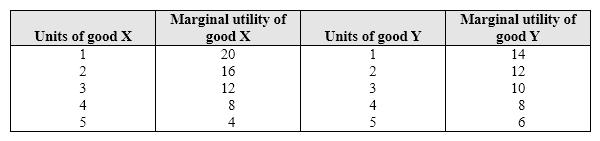 As shown in Exhibit 6-3, assume that the price of good X is $1 per unit and the price of good Y is $2 per unit and your budget is $13. If you consume 4 units of good X and 2 units of good Y and maximize utility, you should consume:
 (Multiple Choice)
4.7/5 (82)
(82) JoAnn considers cola and plain sparkling water to be good substitutes. Suppose the price of sugar, a key ingredient used to produce cola, falls. According to the substitution effect, which of the following is most likely to occur?
(Multiple Choice)
4.8/5 (97)
(97) Exhibit 6-5 Marginal utility data for desserts
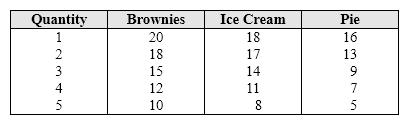 Refer to Exhibit 6-5. Each dessert is priced at $1. If you had $10 to spend on desserts, which of the following combinations of goods would you buy?
 (Multiple Choice)
4.9/5 (88)
(88) A state of consumer equilibrium for two goods consumed exists when the:
(Multiple Choice)
4.9/5 (75)
(75) Exhibit 6-4 Total utility for multiplex tickets, video rentals, and popcorn
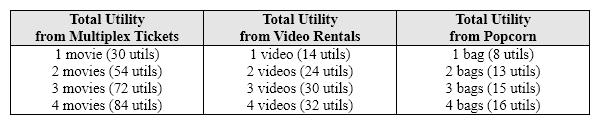 In Exhibit 6-4, assume the Multiplex tickets cost $6 each, video rentals cost $2 each, and bags of popcorn cost $1 each. Suppose the consumer has $12 per week to spend on multiplex tickets, video rentals, and popcorn. What combination of goods will give the consumer the most utility?
 (Multiple Choice)
4.9/5 (83)
(83) A rational consumer should not consume more of a good when:
(Multiple Choice)
4.8/5 (74)
(74) Which of the following is true , according to the law of diminishing marginal utility?
(Multiple Choice)
4.8/5 (71)
(71) The statement "as more of a good is consumed, the utility a person derives from each additional unit diminishes" is known as the:
(Multiple Choice)
5.0/5 (79)
(79) Exhibit 6-4 Total utility for multiplex tickets, video rentals, and popcorn
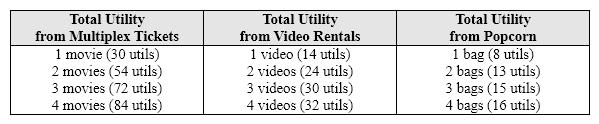 In Exhibit 6-4, assume the Multiplex tickets cost $6 each, video rentals cost $2 each, and bags of popcorn cost $1 each. What is the marginal utility of renting a third video?
 (Multiple Choice)
4.9/5 (66)
(66) Exhibit 6-1 Total utility for good X
 As shown in Exhibit 6-1, the law of diminishing marginal utility is first observed at the:
 (Multiple Choice)
4.9/5 (90)
(90) Exhibit 6-4 Total utility for multiplex tickets, video rentals, and popcorn
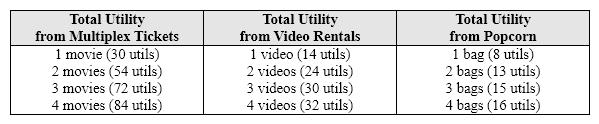 In Exhibit 6-4, assume the Multiplex tickets cost $6 each, video rentals cost $2 each, and bags of popcorn cost $1 each. Suppose the consumer has $12 per week to spend on multiplex tickets, video rentals, and popcorn. In the consumer equilibrium, what is the marginal utility per dollar for each of the three goods?
 (Multiple Choice)
4.9/5 (68)
(68) Show, using utility theory, why a consumer who is initially maximizing her utility will alter her consumption pattern in response to a change in the price of a good.
(Essay)
4.8/5 (76)
(76) The law of diminishing marginal utility exists for the first four units of a good if they have marginal utilities of:
(Multiple Choice)
4.8/5 (70)
(70) When the price of a good falls, consumers may increase the quantity consumed because they have greater total purchasing power. This statement describes the:
(Multiple Choice)
4.8/5 (76)
(76) 
Filters
- Essay(0)
- Multiple Choice(0)
- Short Answer(0)
- True False(0)
- Matching(0)