



 Chat with AI
Exam 6: Consumer Choice Theory

Exam 1: Introducing the Economic Way of Thinking85 Questions
Exam 2: Production Possibilities Opportunity Cost and Economic Growth107 Questions
Exam 3: Market Demand and Supply176 Questions
Exam 4: Markets in Action137 Questions
Exam 5: Price Elasticity of Demand and Supply151 Questions
Exam 6: Consumer Choice Theory96 Questions
Exam 7: Production Costs131 Questions
Exam 8: Perfect Competition126 Questions
Exam 9: Monopoly81 Questions
Exam 10: Monopolistic Competition and Oligopoly97 Questions
Exam 11: Labor Markets105 Questions
Exam 12: Income Distribution Poverty and Discrimination57 Questions
Exam 13: Antitrust and Regulation96 Questions
Exam 14: Environmental Economics47 Questions
Exam 15: Gross Domestic Product109 Questions
Exam 16: Business Cycles and Unemployment94 Questions
Exam 17: Inflation56 Questions
Exam 18: The Keynesian Model111 Questions
Exam 19: The Keynesian Model in Action105 Questions
Exam 20: Aggregate Demand and Supply94 Questions
Exam 21: Fiscal Policy108 Questions
Exam 22: The Public Sector55 Questions
Exam 23: Federal Deficits Surpluses and the National Debt42 Questions
Exam 24: Money and the Federal Reserve System75 Questions
Exam 25: Money Creation117 Questions
Exam 26: Monetary Policy106 Questions
Exam 27: The Phillips Curve and Expectations Theory59 Questions
Exam 28: International Trade and Finance127 Questions
Exam 29: Economies in Transition46 Questions
Exam 30: Growth and the Less Developed Countries55 Questions
Exam 31: Understanding Direct and Inverse Relationships between Variables172 Questions
Select questions type


If a consumer is maximizing his/her utility for a given income, the:
(Multiple Choice)
4.8/5  (83)
(83) In the theory of consumer choice, when a person is choosing which good or service to consume, how does he or she select the units of good or service to consume?
(Multiple Choice)
4.8/5 (75)
(75) If total utility from consuming two cups of coffee is 20 utils, and if the total utility from consuming three cups of coffee is 25 utils, then which of the following is the marginal utility of the third cup of coffee?
(Multiple Choice)
4.9/5 (84)
(84) Greg spends his entire budget on two goods: he plays video games at the mall arcade and he buys pizza. He discovers that his MU/P of video games is lower than his MU/P of pizza. From this, we know that he would be:
(Multiple Choice)
4.7/5 (89)
(89) On Thanksgiving, Jake's mother gives him a huge platter of food. If Jake were to keep eating just to please his mother (even when he really wanted to stop), his marginal utility would be:
(Multiple Choice)
4.8/5 (78)
(78) A utility-maximizing consumer is currently spending all of his/her income on two products, A and B. The MU of the last unit of A consumed is 50, the price of A is $25, and the price of B is $10. The MU of the last unit of B consumed is:
(Multiple Choice)
4.9/5 (81)
(81) Assume the price of Coca-Cola increases. As a result, your real income decreases and you decrease the quantity of Coca-Cola purchased each month. This is an example of the:
(Multiple Choice)
4.7/5 (85)
(85) Suppose that for Merv the marginal utility of $50-per-serving caviar is 100 and the marginal utility of $1-per-serving popcorn is 10. For his snack, Merv should buy:
(Multiple Choice)
4.7/5 (76)
(76) When the price of a good falls, consumers buy more of the good because it is cheaper relative to competing goods. This statement describes the:
(Multiple Choice)
4.9/5 (59)
(59) Assume that an individual consumes only coffee and bagels and that the last cup of coffee yields 12 utils and the last bagel 6 utils. If the price of a cup of coffee is $1 and the price of the bagel is $.50, we can conclude that the:
(Multiple Choice)
4.9/5 (83)
(83) Exhibit 6-6 Marginal utility for data for clothes and amusement
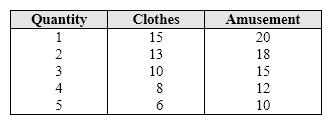 Refer to Exhibit 6-6. Clothes and amusements are priced at $10 each. If you had a budget of $50, which of the following combinations of goods would you buy?
 (Multiple Choice)
4.9/5 (85)
(85) Assume the price of good X increases. As a result, your real income decreases and you decrease the quantity of good X purchased each month. This is an example of the:
(Multiple Choice)
4.9/5 (85)
(85) Suppose a consumer wants to obtain the highest possible satisfaction from goods purchased on a fixed budget. Which of the following must be equal for all goods?
(Multiple Choice)
4.9/5 (79)
(79) Assume that an individual consumes only hotdogs and colas and that the last hotdog consumed yields 15 utils and the last cola 10 utils. If the price of a hotdog is $1 and the price of a cola is $.50, we can conclude that the:
(Multiple Choice)
4.8/5 (66)
(66) Exhibit 6-2 Total utility for hamburgers, fries, and Cokes
 In Exhibit 6-2 assume that the price of hamburgers is $2 each, fries cost 50 cents each, and Cokes cost $1 each. What is the marginal utility of having a second order of fries?
 (Multiple Choice)
4.7/5 (86)
(86) If finding the last stamp to complete your collection makes you happier than finding the first, then:
(Multiple Choice)
4.9/5 (80)
(80) John loves to travel. He would never turn down the opportunity to go on a trip. This means that, for John:
(Multiple Choice)
4.9/5 (79)
(79) 
Filters
- Essay(0)
- Multiple Choice(0)
- Short Answer(0)
- True False(0)
- Matching(0)