



 Chat with AI
Exam 26: Monetary Policy

Exam 1: Introducing the Economic Way of Thinking85 Questions
Exam 2: Production Possibilities Opportunity Cost and Economic Growth107 Questions
Exam 3: Market Demand and Supply176 Questions
Exam 4: Markets in Action137 Questions
Exam 5: Price Elasticity of Demand and Supply151 Questions
Exam 6: Consumer Choice Theory96 Questions
Exam 7: Production Costs131 Questions
Exam 8: Perfect Competition126 Questions
Exam 9: Monopoly81 Questions
Exam 10: Monopolistic Competition and Oligopoly97 Questions
Exam 11: Labor Markets105 Questions
Exam 12: Income Distribution Poverty and Discrimination57 Questions
Exam 13: Antitrust and Regulation96 Questions
Exam 14: Environmental Economics47 Questions
Exam 15: Gross Domestic Product109 Questions
Exam 16: Business Cycles and Unemployment94 Questions
Exam 17: Inflation56 Questions
Exam 18: The Keynesian Model111 Questions
Exam 19: The Keynesian Model in Action105 Questions
Exam 20: Aggregate Demand and Supply94 Questions
Exam 21: Fiscal Policy108 Questions
Exam 22: The Public Sector55 Questions
Exam 23: Federal Deficits Surpluses and the National Debt42 Questions
Exam 24: Money and the Federal Reserve System75 Questions
Exam 25: Money Creation117 Questions
Exam 26: Monetary Policy106 Questions
Exam 27: The Phillips Curve and Expectations Theory59 Questions
Exam 28: International Trade and Finance127 Questions
Exam 29: Economies in Transition46 Questions
Exam 30: Growth and the Less Developed Countries55 Questions
Exam 31: Understanding Direct and Inverse Relationships between Variables172 Questions
Select questions type


The Monetarist transmission mechanism through which monetary policy affects the price level, real GDP, and employment depends on the:

Free
(Multiple Choice)
4.8/5  (84)
(84) Correct Answer: Verified
D
According to the classical view,
Free
(Multiple Choice)
4.7/5 (74)
(74) Correct Answer:Verified
VerifiedD
According to the equation of exchange, if M = 200, P = 100, and Q = 10, the V is:
Free
(Multiple Choice)
4.7/5 (82)
(82) Correct Answer:Verified
VerifiedD
Which of the following is not an important issue in the Keynesian-Monetarist debate?
(Multiple Choice)
4.8/5 (69)
(69) Contrast the Keynesian and Monetarist views on how a change in the money supply impacts the economy.
(Essay)
4.8/5 (80)
(80) When the Fed reduces the money supply, it will cause a decrease in aggregate demand because:
(Multiple Choice)
4.7/5 (83)
(83) Exhibit 16-1 Money market demand and supply curves
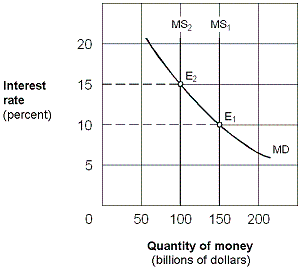 Beginning from an equilibrium at E1 in Exhibit 16-1, a decrease in the money supply from $150 billion to $100 billion causes people to:
 (Multiple Choice)
4.8/5 (69)
(69) According to Keynesians, an increase in the money supply will have its greatest impact on GDP when the aggregate demand curve intersects:
(Multiple Choice)
4.8/5 (86)
(86) The Keynesian cause-and-effect sequence predicts that a decrease in the money supply will cause interest rates to:
(Multiple Choice)
4.9/5 (77)
(77) Keynes called the money people hold in order to buy bonds, stocks, or other nonmoney financial assets the:
(Multiple Choice)
4.8/5 (76)
(76) Suppose that the current money market equilibrium has an interest rate of 5 percent and a quantity of $2 trillion. Suppose that at a 6 percent interest rate, the quantity of money demanded is $1.5 trillion, while at a 4 percent interest rate it is $2.5 trillion. If the Fed makes an open-market purchase of $50 billion, and the money multiplier is 10, what will be the new money market equilibrium?
(Multiple Choice)
4.8/5 (66)
(66) According to Keynesians, an increase in the money supply will have its least impact on GDP when the aggregate demand curve intersects:
(Multiple Choice)
4.8/5 (85)
(85) The Keynesian cause-and-effect sequence predicts that an increase in the money supply will cause interest rates to:
(Multiple Choice)
4.9/5 (75)
(75) In Keynes's view, an excess quantity of money supplied causes people to:
(Multiple Choice)
4.9/5 (75)
(75) Monetarists argue that fiscal policy is ineffective because:
(Multiple Choice)
4.8/5 (98)
(98) Exhibit 16-6 Money, investment and product markets
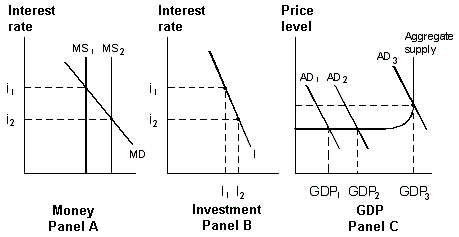 In Exhibit 16-6, an increase in the money supply from MS1 to MS2 causes:
 (Multiple Choice)
4.9/5 (93)
(93) Monetarists argue that the Federal Reserve should allow the money supply to grow:
(Multiple Choice)
4.8/5 (87)
(87) 
Filters
- Essay(0)
- Multiple Choice(0)
- Short Answer(0)
- True False(0)
- Matching(0)