



 Chat with AI
Exam 26: Monetary Policy

Exam 1: Introducing the Economic Way of Thinking85 Questions
Exam 2: Production Possibilities Opportunity Cost and Economic Growth107 Questions
Exam 3: Market Demand and Supply176 Questions
Exam 4: Markets in Action137 Questions
Exam 5: Price Elasticity of Demand and Supply151 Questions
Exam 6: Consumer Choice Theory96 Questions
Exam 7: Production Costs131 Questions
Exam 8: Perfect Competition126 Questions
Exam 9: Monopoly81 Questions
Exam 10: Monopolistic Competition and Oligopoly97 Questions
Exam 11: Labor Markets105 Questions
Exam 12: Income Distribution Poverty and Discrimination57 Questions
Exam 13: Antitrust and Regulation96 Questions
Exam 14: Environmental Economics47 Questions
Exam 15: Gross Domestic Product109 Questions
Exam 16: Business Cycles and Unemployment94 Questions
Exam 17: Inflation56 Questions
Exam 18: The Keynesian Model111 Questions
Exam 19: The Keynesian Model in Action105 Questions
Exam 20: Aggregate Demand and Supply94 Questions
Exam 21: Fiscal Policy108 Questions
Exam 22: The Public Sector55 Questions
Exam 23: Federal Deficits Surpluses and the National Debt42 Questions
Exam 24: Money and the Federal Reserve System75 Questions
Exam 25: Money Creation117 Questions
Exam 26: Monetary Policy106 Questions
Exam 27: The Phillips Curve and Expectations Theory59 Questions
Exam 28: International Trade and Finance127 Questions
Exam 29: Economies in Transition46 Questions
Exam 30: Growth and the Less Developed Countries55 Questions
Exam 31: Understanding Direct and Inverse Relationships between Variables172 Questions
Select questions type


The belief that the velocity of money is not constant but highly predictable is associated with the:
(Multiple Choice)
4.7/5  (95)
(95) Exhibit 16-3 Money market demand and supply curves
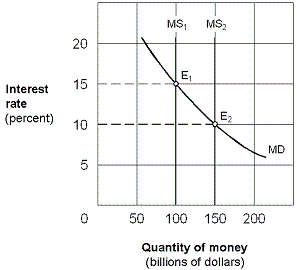 In Exhibit 16-3, assume an equilibrium with an interest rate of 15 percent and the money supply at $100 billion. The Fed uses its policy tools to move the economy to a new equilibrium at E2 with money supply of $150 billion and an interest rate of 10 percent. This change could be the result of a(n):
 (Multiple Choice)
4.9/5 (84)
(84) Exhibit 16-1 Money market demand and supply curves
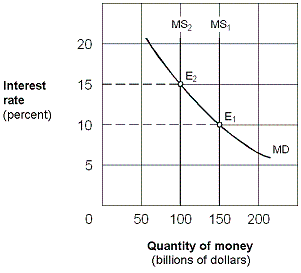 Starting from an equilibrium at E1 in Exhibit 16-1, a leftward shift of the money supply curve from MS1 to MS2 would cause an excess:
 (Multiple Choice)
4.9/5 (85)
(85) Given the strict quantity theory of money, if the quantity of money doubled, prices would:
(Multiple Choice)
4.7/5 (78)
(78) Since classical economists believe that both V and Q are constants for an economy in short-run equilibrium, the equation of exchange becomes a theory in which:
(Multiple Choice)
4.7/5 (93)
(93) Which of the following policies could the Fed use to lower the interest rate?
(Multiple Choice)
5.0/5 (81)
(81) If nominal GDP is $7 trillion, and the money supply is $2 trillion, then what is the velocity of money?
(Multiple Choice)
4.8/5 (75)
(75) Keynes argued that the downward slope of the demand for money curve depends on the:
(Multiple Choice)
4.9/5 (81)
(81) Exhibit 16-5 Money, investment and product markets
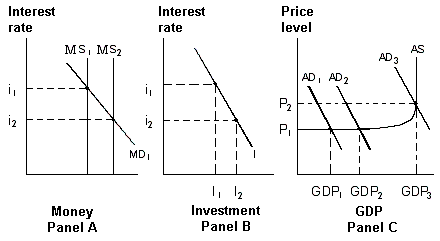 In Exhibit 16-5, a shift in aggregate demand from AD1 to AD2:
 (Multiple Choice)
4.7/5 (81)
(81) Exhibit 16-4 Aggregate demand and supply model
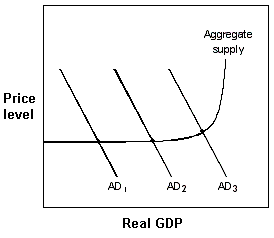 In Exhibit 16-4, which one of the following actions could the Fed use to shift the AD curve from AD1 to AD2?
 (Multiple Choice)
4.8/5 (68)
(68) "Monetary instability has been the major cause of economic instability in this country. Expansion in the money supply has been the source of every major inflation. Every major recession has been either caused or perpetuated by monetary contraction." Who among the following would most likely adhere to this view?
(Multiple Choice)
4.7/5 (74)
(74) While the classicists believed that both velocity and output are stable, Keynesians believe:
(Multiple Choice)
4.8/5 (74)
(74) Assume a fixed demand for money curve and the Fed increases the money supply. The result is a temporary:
(Multiple Choice)
5.0/5 (92)
(92) According to the quantity theory of money, a 10 percent increase in the money supply leads to a 10 percent increase in:
(Multiple Choice)
4.8/5 (79)
(79) An increase in the supply of money will lead to ____ in equilibrium real GDP and ____ in equilibrium price level.
(Multiple Choice)
4.8/5 (85)
(85) Which of the following is the objective of expansionary monetary policy?
(Multiple Choice)
4.9/5 (88)
(88) The Keynesian mechanism through which monetary policy affects the price level, real GDP, and employment depends on the impact of the:
(Multiple Choice)
4.8/5 (96)
(96) 
Filters
- Essay(0)
- Multiple Choice(0)
- Short Answer(0)
- True False(0)
- Matching(0)