



 Chat with AI
Exam 26: Monetary Policy

Exam 1: Introducing the Economic Way of Thinking85 Questions
Exam 2: Production Possibilities Opportunity Cost and Economic Growth107 Questions
Exam 3: Market Demand and Supply176 Questions
Exam 4: Markets in Action137 Questions
Exam 5: Price Elasticity of Demand and Supply151 Questions
Exam 6: Consumer Choice Theory96 Questions
Exam 7: Production Costs131 Questions
Exam 8: Perfect Competition126 Questions
Exam 9: Monopoly81 Questions
Exam 10: Monopolistic Competition and Oligopoly97 Questions
Exam 11: Labor Markets105 Questions
Exam 12: Income Distribution Poverty and Discrimination57 Questions
Exam 13: Antitrust and Regulation96 Questions
Exam 14: Environmental Economics47 Questions
Exam 15: Gross Domestic Product109 Questions
Exam 16: Business Cycles and Unemployment94 Questions
Exam 17: Inflation56 Questions
Exam 18: The Keynesian Model111 Questions
Exam 19: The Keynesian Model in Action105 Questions
Exam 20: Aggregate Demand and Supply94 Questions
Exam 21: Fiscal Policy108 Questions
Exam 22: The Public Sector55 Questions
Exam 23: Federal Deficits Surpluses and the National Debt42 Questions
Exam 24: Money and the Federal Reserve System75 Questions
Exam 25: Money Creation117 Questions
Exam 26: Monetary Policy106 Questions
Exam 27: The Phillips Curve and Expectations Theory59 Questions
Exam 28: International Trade and Finance127 Questions
Exam 29: Economies in Transition46 Questions
Exam 30: Growth and the Less Developed Countries55 Questions
Exam 31: Understanding Direct and Inverse Relationships between Variables172 Questions
Select questions type


According to the Monetarist view, the impact of expansionary monetary policy will be:
(Multiple Choice)
4.9/5  (72)
(72) The demand for money curve shows that there is an inverse relationship between the quantity of money demanded and the:
(Multiple Choice)
4.8/5 (91)
(91) According to the Monetarists, the primary cause of inflation is:
(Multiple Choice)
4.9/5 (67)
(67) The quantity theory of money of the Classical economists says that a change in the money supply will produce a:
(Multiple Choice)
4.9/5 (81)
(81) According to the quantity theory of money, which one of the following economic variables would change in response to an increase in the money supply?
(Multiple Choice)
4.9/5 (79)
(79) Contrast the Keynesian and Monetarist views on the effectiveness of fiscal policy.
(Essay)
4.7/5 (88)
(88) If the money supply is $250 billion and nominal GDP is $1 trillion, the velocity of money is:
(Multiple Choice)
4.9/5 (82)
(82) Which of the following is a reason for the Keynesian view that monetary policy plays a minor role in affecting the economy?
(Multiple Choice)
4.8/5 (81)
(81) Exhibit 16-1 Money market demand and supply curves
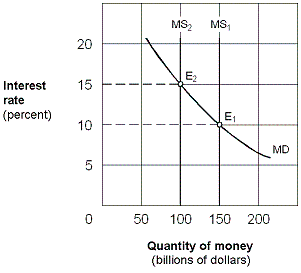 As shown in Exhibit 16-1, assume the money supply curve shifts leftward from MS1 to MS2 and the economy is operating along the intermediate segment of the aggregate supply curve. The result will be a:
 (Multiple Choice)
4.7/5 (80)
(80) The quantity of money demanded to satisfy transactions needs:
(Multiple Choice)
4.9/5 (68)
(68) If the velocity of the M1 money supply is 4 and nominal GDP is $200 billion, the stock of money in circulation must be:
(Multiple Choice)
4.9/5 (86)
(86) Exhibit 16-6 Money, investment and product markets
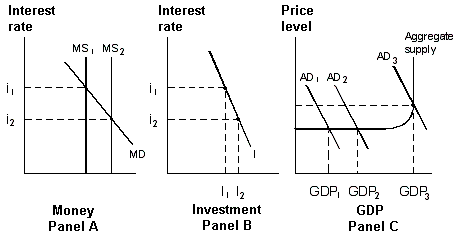 In Exhibit 16-6, if the interest rate falls from i1 to i2, then:
 (Multiple Choice)
4.8/5 (79)
(79) Exhibit 16-5 Money, investment and product markets
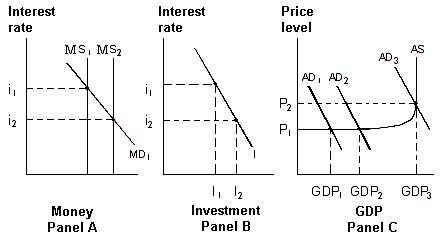 In Exhibit 16-5, if the interest rate falls from i1 to i2, investment spending will:
 (Multiple Choice)
4.9/5 (87)
(87) Starting from a position of macroeconomic equilibrium at below the full-employment level of real GDP, an increase in the money supply will:
(Multiple Choice)
4.8/5 (69)
(69) Given the strict quantity theory of money, if the quantity of money were decreased by 50 percent, prices would:
(Multiple Choice)
4.8/5 (66)
(66) 
Filters
- Essay(0)
- Multiple Choice(0)
- Short Answer(0)
- True False(0)
- Matching(0)