



 Chat with AI
Exam 28: International Trade and Finance

Exam 1: Introducing the Economic Way of Thinking85 Questions
Exam 2: Production Possibilities Opportunity Cost and Economic Growth107 Questions
Exam 3: Market Demand and Supply176 Questions
Exam 4: Markets in Action137 Questions
Exam 5: Price Elasticity of Demand and Supply151 Questions
Exam 6: Consumer Choice Theory96 Questions
Exam 7: Production Costs131 Questions
Exam 8: Perfect Competition126 Questions
Exam 9: Monopoly81 Questions
Exam 10: Monopolistic Competition and Oligopoly97 Questions
Exam 11: Labor Markets105 Questions
Exam 12: Income Distribution Poverty and Discrimination57 Questions
Exam 13: Antitrust and Regulation96 Questions
Exam 14: Environmental Economics47 Questions
Exam 15: Gross Domestic Product109 Questions
Exam 16: Business Cycles and Unemployment94 Questions
Exam 17: Inflation56 Questions
Exam 18: The Keynesian Model111 Questions
Exam 19: The Keynesian Model in Action105 Questions
Exam 20: Aggregate Demand and Supply94 Questions
Exam 21: Fiscal Policy108 Questions
Exam 22: The Public Sector55 Questions
Exam 23: Federal Deficits Surpluses and the National Debt42 Questions
Exam 24: Money and the Federal Reserve System75 Questions
Exam 25: Money Creation117 Questions
Exam 26: Monetary Policy106 Questions
Exam 27: The Phillips Curve and Expectations Theory59 Questions
Exam 28: International Trade and Finance127 Questions
Exam 29: Economies in Transition46 Questions
Exam 30: Growth and the Less Developed Countries55 Questions
Exam 31: Understanding Direct and Inverse Relationships between Variables172 Questions
Select questions type


Exhibit 15-1 Production possibilities curves
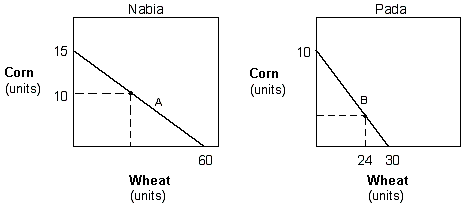 In Exhibit 15-1, the production possibilities curves of wheat and corn for Nabia and Pada are presented. In Nabia the cost of producing one more unit of wheat is equal to:
 (Multiple Choice)
4.8/5  (97)
(97) If nation A has an absolute advantage over nation B in the production of a product, this implies that:
(Multiple Choice)
4.8/5 (75)
(75) Which of the following is an infant-industry argument in favor of restrictions on foreign trade?
(Multiple Choice)
4.9/5 (79)
(79) Since World War II, tariff reductions have occurred in large part because of negotiations under the:
(Multiple Choice)
4.9/5 (75)
(75) Which of the following transactions would be recorded as a credit in the U.S. current account?
(Multiple Choice)
4.9/5 (74)
(74) If the opportunity cost of producing cheese is higher in Greece than it is in Italy, then:
(Multiple Choice)
4.8/5 (78)
(78) Suppose a German bank purchases a U.S. Treasury bond. This transaction would be recorded in the:
(Multiple Choice)
5.0/5 (88)
(88) An increase in demand for a nation's currency in the foreign exchange market will:
(Multiple Choice)
4.9/5 (95)
(95) Suppose rice can be produced in country X at a lower cost than in country Y, while tuna can be produced in country Y at a lower cost than in country X. International competition will:
(Multiple Choice)
4.9/5 (85)
(85) The main explanation for why the cheap foreign labor argument is a poor reason for restricting international trade is that:
(Multiple Choice)
4.9/5 (78)
(78) Which of the following is not an argument used in favor of protectionism?
(Multiple Choice)
4.9/5 (88)
(88) Which of the following would not be counted in the U.S. BOP current account?
(Multiple Choice)
4.7/5 (87)
(87) Which of the following would cause the U.S. dollar to depreciate against the Japanese yen?
(Multiple Choice)
4.9/5 (91)
(91) The main problem with using the infant industries argument to justify protecting an industry from foreign competition is that:
(Multiple Choice)
4.9/5 (78)
(78) 
Filters
- Essay(0)
- Multiple Choice(0)
- Short Answer(0)
- True False(0)
- Matching(0)